
Boyne Sentencing Transcript: Speech, Stalking, and a 20-Year Hammer
Boyne transcript reveals courtroom fight over PSI, true threats, and judicial fear

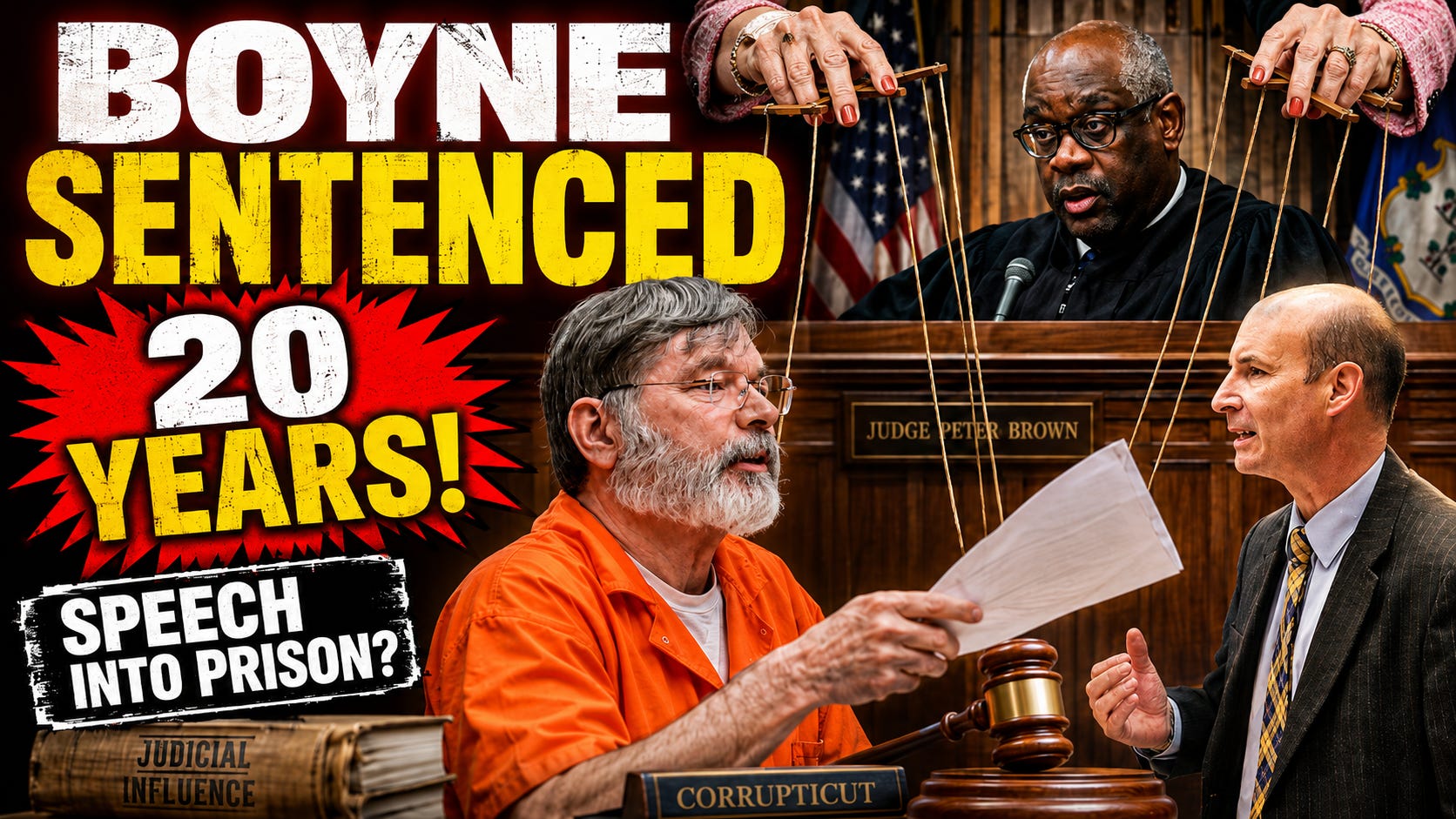
LUTHMANN NOTE: The transcript is the receipt. No more courthouse whisper campaigns. No more polished spin. Judge Brown, Jack Doyle, Jane Grossman, Thomas Moukawsher, and Paul Boyne are now on the record for the public to inspect. Boyne said Connecticut turned speech into conduct. Doyle said the jury found true threats. Grossman said only jail could restrain him. Moukawsher demanded deterrence and spoke of “time and old age.” Brown imposed 20 years and 10 years special parole. This is not merely a sentencing transcript. It is the blueprint of how a state can turn a dissident writer into a prisoner. This is the Boyne Sentencing Transcript, first available on TheFamilyCourtCircus.com.

By Richard Luthmann
(NEW HAVEN, CONNECTICUT) – The Paul Boyne sentencing hearing unfolded as a constitutional brawl inside a Connecticut courtroom. Judge Peter Brown opened by disposing of preliminary matters, unsealing certain defense exhibits, vacating an earlier transcript fee-waiver order, and denying seven late-filed Boyne motions, including an emergency request for more time to review and object to the PSI.
Boyne objected that he was housed at MacDougall-Walker with no meaningful access to paper, pens, copiers, computers, Google Scholar, or the tools needed for pro se litigation. Brown nevertheless proceeded.
Boyne then argued motions for judgment of acquittal and new trial, insisting the State had criminalized speech by relabeling it as conduct. He cited First Amendment cases including NAACP v. Button, Matal v. Tam, Brandenburg v. Ohio, NAACP v. Claiborne Hardware, United States v. Cassidy, and Cohen v. California, arguing that stalking and harassment are not freestanding exceptions to the First Amendment.
State’s Attorney Jack Doyle countered that the jury had heard the evidence, received instructions, and convicted Boyne of stalking and electronic stalking. Brown denied both motions, finding sufficient evidence supported all eighteen counts and refusing to grant a new trial.
The hearing then turned explosive. Doyle told the court that Boyne had allegedly disclosed the confidential PSI by reading it over prison calls to journalist Richard Luthmann, who then published the victim statements on The Family Court Circus. Doyle said the State would investigate possible contempt and argued the episode showed Boyne’s refusal to obey court orders.
Retired Judge Thomas Moukawsher’s statement was read into the record, invoking Sandy Hook, January 6, slain judges, the murder of Maryland Judge Andrew Wilkinson, and the need for a serious sentence to deter future bloggers.
Judge Jane Grossman personally addressed the court, saying Boyne’s conduct changed her life and that incarceration was the only thing that would restrain him.
Boyne’s allocution was a final First Amendment protest. He argued that Connecticut had seceded from constitutional law by transforming blog posts into stalking and warned that speech cannot be renamed conduct by judicial fiat.
Brown rejected that frame, stating the jury found Boyne’s speech constituted true threats.
He imposed a total effective sentence of 20 years to serve, followed by 10 years special parole, plus standing criminal protective orders through 2051, computer-access conditions, no weapons, mental-health screening, and no new arrests or probable cause.
Boyne Sentencing Transcript – State of Connecticut v. Paul Boyne
Sentencing Hearing — May 26, 2026
Connecticut Superior Court, Judicial District of New Haven
Before the Honorable Peter Brown
Principal Speakers: Judge Peter Brown, State’s Attorney Jack Doyle, Defendant Paul Boyne
Publisher’s Note: This is an unofficial transcript prepared from an audio transcription of Paul Boyne’s sentencing hearing. It has been cleaned for readability, punctuation, speaker identification, and obvious transcription errors. Unclear or inaudible portions are marked where necessary. Legal citations have been added editorially in brackets for publication and reader reference. They are not necessarily part of the spoken record unless introduced by the speaker.
I. Boyne Sentencing Transcript: Court Called to Order
Court Officer / Clerk:
Superior Court is now in session for the transaction of criminal business with Judge Brown presiding. Folks, as a reminder, while court is in session, no cell phones are to be used. Turn them off or put them on silent. If you need to use your phone, please step out into the hallway.
The Court:
Good morning, everyone.
State’s Attorney John “Jack” Doyle:
Good morning, Your Honor.
The Court:
The matter is State of Connecticut versus Paul Boyne. The matter is down for sentencing today. Counsel, Mr. Boyne, please put your names on the record. We will start with the State.
Attorney Doyle:
Good morning, Your Honor. John Doyle for the State of Connecticut.
The Court:
Thank you.
Standby Counsel:
Good morning, Your Honor. Mr. Boyne is present. I am Attorney Brown, standby counsel. He will be representing himself.
The Court:
Understood. Good morning. Mr. Boyne, do you have your proper listening device?
Paul Boyne:
Yes.
The Court:
Very good. As I indicated, this matter is down for sentencing today. Before we proceed to that, there are a couple of matters I need to take up.
II. Boyne Sentencing Transcript: Defense Exhibits and Sealing Issues
The Court:
The first matter is that the last time we were in court, there had been requests from the defense with regard to the unsealing of defense exhibits A through D. Copies of A through D were provided to Mr. Boyne, who is representing himself now.
I informed the State that at this time I would be asking the State’s position as to any further need for defendant’s exhibits A through D to remain sealed. I reviewed those documents. A great many of them have been redacted, and that would be what would be released to the public.
What is the State’s position with regard to defendant’s exhibits A through D?
Attorney Doyle:
I do not have any objection to those documents being unsealed. Obviously, there are others that remain sealed, but I am not addressing those.
The Court:
Exactly right. I am glad you brought that up. I am going to unseal defendant’s exhibits A through D.
State’s Exhibit 3, I believe, was a forensic examination report. That will remain sealed. I think there was actually an agreement by the parties that that had to do with a court-ordered evaluation in a family matter. That will remain sealed.
Court’s Exhibits 1 and 3 are sealed. One is redacted. Three was email correspondence. Those will remain sealed for in-camera review purposes.
That takes care of that first issue.
III. Boyne Sentencing Transcript: Transcript Request and Fee Waiver
The Court:
Next, Mr. Boyne, the Court is going to vacate its previous fee-waiver order that I signed at your request. The reason is that the expedited request that you asked for could not be met, given the volume that you requested and the late timing of the filing of that request.
After sentencing, you will be provided a standard form with another fee waiver. Make whatever request you think is appropriate at that time.
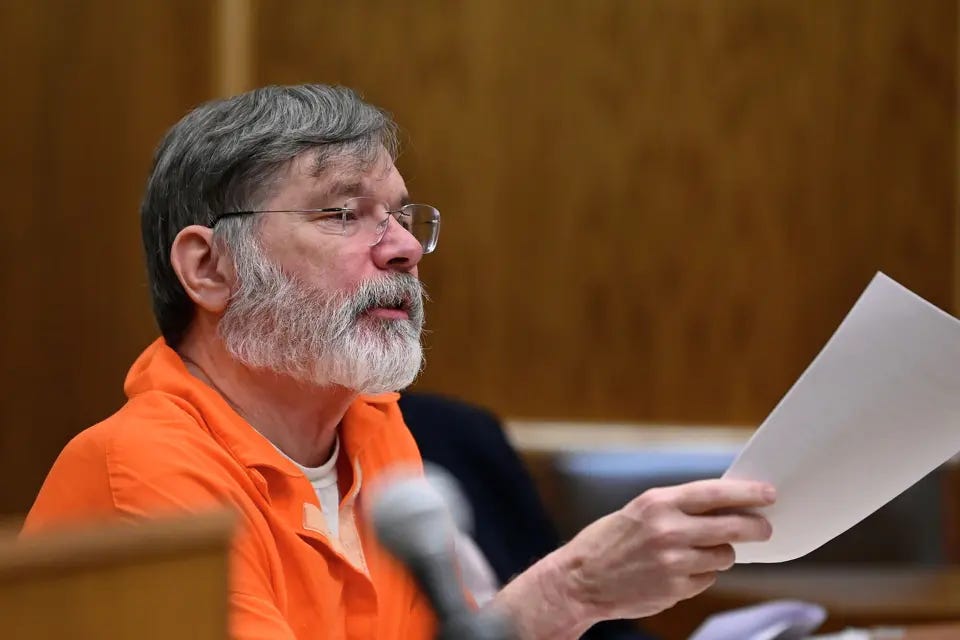
Boyne:
Excuse me, Your Honor. This is for the transcripts?
The Court:
Yes, for the transcripts.
Boyne:
To go with the motion.
The Court:
The clerk did say they would get back to me on what they could do. I am telling you now what the Court’s decision is. You were provided with a number of transcripts prior to today. The request that you made for the vast volume of transcripts could not be accomplished given the timeframe based on your request.
Again, after sentencing, make whatever request you want to make.
IV. Boyne Sentencing Transcript: Untimely May 22 Motions Denied
The Court:
The defendant filed a motion to disqualify this Court in April 2026. I referred that motion to Judge Keegan. Judge Keegan denied that motion. Judge Keegan also extended the defendant’s time to file any post-trial motions to May 19, 2026.
The defendant did, in fact, file two motions in timely fashion: a motion for judgment of acquittal, which I will hear, and a motion for new trial, which I will also hear.
The defendant also, this past Friday, filed seven motions which were not timely filed. These were file-stamped May 22. They include yet another motion for disqualification; an emergency motion to extend time to review and object to the PSI report and continue the hearing; a motion for discovery; a motion for clarification; a motion to vacate; a motion for return of seized property; and a motion for immediate release.
All of these motions were filed this past Friday, May 22, clearly beyond the deadline that Mr. Boyne had been given. You met the deadline with regard to your motions for acquittal and new trial.
Is there any explanation for not filing these other motions in timely fashion?
Boyne:
Sir, I did not get the PSI until Friday.
The Court:
This court date has been set since March. You knew when this court date was coming. So it was incumbent upon you to file whatever you thought you needed to file once you started representing yourself, including any motion for more time if you thought that was what you needed.
Boyne:
I would like to put on the record that you do realize I am at Walker. We do not even have access to paper, pens, copiers, computers. I do not understand how “timely” applies to a pro se person in Walker. You cannot even have access to Google Scholar. Could I have a copy of those motions that you just denied?
The Court:
They are your motions, sir. You obviously have copies.
Boyne:
I do not think I had copies. I came down here on Friday to file them.
The Court:
I am going to give you one opportunity. Motion for judgment of acquittal. Please proceed.
Boyne:
I need a copy of it. There should be two.
The Court:
These are the court copies. I will hand them to the clerk. You should have been prepared for this, Mr. Boyne. You are the one who has chosen to represent yourself. Please do this expeditiously.
V. Boyne Sentencing Transcript: Boyne’s Motion for Judgment of Acquittal
The Court:
Motion for judgment of acquittal. Please proceed.
Boyne:
Yes, Judge. You put me back in jail.
The first thing I will start out with is that I think we have established that the judicial authority has read Chiles v. Salazar, correct?
The Court:
Make your argument.
Boyne:
We did that at the last hearing. I am just putting it on the record.
The Supreme Court says you cannot relabel speech as anything else, such as stalking. There was nothing presented during the trial other than six political essays that rest on a blog or server in cyberspace, which does not constitute conduct. It constitutes speech.
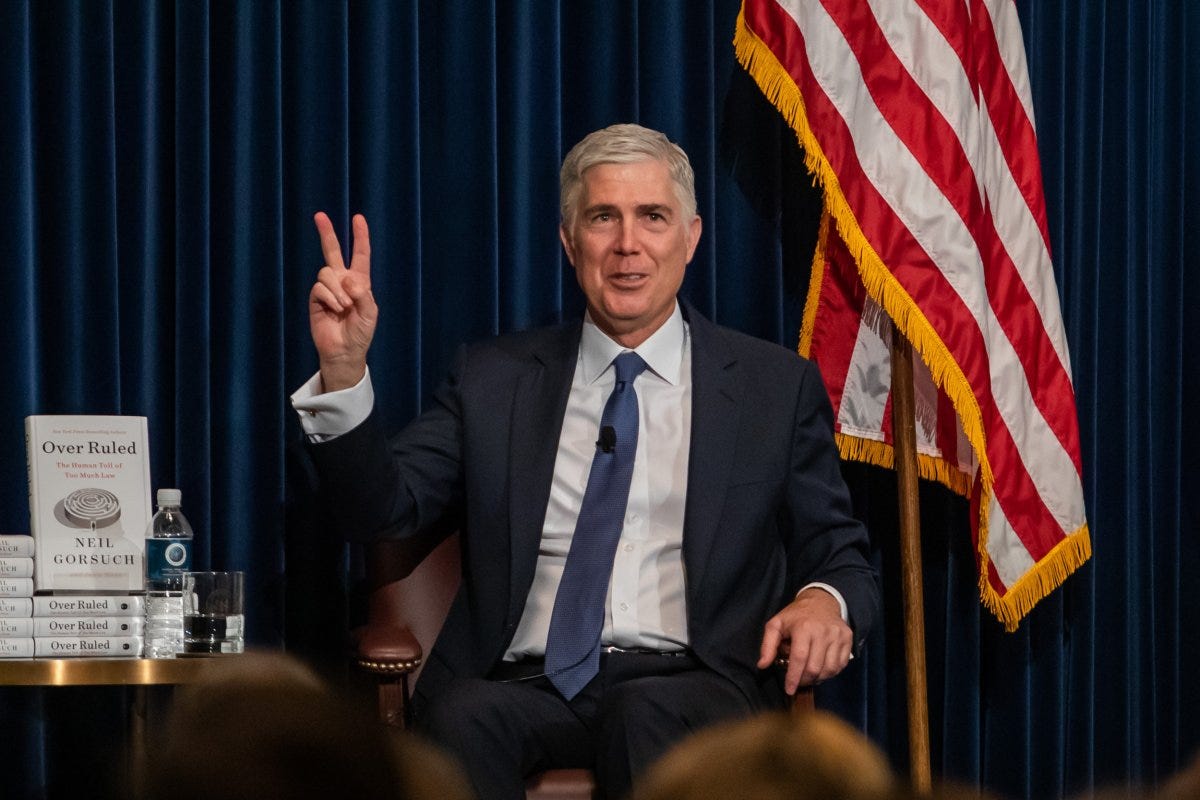
In Chiles v. Salazar, Justice Gorsuch cited Supreme Court precedents that have not changed going back to 1963 in NAACP v. Button, where the exact same tactic was used to try to nullify a right. In that case, it was a right of Black people. Button was actually the Attorney General of Virginia. He got it wrong.
[Editorial Legal Note: NAACP v. Button, 371 U.S. 415 (1963), involved First Amendment protection for NAACP litigation and advocacy activity against a Virginia statute regulating legal solicitation.]
I think what we are seeing here is we have Attorney Doyle, who lacks candor toward the tribunal in bringing forth this limitation to his prosecution. Given the federal right at hand, and given the fact that my incarceration is being funded by federal money, it is a misuse of federal funds. That is a violation of 18 U.S.C. § 242, criminal conduct codified under the Enforcement Act of 1871, the Enforcement Act of the Fourteenth Amendment, which Attorney Doyle also knows as the Ku Klux Klan Act.
[Editorial Legal Note: 18 U.S.C. § 242 criminalizes willful deprivation of rights under color of law. Section 1983 and related civil-rights remedies trace to the Civil Rights Act of 1871, often called the Ku Klux Klan Act.]
So this prosecution is criminal conduct in itself. Some people would say malicious. I think criminal conduct would be a better word.
If we take the motion for acquittal dated May 5 for § 53a-181c, the provision cited in the information says “such person intentionally directs such conduct,” not such speech, but such conduct, “at the other person in whole or in part because of the actual or perceived race, religion, ethnicity, disability, sex, sexual orientation, or gender identity or expression of such other person.”
[Editorial Legal Note: Conn. Gen. Stat. § 53a-181c governs stalking in the first degree.]
If we edit it to this case, if it says speech, not conduct, then we bring in the Supreme Court case Matal v. Tam. Justice Alito clearly said that the proudest boast of American First Amendment jurisprudence is that we protect the thought that we hate.
[Editorial Legal Note: Matal v. Tam, 582 U.S. 218, 246 (2017) (plurality opinion) (“[T]he proudest boast of our free speech jurisprudence is that we protect the freedom to express ‘the thought that we hate.’”) (quoting United States v. Schwimmer, 279 U.S. 644, 655 (1929) (Holmes, J., dissenting)).]
The Court:
I am going to give you another minute, and then I am going to give the State an opportunity to respond. I have your motion. I read your motion. I know the State has read your motion. Anything else?
Boyne:
I think we should inform Jack that he has a right to remain silent, and anything he says can and will be used against him in a federal court of law for deprivation of rights. He is probably entitled to have Attorney Tom represent him.
The Court:
Mr. Boyne, I have your argument.
Boyne:
There are two motions here.
The Court:
We are going to get to the motion for new trial. Let me address the motion for judgment of acquittal.
Boyne:
There are three motions. No, there are two acquittal motions. I am not done with the acquittal. Your problem is State v. Billings. Justice Clark, who was Lamont’s counsel before Lamont put him on the appellate court, stated that speech alone does not go under stalking.
The Court:
Mr. Boyne, your argument is abundantly clear. It is the same argument you have made over and over again. There is nothing to add to it at this point. I am going to give the State an opportunity to respond.
Boyne:
I am trying to put on the record whether the judicial authority understands he is bound by State v. Billings and Supreme Court law.
VI. Boyne Sentencing Transcript: State’s Response to Motion for Judgment of Acquittal
Attorney Doyle:
Thank you, Your Honor. I reviewed the case. As Your Honor is aware, this case has involved years of proceedings, motions, filings by counsel, and filings by the defendant himself.
The conduct the defendant engaged in was subject to a lot of rulings by this Court and other judges, and there was a structured jury charge given to the jury.
Boyne:
Objection. Counsel just used the word “conduct.” He never proved any conduct. There were six essays.
The Court:
Mr. Boyne, okay. You have that on the record. Thank you. Go ahead.
Attorney Doyle:
The criminal behavior and conduct that Mr. Boyne engaged in was tried before a jury. Mr. Boyne’s disappointment is that a jury of this state found him guilty of these offenses. His arguments and claims may at some point be addressed by the Appellate Court or Supreme Court of this state. They will look at whether what was done here was proper. The law of this state supports the conviction. I would ask the Court to deny the motion.
The Court:
Anything else?
Boyne:
The finding of guilty by the jury was based on your deficient jury instructions.
The Court:
That is an issue you can take up on appeal if you choose to do that.
Boyne:
But you are bound by the Constitution and the Supremacy Clause. The problem you missed was the First Amendment and Brandenburg v. Ohio, advocacy of violence. There was nothing in your jury instructions that covered that. I brought up the issue to you in letters or possibly one of the motions you are throwing away. In United States v. Stinson, which was done in the Eastern District of Virginia at the end of last year, Judge Trenga’s jury instructions included that based on Brandenburg v. Ohio, based on Hess v. Indiana, and based on NAACP v. Claiborne Hardware. That jury instruction was very clear. When you apply Brandenburg to what Mr. Stinson put online, the federal jury of twelve came back and acquitted him. But here in Connecticut, in your courtroom, the outcome under the same Constitution, same federal case law, and same First Amendment is totally opposite.
[Editorial Legal Note: Brandenburg v. Ohio, 395 U.S. 444 (1969), protects advocacy of violence unless it is directed to inciting imminent lawless action and likely to produce such action. See also Hess v. Indiana, 414 U.S. 105 (1973); NAACP v. Claiborne Hardware Co., 458 U.S. 886 (1982).]
VII. Boyne Sentencing Transcript: Court Denies Motion for Judgment of Acquittal
The Court:
Thank you, Mr. Boyne. I will give you an opportunity to respond to the State’s argument. I am now going to rule on this matter.
The motion for judgment of acquittal is governed by Connecticut Practice Book § 42-51. The State also relies on State v. James, 247 Conn. 662, 669, a 1999 case of the Connecticut Supreme Court.
[Editorial Legal Note: Practice Book § 42-51 governs motions for judgment of acquittal after a verdict or discharge of the jury. See State v. James, 247 Conn. 662, 668–69, 725 A.2d 316 (1999), addressing sufficiency review.]
The trial court must decide whether there was sufficient evidence on which the jury reasonably could have concluded that the defendant was guilty beyond a reasonable doubt of the crimes charged.
In this case, the State introduced evidence as to each charge of the three informations. The Court finds there was sufficient evidence on which the jury reasonably could find the defendant guilty beyond a reasonable doubt as to all eighteen counts.
Accordingly, the defendant’s motion for judgment of acquittal is denied.
We move to the defendant’s motion for new trial.
Boyne:
Do you have both motions for acquittal?
The Court:
I have the one dated May 5.
Boyne:
I filed two. One for § 53a-181c and one for § 53a-181f. You do not have two?
The Court:
If the arguments were all the same, to the extent that there was another motion for judgment of acquittal with regard to other counts on the same grounds, those motions are denied as well.
Boyne:
That was not my question. The question was whether the motion is before the Court.
The Court:
The only one that the Court sees that was before it is the one file-stamped May 18 and dated May 5.
Boyne:
There should be one dated May 5 and one dated May 6.
The Court:
I have one dated May 5.
Boyne:
Could the clerk look to see if there are two motions for acquittal? They should have come in on different days because they were mailed.
The Court:
It goes to the record. There is one dated April 29, 2026, file-stamped with the Court on May 6.
I note there is reference again to § 53a-181f here. Acquittal on each count charging electronic stalking. Same arguments, same ruling. The motion for judgment of acquittal is denied.
[Editorial Legal Note: Conn. Gen. Stat. § 53a-181f governs electronic stalking.]
VIII. Boyne Sentencing Transcript: Boyne’s Motion for New Trial
The Court:
We are moving on to the motion for new trial.
Boyne:
My first point, I will reiterate, is that you are punishing speech by relabeling it. That is what this was all about.
If you go back to the start of this, I believe you can see a due process failure by Attorney Doyle and the Connecticut State Police, where once you had the subscriber information for the blog — which, by the way, came about because of a complaint by Douglas Lavine to Judge Carroll — I think Judge Carroll’s words were, “We’ll take a fresh look at it.”
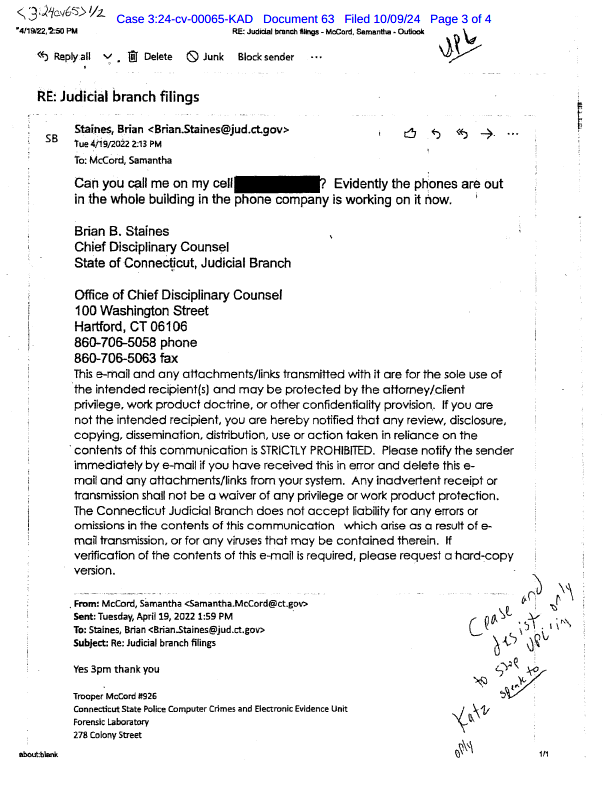
Kevin Kane had looked at this as the Chief State’s Attorney going back to probably 2015. The FBI came and visited me in 2017, and the resolution in the Eastern District of Virginia was protected speech. The FBI looked at this in January 2022, and the resolution of that was protected speech under federal stalking laws, federal case law, and the First Amendment.
But in February 2022, you had my name and address. You have a law in Connecticut called the Shield Law. You do not issue search warrants on journalists, news-gathering organizations, et cetera. You issue a subpoena. That would be the first fatal flaw in the prosecution’s effort to punish public expression.
[Editorial Legal Note: Connecticut’s reporter’s privilege statute is codified at Conn. Gen. Stat. § 52-146t. Boyne references it as a “Shield Law.”]
The Court:
Motion for new trial is governed by Practice Book § 42-53. It states that the Court shall grant the motion for an error by reason of which the defendant is constitutionally entitled to a new trial. Is it your argument that there was some constitutional error that entitles you to a new trial?
[Editorial Legal Note: Practice Book § 42-53 governs motions for new trial.]
Boyne:
I just said you had a law in Connecticut.
The Court:
I am asking you if that is your argument.
Boyne:
Yes. I think that would go to the Fourteenth Amendment due process protection.
The Court:
The other question is whether there was any error which the defendant can establish was materially injurious to him. Is that the same argument you are making?
Boyne:
If you want to label speech conduct and throw the First Amendment out the window, yes, that is materially injurious to me and to the public. Once you pull in the First Amendment, everybody else has an interest.
The Court:
Attorney?
Attorney Doyle:
The motion for new trial should be denied. As Your Honor pointed out, the Practice Book section requires error that constitutionally entitles him to a new trial. The case has gone through several years of litigation, as well as a criminal jury trial. The Court made sure that Mr. Boyne’s constitutional rights were protected regardless of his interpretation.
I do not agree with the facts asserted by Mr. Boyne in this motion. The Court was aware of the arrest warrants, factual allegations, and presided over the jury trial. There is no basis for a new trial.
Boyne:
Now we have Practice Book § 42-53, where it starts off, “Upon motion, the judicial authority may grant a new trial as required in the interest of justice.”
The Court:
I am going to get to that part. I am talking about the part where it says the Court shall grant the motion for certain things.
Boyne:
The constitutional one. I will make that claim first. That is a big deal in this country. I think President Trump says if we do not get it right here, there is no place to go.
That also goes to the absence of strict scrutiny. The prosecution skimmed over that during trial. It never specified what the particular words were. All it was, was six blog posts. Everything in the six blog posts was not criminal. The State never separated it. If you really want to believe the stuff Attorney Doyle puts before your court, his information said the conduct ceased on April 19, 2024, and actually it was going on while I was in prison from July 2023 to April 2024.
That is Attorney Doyle and his lack of candor toward the tribunal.
The Court:
I have your argument.
Boyne:
For any other error materially injurious to the defendant, one thing we skipped over was the illegal search and seizure in Virginia. Nobody nailed down the conspiracy between Attorney McCord, Detective McCord, Attorney Doyle, and Agent Heimer, who decided just to blow off Judge Saylor’s orders. That should have killed it right there.
You had people in Virginia an hour and a half after the raid here, “Take this stuff.” That is not the law in Virginia. We brought that up: 19.2-58. That was not only injurious to me, it was injurious to the sovereignty of Virginia. Attorney Doyle violated the sovereignty of Virginia, premeditated in his memo of June 18, 2022.
The Court:
I have your arguments. I am going to rule.
Boyne:
Wait a minute. I thought we were going to get back to the interest of justice.
The Court:
I am going to rule as follows: the defendant has failed to establish that there was an error by reason of which the defendant is constitutionally entitled to a new trial. The defendant has also failed to establish any error which was materially injurious to him.
Now I am being asked to exercise my discretion in the interest of justice to find that a motion for new trial should be granted. Do you want to be heard briefly as to why I should do that?
Boyne:
The other constitutional thing we left out is my Sixth Amendment right to represent myself, because the counsel I had did not bring up the First Amendment, did not bring up Brandenburg, and even the Office of the Public Defender brought in another chair for the jury instructions. They could have just copied Judge Trenga’s jury instructions.
They left that completely out. The First Amendment was not an issue in this trial. It was stalking. People seek things out, go hunting for them on the internet, read them voluntarily, and then become victims of crime. That was exactly the issue in United States v. Cassidy in 2011, handed down by Judge Titus. That was a criminal case. Your argument now—
The Court:
Mr. Boyne, I am going to rule on your motion.
The Court will not be exercising its discretion in the interest of justice to grant this motion for a new trial. The motion for new trial is denied.
[Editorial Legal Note: United States v. Cassidy, 814 F. Supp. 2d 574 (D. Md. 2011), dismissed an indictment under the federal stalking statute on First Amendment grounds where online posts concerned a public religious figure and were viewed voluntarily.]
Boyne:
Could you put the definition of your discretion on the record, please?
IX. Boyne Sentencing Transcript: Presentence Investigation Report Corrections
The Court:
We are going to turn to the presentence investigation report.
The State had an opportunity to review the PSI?
Attorney Doyle:
Yes, Your Honor.
The Court:
Any changes, corrections, deletions?
Attorney Doyle:
Not regarding the PSI itself. I do have something thereafter, but not in regard to the PSI.
The Court:
Mr. Boyne, have you had an opportunity to review the PSI?
Boyne:
Yes.
The Court:
Any changes, corrections, anything at all?
Boyne:
Yes. On page one, at the bottom, where it says bond $350,000, correct that to $1.05 million.
The Court:
Thank you.
Boyne:
On page ten, under education, where it says 1984, it should be 1983.
The Court:
Thank you. I should note that I have something on this page as well under family background. If I am not correct, you can tell me, but it says Paul was born on June 4, 1961, in Norwich, Connecticut, to Peter and Eleanor Brown.
Boyne:
I did not even see that.
The Court:
That should be Boyne.
Boyne:
I do not think that is germane, but I do not know who put this together.
I object to the limited time and resources I have had to deal with what is in here. The statements that are included come from judges who are bound by the Supremacy Clause. We have some problems with what they are recommending, given that it is in violation of the First Amendment and seeks to punish speech. One of them even wants to “send a message.”
The Court:
Mr. Boyne, when you have an opportunity to be heard by the Court before sentencing, you can bring that up. I am just asking about corrections, deletions, mistakes, typos, that type of thing. Substantively, I will give you an opportunity to be heard at the appropriate time, as well as anyone else you wish to be heard on your behalf.
Boyne:
I think my point is there is a constitutional failure of this report.
The Court:
You can bring that up in your argument.
X. Boyne Sentencing Transcript: State Raises Alleged Disclosure of Confidential PSI
The Court:
Are we ready for sentencing?
Attorney Doyle:
Yes, Your Honor. I think it is important to bring something to the Court’s attention.
We have the PSI that has been presented here. I have a transcript from a proceeding before Your Honor on May 15. I ordered it from the court reporter’s office and had it provided this morning. Let the record reflect I provided a copy to Mr. Boyne and to standby counsel.
In that transcript, once the decision was made that Mr. Boyne was going to represent himself, Your Honor noted to him that he was going to get the PSI, the presentence investigation report. The parties have a right to review it. But Your Honor told him, “You cannot disclose that PSI to anyone. That information is confidential. But you are representing yourself, so you have the right to see it in preparation for sentencing.”
That is also consistent with what happens when individuals are represented by counsel. Their attorney will go over the PSI with them. They can review it and address the court about changes and recommendations.
Thereafter, Your Honor told the defendant he had a right to consult standby counsel, but did not have a right to disclose the specifics of the PSI with anyone outside of standby counsel. Your Honor directed Mr. Boyne that this was a confidential document.
The irony this morning is that while Your Honor was addressing the variety of motions the defendant filed, and the defendant asserted he did not have time to prepare or adequately work on them, and made comments about legal resources and the inability to get a pen, Mr. Boyne apparently had time to use his phone calls outside of the prison system.
As Your Honor is aware, some of those calls were introduced during trial. It has come to the State’s attention that on The Family Court Circus website, as of yesterday, there appeared to be the entirety of the confidential presentence investigation report, put there by an individual who identifies himself as Richard Luthmann.

It is noted in that article that Mr. Boyne, during that conversation — and granted, this is someone else writing this — but I reviewed it, and what is there in relation to the statements made by the three victims is exactly verbatim what is in the presentence investigation.
It appears that, similarly to other conduct Mr. Boyne engaged in while this case was on trial, Mr. Boyne proceeded to read the entirety of that PSI to another individual, who then put it up on the website. That is the basis of this prosecution, and I need to bring that to the Court’s attention.
On behalf of the State, I can indicate that we are going to investigate that further. I made a request this morning to the Department of Correction to obtain those recordings. We may bring it to the Court’s attention with regard to contempt, because that was a direct order Your Honor gave him on May 15. Sometime between May 15 and today, Mr. Boyne says he got the PSI the other day, presumably by Attorney Brown. This is no fault of Attorney Brown. Attorney Brown is standby counsel. But Mr. Boyne was clearly told not to disseminate that information.
XI. Boyne Sentencing Transcript: State’s Sentencing Argument
Attorney Doyle:
I will now move on to my sentencing comments.
It occurred to me this morning that the basis for why we are here is eighteen counts of stalking and electronic stalking that Mr. Boyne was convicted of. Your Honor presided over the trial. Your Honor heard the testimony from the witnesses. Your Honor is aware of the affidavit and everything else in this case. This was obviously a complicated trial and involved many proceedings over several years.
When Mr. Boyne is continuously providing private information about other individuals, now what he did yesterday is contempt of court. I will make that position to the Court. He provided private information that was provided by these three witnesses under state law as part of the presentence investigation process for the Court to consider. He put that information out there.
The charges he was convicted of include putting personal identifying information — such as addresses and locations of Superior Court judges — encouraging violent activity with them, and targeting them because of his perception of their religious identity or sexual orientation.
Boyne:
Objection.
The Court:
Mr. Boyne, I am going to tell you one more time: give counsel an opportunity to be heard.
Attorney Doyle:
What is ironic is that what is missing from Mr. Boyne’s PSI is much information about his own background. He says he went to the Naval Academy, lived with his elderly parents in Virginia, but gives very little about where he worked, what he did, other documents, siblings, or family members.
That goes to the heart of this. He does not want his own information out there. He is very restrictive about it, and that is his right. But meanwhile, he sits in judgment of what information he is going to put out there about other people — three Superior Court judges who, over a series of years, as Your Honor has read from their statements and heard from their testimony, were terrorized by the conduct of the defendant and the effect it had on their families.
He still sits here today believing he has a right to do so.
Your Honor presided over the trial. Your Honor instructed the jury properly, took all the law currently in effect, balanced the constitutional rights and obligations the defendant has and everyone else in this country has, and instructed the jury properly that the defendant’s conduct and behavior were for the jury to consider. That jury of six sat here, listened to all the testimony, listened to all the evidence, and determined that Mr. Boyne’s conduct and behavior were true threats, not protected by the United States Constitution and not protected by the First Amendment.
No matter how many times he wants to assert otherwise, that is the evidence at this time.
The victim advocate is here. One of the three Superior Court judge victims will be addressing this Court this morning. There are two other statements to be read.
XII. Boyne Sentencing Transcript: Statement of Retired Judge Thomas Moukawsher, Read Into the Record
Victim Advocate / Reader:
Good morning, Your Honor. I have a statement from Judge Moukawsher. He cannot be here today, but I ask to read this into the record on his behalf.
For over four years, concern for my safety and my family’s safety has been a shadow over my life. Time after time, my wife and I had to consider just how seriously to take the things that were said and done by the defendant. But those things were happening against the backdrop of changing realities, and those realities forced us to believe that the danger was real.
It is a matter of public record that in 2013, when I became a judge, violence was creeping into public life. Connecticut had already had a mass shooting at the offices of the state lottery. Just months before I took office, we experienced the horror of the public school massacre at Sandy Hook. Violence in the United States had reached the courts too.
In 2005, a dissatisfied litigant went to the home of U.S. District Court Judge Joan Lefkow and murdered her husband and her mother. This shocking event coincided with the beginning of the decline in public respect for the courts. Yet I did not understand the full implications of all of this until it reached me.
I went into my judgeship believing that being a judge was a position of trust, honor, and scholarship — not the front lines of armed conflict between the State and those trying to undermine it.
Yet violence kept happening. Just before the blog started focusing on me, U.S. District Court Judge Esther Salas was in the basement of her home cleaning up after her son’s birthday party when he answered the front door and was shot and killed by a disgruntled lawyer.
Who would be next? I began to think it might be me.
The picture of my wife and my home published in the blog in late 2021 was deeply disturbing. I had been aware of the blog, but now I saw it turning from criticism to a program of violence. How were we to know whether people would actually show up at our home and try to burn it down, as the author of the blog suggested later?
What was I to make of the author’s posts that consistently urged people how necessary and proper it would be to kill me with a .50 caliber or .308 caliber bullet? How could I not take seriously the author’s posts that positively begged people to kill me, crack my cranium, and showed my face as it would be seen through a rifle scope?
Violence was no longer hypothetical. It was being urged as a weapon against me and the rulings I made in court. This was all shortly after a violent mob attacked the Capitol of the United States and armored fighting vehicles were stationed at Connecticut courthouses.
It would have been foolish of me to ignore the threats against me in the blog. So I did not ignore them. My wife and I worried. Our sleep was broken by every strange noise. We spent time looking out the windows. We spent thousands of our own dollars on security measures. We looked carefully when we left home or work. I drove to the courthouse at different times and from different directions. We were especially vigilant when there were children in our home, when having a holiday dinner, and when having friends over.
Public service had come to mean danger, not honor.
I believe that danger reached well beyond the internet. It was in my courtroom on multiple occasions. As the presiding judge for the Regional Family Trial Docket, my workload increased as other judges sought to avoid controversial family cases.
The Ambrose v. Ambrose case was only one example. In it, the mother’s counsel adopted the author of the blog’s claim that there was a Jewish conspiracy in the courts to sell and exploit children. Incredibly, a lawyer raised this claim against a Jewish judge demanding that I disqualify myself.
I held a remote hearing on the motion, but someone had provided the Teams internet link to several people who were not parties to the case. Most of them were identified only by telephone numbers, but one was identified by the name Alex Jones, the Sandy Hook denier and conspiracy theorist. These people then proceeded to disrupt the hearing by using the Teams chat function to spew their lies and insult and mock the proceedings.
Based on what the Ambrose attorney said to me on the record about the origin and timing of her outrageous claims, I believe she got them directly from the defendant and that he was one of the people on the call. The claims ground the case to a halt while I considered them and what my duty required me to do to the attorney who raised them: disbarment.
Increasingly, I believed I saw the blog’s allegations showing up in other cases, accompanied by a rise in other blatantly false conspiracy claims. In one case, a party posted allegations from the blog on the docket of the case. In another, the party adopted the same tactics as the mother in the Ambrose case.
It was as though the person advising the mother and her lawyer in Ambrose was also advising the party in the other case, including about how to make false claims of sexual abuse and corruption.
I believe there were traces of the blog in several other cases too, the most painful of which involved a young man who, following the request of both parties, I permitted to write a letter to the court about custody. Sadly, the letter echoed the blog allegations and attacked the integrity of the court.
The poison was spreading. I was left with no doubt that there was nothing merely rhetorical about the blog’s claims and threats of violence. The poison and talk of violence kept showing up in court.
The final thing that hammered home the new hostility and violence toward the courts occurred just as I retired in 2023. A Maryland family court judge, Andrew Wilkinson, made a custody ruling. Later that day, while his wife and son were inside the home, he was gunned down in his driveway by the man who lost the custody ruling.
From that day through the trial of this case to this day, the dangers posed by people calling for the murder of judges has been all too real to me.
The defendant in this case is well aware of this. It was part of his plan to intimidate and terrorize me, my family, and other judges. The uncertainty alone achieved that purpose. But I believe he clearly had more in mind. I believe he wanted his advocacy to succeed and for one or more of us to be murdered. His hope may have been that some mentally disturbed individual might really believe his lies and act on them.
My other fear was that he would act himself.
The tone of the blog began as mere criticism, but perhaps to gain attention or test its boundaries became increasingly vicious in tone. Then it started advocating violence. If the blogger was to keep escalating his campaign, there would have to be violence, even if he had to do it himself. His level of hatred was such that it was a natural next step.
For me and my family, the impact of this crime has been deeply painful. But there is more at stake here than the suffering of the individual judges involved. The system of justice in this country is being undermined by threats against judges.
I have seen it happening with my own eyes, and I am convinced that unless a very strong message is sent, this kind of intimidation will become routine. If it does, it will drive good people away from public service. It will mean more judges will seek to avoid controversial cases, and more people in those cases will feel that a system that cannot deliver justice no longer deserves public support.
The stakes are high. A serious sentence is needed in this case to send a message of deterrence to others who might be tempted to follow the path of the blogger in this case.
The character of the blogger himself is obviously an important thing to consider in sentencing. I believe that everyone who has encountered this man knows that if he were released, he would return to doing exactly what he was doing before, maybe incrementally again, but ultimately returning to intimidating and threatening judges and now prosecutors too.
How can it be doubted? Even while the case against him has been pending, he has continued his attacks. A substantial prison sentence is the only thing that might cause him to give up.
But that is only a hope. I am not so sure it will work. So there is another thing to be gained from a substantial prison sentence: time and old age. Time for our families to feel safer. Old age to make it more difficult for this man to pursue us. It is a brutal calculation. But unless I am misreading his personality, there will not be any real admissions of guilt, expressions of genuine remorse, or recognition that his view of the world is profoundly wrong.
He will leave for prison nursing the same prejudices and hatreds and will take them to his grave.
XIII. Boyne Sentencing Transcript: Judge Jane Grossman Addresses the Court
The Court:
Judge Stewart obviously will not be here. The State may call Judge Grossman.
Judge Jane Grossman:
Thank you, Judge Brown. Long time since I sat in this spot.
Let me start by saying that I am very grateful to you for having finally landed this case and gotten it to verdict with as much dignity and decorum as was possible under the unusual circumstances. I understand how difficult that task was, and I appreciate your devotion to it.
I also want to thank the State’s Attorney’s Office, and in particular Attorney Doyle and the inspector, for holding the defendant accountable for his actions. Again, not an easy task, and I think under unusually difficult circumstances.
You have obviously read my PSI statement. I am not going to review it here. I think it would be more helpful if I take this opportunity to share with you some things I was not able to say in the PSI and was not able to say on the stand.
In terms of history, I think you know that Judge Moukawsher, Judge Stewart, and I are not the only judges this defendant threatened. We are certainly not the only Judicial Branch employees he threatened, harassed, stalked, or called filthy names. We could fill a couple of courtrooms with all the people he targeted.
All of that conduct was offensive. But of course, it was not all criminal. There is plenty of offensive conduct that is not criminal conduct. If he stayed in the offensive category and did not move into the criminal category, we would not be here today.
Among those many victims targeted by criminal conduct, I was part of a smaller group the State thought it could bring criminal charges against. Eventually, that group was brought down to three: myself, Judge Stewart, and Judge Moukawsher.
We obviously did not have to participate in the criminal prosecution. The three of us chose to do that.
When I said yes to being a victim in this case, I thought I knew what I was signing on for. I knew there would be some repercussions. The defendant is a bully, and all bullies act out when they are held accountable. That is really what most of this has been about.
But what I did not anticipate was how pervasive those repercussions would be and the impact they would have on my day-to-day life. I went into this with some stoicism and some expectation that the thick skin I developed as a judge on the bench for a long time would suffice for these circumstances. To my surprise, that was not true.
Like Judge Moukawsher, I am painfully aware of the person who targeted Judge Salas’s family in New Jersey and the person who killed Judge Wilkinson in Maryland. Those events, and others like them, were part of my experience being targeted by this defendant.
The blog commented on those shootings — not specifically all of them, but shootings of judges around the country — and that became part of my experience.
The confluence of those events, the defendant’s continued threats and conduct directed at me, the targeting of those judges, and the comments of the blog about those judges had a profound impact on me.
As I said in my trial testimony, I changed a lot of my behavior. I stopped answering the door for anyone I did not already know, something I did not do before. I became very vigilant about how I come and go from the house. I am still like that. I did not expect that.
The defendant’s actions continue to have an impact on me in ways I did not anticipate. I will share just one recent example.
I have an alarm system in my house. When we set it at night, it is set to alert if there is movement in certain parts of the house. Just last week, that alarm went off in the middle of the night. My first thought was Paul Boyne. My second thought was, “Oh no, Paul is in jail, so I do not have to worry that it is him.”
That revelation was a revelation to me. I did not think my concern about him was so present, but it continues to be present.
That brings me to the next point. As you can see from the PSI, I am asking you to sentence the defendant to a significant period of incarceration and the longest possible period of supervision.
I do not do that lightly. He is 67. He has no record. I do not do this lightly. I believe he is quite ill. I have reason to think that is true. But that is my request.
There are two reasons.
The first is the things I have just described: the impact it has had on me personally and the fact that that impact is still very present.
The other thing is that incarceration is, in my experience, the only thing that curtails his behavior. I will tell you about a couple of examples that lead me to believe that is the only way his behavior will be curtailed.
This case starts with him threatening to shoot me through the windows in the back of my house. I gave a statement to the police about that. That statement was used in the search warrant executed at his parents’ house. Obviously, he got a copy of that search warrant. His response to reading my comments in that search warrant was to use those comments to harass, stalk, and threaten me again.
He did not step back and say, “I really upset this lady,” or, “I am in trouble now.” He doubled down on that. That was the second blog post about me, about my car, making fun of me for being upset about the first post.
Then during my testimony in your courtroom, he was watching me testify. I know I was physically upset, and I was not a composed witness, for which I owe you an apology. What he was doing was commenting, laughing, passing notes to people in the gallery, unable to just sit through it and unable to restrain himself from commenting on it, as I think he is struggling to do now.
Also during my testimony, Your Honor took a recess. I walked out into the hallway. The defendant followed me. As I was trying to get on the elevator, he approached me and made comments directed at me about my testimony.
I had been in your courtroom two minutes earlier. There was a full no-contact protective order. He was standing in back of me talking junk about the testimony I had just offered in your courtroom.
The guy will not be restrained.
There are more examples. I think he said in his own trial testimony that he amped up his behavior because he thought he was not getting the attention he deserved, that nobody was listening to his version of events, about which of course he is always right.
Even from jail, on the eve of sentencing, when he knows Your Honor is about to impose a sentence, the maximum penalty for which would be ninety years in jail, he defies a court order and reads the PSI with my comments in it to somebody who has now posted it on the website.
My personal experience with this defendant is that his behavior toward me will not be restrained unless he is in jail.
So I am asking you to impose a period of incarceration. I do not want you to do that lightly. I do not do it lightly. But I do not know of any other way to restrain this man’s behavior otherwise.
Am I going to have a lifetime of waking up when the alarm goes off and thinking, “Where is Paul Boyne?” That is what I am worried about.
That is my experience with this guy, and that is my request. I do not envy your job today. I appreciate your attention to the case and I appreciate your patience.
XIV. Boyne Sentencing Transcript: State’s Final Sentencing Position
Attorney Doyle:
Obviously, historically there is stuff that we attribute to Mr. Boyne and a jury found. There are others that he associates with who add additional commentary.
It was quite disturbing yesterday when I found out that his PSI was up on the website. It was surprising that I was able to actually go to the website because, for the longest period of time, as came out during trial, if you tried to look at it from a state facility, sometimes you could get in and sometimes you would get profanities and be blocked once the site realized the IP address was associated with a judicial or state website.
But I was able to see it. It was not until about 8:00 last night that I had to contact the victim advocate, have the victim advocate contact the victims, and let them know that this information was up on the website. Then I had to contact the inspector to contact Department of Correction services.
I ask Your Honor to take that into account.
We need to recall that through this case, as Judge Grossman just alluded to, we have a history of this defendant not following court orders. We have everything from documents and records, to an order to undergo a competency hearing, to an order to wear an electronic monitoring bracelet, to not sharing a witness list — as Your Honor may recall, that occurred outside of trial — to contacting witnesses, through eight attorneys, nine if we include Attorney Brown as standby counsel, and then the Court’s orders regarding the PSI.
Again, it is quite disturbing that he says he does not have enough time to reply to standard motions and court orders issued by Judge Keegan, but has time to spend what I assume was more than one fifteen-minute Department of Correction call reading the PSI to Mr. Luthmann so it could be put on the website.

This is an unusual case. Four Superior Court judges had to testify regarding their daily lives and experiences. Three of them were victims of Mr. Boyne’s crimes. They are public figures. They have a certain role, like Your Honor does, like I do, and like many people in state positions have. But to have them come in and testify in open court before a jury is unusual.
I want to credit them for being able to do that. But as Your Honor knows, they were here because they were terrorized by this particular defendant and targeted by this defendant.
We will see what happens when he addresses the Court regarding sentencing. But throughout this matter, throughout these hearings in front of juries and outside of juries, in pleadings before the Court, in his statements to the Court, there has been absolutely no remorse and no acceptance of responsibility, just this attempt to wrap himself within the First Amendment and proclaim that his conduct is appropriate and allowable.
I want to thank the Court for allowing what I believe was a very fair trial, imposing the law and procedures on all the lawyers. I also want to thank the jury that told Mr. Boyne that this conduct is not acceptable.
Lastly, as the presentence investigation report indicates, I am asking the Court to impose a split sentence with a period of incarceration. In almost thirty years as a prosecutor, I have never stood in front of a Superior Court judge after a trial and verdict and asked for a particular number or sentence. I think that is within the wisdom and discretion of the Superior Court judge who presided over the case.
All I would ask is that it be a significant period of incarceration with appropriate conditions to follow. I am not hoping Mr. Boyne will follow those conditions because he has a history of not following them. But I do think the probation conditions should be as outlined in the PSI, which includes no contact in any form, shape, or version with these three judges or their families.
There is a request that the Office of Victim Services prepare standing criminal protective orders, which are present to the Court. I will indicate at the outset that those documents do not include the personal identifying information of the three judge victims. I understand that in law-enforcement databases that information may need to be provided. But on these particular documents that Mr. Boyne needs to have copies of, if the Court is inclined to issue them, I ask that that information not be provided.
I also believe a 25-year period for the standing criminal protective order is appropriate, and I ask the Court to consider that.
A split sentence is appropriate. A significant period of incarceration is warranted based on everything that has been presented for the Court.
Those are all my comments on behalf of the State of Connecticut. I also want to thank the Court. This has been a difficult endeavor for all of us over the last several years, and Your Honor presided over and organized what the State believes to be a well-run trial.
XV. Boyne Sentencing Transcript: Court Questions State on Computer-Access Condition
The Court:
Thank you. Before you take your seat, let me check in on a couple of things.
The PSI has special conditions or circumstances recommended. Again, no contact with the victims or victims’ families by telephone or in writing. Obviously, that will be covered by the standing criminal protective orders.
It also says the defendant must agree to and sign a computer-access agreement. I take it that would be for the specific purpose of allowing probation, or whatever authority is involved at that point, during whatever period Mr. Boyne is under supervision, to search the computer to determine if he has in any way violated the Court’s order with regard to contact or attempts to contact the victims or their families. Is that correct?
Attorney Doyle:
That is correct, Your Honor. That would enable probation, whether here or in Virginia, to do spot checks or remote checks to see if he is researching those individuals, finding those individuals, or tracking those individuals. That would be the purpose.
The Court:
Thank you.
XVI. Boyne Sentencing Transcript: Boyne’s Allocution / Sentencing Statement
The Court:
Mr. Boyne, you wish to be heard?
Before you start your comments, I think it is incumbent upon me to state that if it is your intention to address what Attorney Doyle has put on the record with regard to what apparently was a disclosure of confidential information, that is the PSI, I will remind you that you have standby counsel available to you. You have a right to be represented by counsel if you choose to be represented.
Right now, you are representing yourself, but you do have a right to counsel. Anything you say could be used against you. If you determine that you want to address that allegation specifically, you may want to talk to Attorney Brown about that before you do it.
You may proceed with your remarks.
Boyne:
The First Amendment does not permit the government to imprison a person for speech unless that speech falls within a narrow and well-defined category of unprotected expression. Stalking is not a Supreme Court-recognized exception to the First Amendment. Neither is harassment.
Justice Alito said that in Elonis v. United States, 575 U.S. 723 (2015). The First Amendment does not permit the government to imprison a person for speech unless the speech falls within a narrow, well-defined category. I am reading this from a Fourth Circuit decision that came down in January before we started this trial. It was written by Judge James Wynn, a Black man in a black robe from North Carolina who sits on the Fourth Circuit.
This is United States v. Al-Timimi, 164 F.4th 292, 2026.
[Editorial Legal Note: Boyne cites United States v. Al-Timimi, 164 F.4th 292 (4th Cir. 2026), for First Amendment limits on criminalizing speech.]
The history of that case was that Mr. Al-Timimi was a Muslim scholar who, after 9/11, the Twin Towers, and the Pentagon, made comments to people, and the government charged those comments as criminal. That case was heard before Judge Brinkema in the Eastern District of Virginia. She ended up sentencing him to 20 years in prison. The appeal finally worked its way through a number of issues over time, was remanded back to the District Court, and finally was ready for appeal.
It is a lesson in the First Amendment.
Judge Brinkema sits in the Alexandria courthouse, less than ten miles from my home. I live in the Fourth Circuit. So no one in Virginia lifted a finger when McCord reached out to Virginia State Police for assistance. You only got the assistance of Heimer. He did not know anything about the First Amendment.
The prosecutor for Fairfax County told Judge Smith, “Not our circus, not our monkeys. We have no interest in this.” It was not a crime in Virginia. Stalking in Virginia is a misdemeanor and only involves physical conduct, like following somebody around, just like it was originally enacted in Connecticut years ago. Then it morphed into this strangeness of being applied to speech to destroy the First Amendment.
Pretty serious stuff is going on here.
We have other cases in the Fourth Circuit. When Judge [unclear] was turned down by Kevin Kane back in probably 2015 or 2016, she went to her friend Edra Daly and got the FBI involved. That ended poorly in the Eastern District of Virginia, in the Alexandria courthouse, before Judge Brinkema, where Connecticut, acting through I suppose its judiciary and executive branch, complained to the U.S. Attorney and dispatched a goon squad to Virginia with a ridiculous search warrant.
If you put that search warrant next to the search warrant that was concocted by McCord, they are very similar. The magistrate did not pay any attention to it, signed it, and the FBI came to my house, rang the doorbell at 9:30 in the morning, came in, and said what they were there for. No rifles, no SWAT team, the door was not bashed down. I showed them where everything was, and we sat and talked for six hours. I was interviewed by the FBI for six hours, and I explained everything.
The lead investigator who came from Connecticut FBI was of the opinion that family court was a civil-rights deprivation machine. The local guys from the Washington Field Office apologized when they left my house.
Then we proceeded in a lot of filings in the Eastern District of Virginia, where the U.S. Attorney for the Eastern District of Virginia finally found out the real story, which was never presented to you, and which is probably in Jack’s files. By the way, there is something in the Practice Book that says he is supposed to turn over things in his files that are beneficial to me. I think it is § 43-11, and we will get to that.
Washington Field Office got hoodwinked by FBI Connecticut, got up to the U.S. Attorney in the Eastern District of Virginia, and they said, “Give him his stuff back.”
One of the big arguments there rested on United States v. Cassidy, again, that came out of Maryland. It only took six months to handle that. A guy got arrested for the same type of stuff you are saying here is stalking by FBI Baltimore. Eugene Volokh was involved. Lots of amicus briefs at the trial level. The result of that was: no, this is protected speech.
Judge Titus went into great detail to explain what a blog was, what a voluntary reader was, what speech was, what public officials were, the marketplace of ideas, the First Amendment. He quoted all sorts of case law. Finally, he ruled that Mr. Cassidy could be released from jail because everything he did was free speech. He said he would keep him in jail for a week to allow the feds to appeal it. The feds did not appeal it. That is how perfect it was. The defense said, “Oh yeah, right. We got it wrong,” and Mr. Cassidy went home in December 2011. He spent only six months in jail.
When we, the people, read the federal court decisions, whether it is United States v. Cassidy, NAACP v. Button, NAACP v. Claiborne Hardware, Brandenburg v. Ohio, Holder v. Humanitarian Law Project, and Cohen v. California, there is nothing new here.
[Editorial Legal Note: See United States v. Cassidy, 814 F. Supp. 2d 574 (D. Md. 2011); NAACP v. Button, 371 U.S. 415 (1963); NAACP v. Claiborne Hardware Co., 458 U.S. 886 (1982); Brandenburg v. Ohio, 395 U.S. 444 (1969); Holder v. Humanitarian Law Project, 561 U.S. 1 (2010); Cohen v. California, 403 U.S. 15 (1971).]
Now you come along and say stalking is conduct — or I am sorry, speech is stalking, speech is conduct. Then on March 31, Gorsuch hands down a decision and says, no, you do not do that. You do not call speech something that it is not. The First Amendment is no word game.
All we hear here is stalking, harassment, conduct, and poison — poison in the marketplace of ideas. I believe there is a concurring opinion in Chiles v. Salazar where it talks about the importance of the marketplace of ideas to this country. Wynn goes on to talk about the First Amendment being a structural safeguard to our democracy.
These “victims” of the blog are nothing more than public officials who serve we the people. I keep hearing the word “intimidate.” The Continental Congress of 1774 wrote a letter to the people of Quebec on the purpose of freedom of speech. It was to shame and intimidate public officials into more honorable service. So we have a right to shame and intimidate public officials.
This issue, which Attorney Bussert made in his closing arguments, is that the fundamental issue behind the blog and the opinions it expresses, which come from many people, are about our children.
You are punishing we the people, public opinion. James Madison created the First Amendment so that public opinion could not be criminalized. That was one of the bases for it. The extended republic needed to survive because the people had to have the right to express themselves in praise and dissatisfaction. Dissent and political discourse have to be protected in this country. Otherwise, we are not a country. We are gone.
You wore the uniform of a U.S. soldier. You took the same oath I did to defend the Constitution against all enemies, foreign and domestic.
Now I sit here looking at this stalking law, knowing what a Black man in a black robe on the high court of Illinois ruled in 2017 in Illinois v. Reliford: unfaithful to the First Amendment. He struck it down. The D.C. Court of Appeals, en banc, reviewed the same stalking law in 2023 and reached the same conclusion. The D.C. Council, during the pendency of Mashaud v. Boone, repealed the law knowing how screwed up it was when applied to speech.
Stalking never swept speech in Connecticut. The first decision on that was written by Judge Douglas Levine in 1993 in Middletown, in State v. Culmo, where the stalking law had a First Amendment challenge, and he addressed it. Stalking cannot sweep speech. That case has been recited since 1993 in appellate court decisions going all the way up to State v. Billings. It has not changed.
[Editorial Legal Note: Boyne references State v. Culmo and State v. Billings for Connecticut First Amendment limits on stalking-law applications.]
You have a statute for true threats. You did not charge me with true threats. That was stated by McCord on that stand, under oath. Quite honestly, if it had been a true threat, the FBI would have taken it.
We know by testimony before you that the FBI monitors this website. They were the ones that told Connecticut State Police it had moved from overseas back to the United States. Connecticut State Police did not figure that out. The FBI called them and told them. They keep an eye on it. They knew who I am.
I talked to a lot of FBI guys. The FBI guy involved in January 2022, when Judge Gold issued some type of search warrant and they took it to the feds, was Special Agent Ron Offit. I talked to him. He did not swear out any search warrant, any arrest affidavit, and find any probable cause. Virginia did not find a problem with it. The feds did not find a problem with it.
I think there is a problem if Connecticut has seceded from the Union and abandoned the Constitution.

The Court:
Mr. Boyne, one second. I just want to point out that you have spoken for about 15 minutes now. There is no time limit, certainly that was reasonable. But let me ask you, do you intend to call anyone to speak on your behalf, or will you be speaking on your own behalf?
Boyne:
I will speak on my behalf because I represent myself. I am a member of the public, and the public restrains the government from doing what it has done.
The State of Connecticut has been at this for twelve years. The First Amendment, maybe we say it is a right of the people, but what it does is restrain the government, except in Attorney Doyle’s case.
Going back to Virginia, and this is where I tell you the story. We have a Black man with a law degree who was involved in politics in Virginia. I think he was from down around Newport News or Virginia Beach. He made comments about a white Republican. The Black man was a Democrat. The other guy served in the state legislature. He said he deserved two bullets to the head, he was a fascist, and he and his wife were breeding fascists who deserved to die. There was something about watering or urinating on graves. It made it all the way up to President Trump’s tweets.
Nobody approached him with an arrest warrant. That gentleman’s name is Jay Jones, and he was elected as the new Attorney General of Virginia.
When you look at that and look back at Brandenburg v. Ohio, you see that in this country, this is how we as Americans talk.
Speech. We never said speech was conduct.
Attorney Borrelli sat right there and told you this is a First Amendment case. Justice Alito said from the bench in NRA v. Vullo that all you have to do is show the government is trying to suppress expression. Attorney Borrelli said this is a First Amendment case and speech is conduct. But he had no citation for that. No reference whatsoever.
We can go back to 1791 and check every year going forward to today, and we still do not have a reference for speech as conduct. But that is all you heard. A judge of the Superior Court told you that because public opinion is something she does not like.
There are a lot of people in the public who do not like things she does under her broad discretion to destroy children.
Back to the marketplace of ideas. It is all a marketplace of ideas. Part of the themes presented in the blog, outside — well, actually, I think it was even in one of the six criminal postings out of the 850 that existed at the time of arrest — was: who is inciting violence here?
You have people dragged up into family court, and somebody sits in a black robe and does serious damage to folks. We, the people, have a right to voice our opinions about that. You cannot take it away. You cannot pretend it does not exist. You cannot call it stalking. You cannot call it fentanyl and send me to jail as a drug dealer. Just call it blog fentanyl.
That is not the fabric of America.
Walk through Arlington Cemetery. Stop by your friends buried there and say, “Oh yeah, I am supposed to believe what Attorney Doyle says.” I do not believe for a minute he has ever served in the military. I do not believe he has ever stood at a funeral in Arlington. I do not believe he knows how gut-wrenching it feels to hand the triangle of blue and stars to the widow on behalf of a grateful nation.
Those people did not die for Jack to come in and start hammering speech. That is not what you wore a uniform for. That is not America.
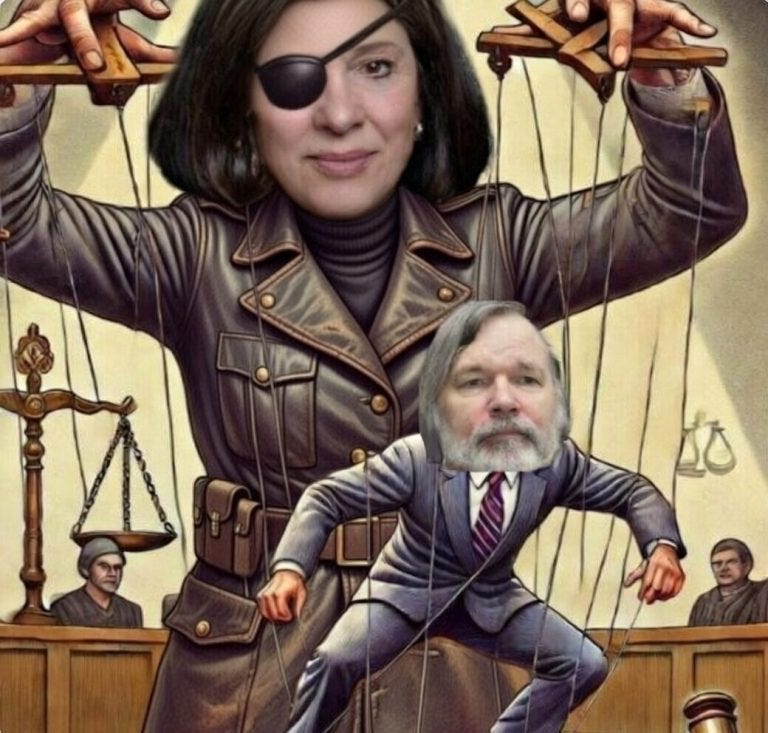
I need to add one point. On March 1, 2019, your prior boss, Chief Justice Robinson, issued an op-ed in the Connecticut Post, and he said, “Disavow the blog.” The Constitution does not tolerate that result. We have danced around Joette Katz’s game, in the Connecticut Law Tribune in January 2022, that “the blog is not free speech.”
I think the only thing you are left with is an unconditional release.
Thank you, sir. I appreciate your time.
XVII. Boyne Sentencing Transcript: Standing Criminal Protective Orders
The Court:
Mr. Boyne, I am now going to review with you the standing criminal protective orders with regard to Thomas Moukawsher, Jane Grossman, and Elizabeth Stewart.
You are ordered to surrender or transfer firearms and ammunition in your possession. Do not assault, threaten, abuse, harass, follow, interfere with, or stalk those persons. Stay away from the home of the protected persons or where those persons reside. No contact with those persons. Stay 100 yards away from the protected persons.
These orders will remain in effect until May 26, 2051.
[Editorial Legal Note: Connecticut standing criminal protective orders are governed generally by Conn. Gen. Stat. § 53a-40e.]
Violation of these orders is a Class D felony, punishable by incarceration for up to five years.
Do you understand that, Mr. Boyne?
Boyne:
Yes.
The Court:
The defendant acknowledges that he understands.
The conditions recommended in the presentence investigation report are, again, no contact with the victims or their families. I think that is largely covered by the standing criminal protective orders.
The defendant is also going to be required to agree and sign a computer-access agreement prior to utilizing any computer while on probation or any other type of supervision.
This is directed to Attorney Doyle. The recommendation includes a prohibition on searching, sharing, or writing about the victims. I guess my question would be this: outside of the defendant communicating anything to anyone in any fashion that constitutes a true threat, what is the issue with regard to simply searching or writing in general about the victims? If it is not a true threat being communicated, what is the defendant violating if he is simply searching one of the victims?
Attorney Doyle:
Your Honor, I think we are in a different status now because we are in a situation where they have been found to be victims of the crime. I think it is for rehabilitative purposes of probation. I understand probation can set those conditions, and the law is clear that individuals on probation, no matter what state or system, have lesser rights because they are under supervision.
I do think that is part of the rehabilitation. The other thing I would note is probation will have this, whether here or in Virginia. I am presuming at some point it will be Virginia. They will have that system. Systems change. There are ways to monitor remotely. Sometimes individuals are brought to probation with the computer to check the computer, to make copies, and so on. I think whatever the current functions or abilities of probation are, that would apply.
The Court:
Just on that narrow issue, anything at all, Mr. Boyne?
Boyne:
What he is saying is because somebody is convicted of stalking, somehow he is stripped of First Amendment rights. That seems pretty consistent, but I do not think you have any basis to do that. If you rob a bank, are you prevented from using money?
The Court:
You object to that condition. I note that for the record.
XVIII. Boyne Sentencing Transcript: Court’s Finding Before Sentence
The Court:
The defendant has consistently argued that he is being punished for the exercise of his protected First Amendment rights. That is not true.
A jury of your peers, Mr. Boyne, found you guilty of communicating speech which constitutes true threats. That was the instruction of the Court to the jury, and that is what they found. The jury found you guilty of communicating true threats which resulted in stalking and electronic stalking toward Judge Grossman, Judge Moukawsher, and Judge Stewart.
The Court heard during trial the testimony of the victims, and also heard today the statements read by the victim advocate, as well as hearing from Judge Grossman. I have heard about the fear and emotional distress they suffered because of your actions, as well as the fear and emotional distress endured by members of their families.
No one should have to endure such fear or emotional distress because they are simply doing their jobs.
You have an absolute First Amendment right to communicate your thoughts or your views on any issue, no matter how unpopular, disgusting, or offensive it may be. But when you cross the line into communicating true threats, you have broken the law and you will be punished for that.
I am about to impose sentence. Is there anything further you want to say?
Boyne:
Could you write out the true threats that you pretend exist? The only thing you did in the jury instructions was refer to six essays, stripped of the context of the other 850. Under strict scrutiny, which is required and which you ignored, you failed to put that forward.
There was no bill of particulars claiming true threats. In fact, the information did not even say true threats. You threw it in at the end. There is a statute for true threats. There would be a constitutional due process and equal protection requirement under the Fourteenth Amendment that the State would have charged that.
The Court:
Mr. Boyne, I am now going to sentence you. If you are able, you can stand. If you cannot stand, that is fine. Can you stand?
Boyne:
No.
XIX. Boyne Sentencing Transcript: Sentence Imposed
The Court:
The Court will sentence you to the care and custody of the Department of Correction as follows.
Starting with file ending 215.
Count One, stalking in the first degree: three years to serve, two years special parole.
Count Two, stalking in the first degree: three years to serve, two years special parole.
Both run consecutive to each other.
Now going to file ending 216.
Count One, stalking in the first degree: three years to serve, two years special parole. That runs consecutive.
Count Two, stalking in the first degree: three years to serve, two years special parole. That also runs consecutive.
Now going to file ending 217.
Count One, stalking in the first degree: three years to serve, two years special parole. That runs consecutive.
Count Two, also stalking in the first degree: five years to serve flat. That runs consecutive.
At this point, it is twenty years to serve, ten years special parole.
[Editorial Legal Note: Connecticut special parole is governed generally by Conn. Gen. Stat. § 54-125e.]
Going back to file ending 215, Counts Three, Four, Five, and Six are all five years to serve flat, concurrent.
File ending 216, Counts Three, Four, Five, and Six are all five years to serve flat. Those are also concurrent.
File ending 217, Counts Three, Four, Five, and Six are all five years to serve flat. Those all run concurrent.
Do you have that, Mr. Clerk?
Clerk:
Yes, Your Honor.
The Court:
With regard to file endings 215, 216, and 217?
Clerk:
Yes, Your Honor.
The Court:
So the total effective sentence is twenty years to serve, ten years special parole.
Mr. Boyne has no record, as was pointed out. I am well aware of that. But Mr. Boyne’s consistent lack of compliance with court orders disturbed this Court.
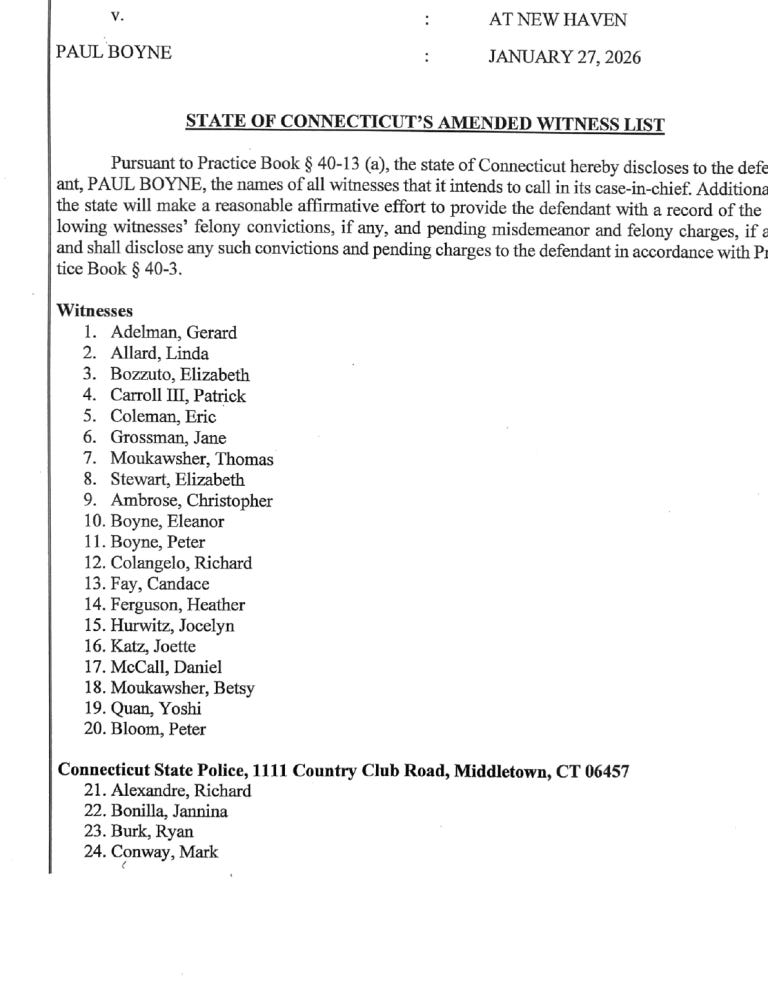
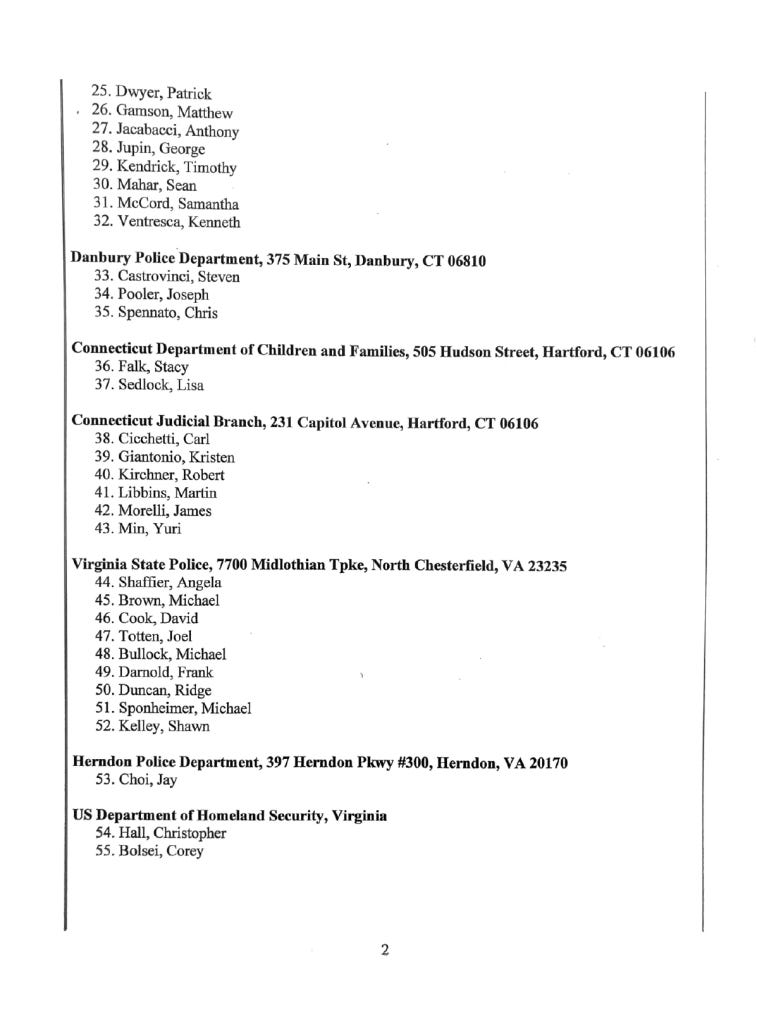
Number one: during trial, Mr. Boyne was represented by counsel. The State did not file with the Court its witness list. The State handed the witness list to counsel and left it on counsel’s table. That list ended up online. I concluded, and it made perfect sense to conclude, that Mr. Boyne presented that to a third party who posted it online. That was very concerning to the Court.
Number two: hearing Judge Grossman this morning about apparently what took place during trial, with the defendant going to speak with somebody who was testifying about her testimony, outrageous. Outrageous.
Boyne:
Didn’t happen.
The Court:
I am talking. This is totally outrageous.
Number three: I specifically indicated that the PSI was to be given to you. You are representing yourself. You look at it, you talk to your standby counsel, and it is to go nowhere else. I asked you whether you acknowledged it, and finally, reluctantly, you acknowledged it. Clearly, Mr. Boyne, despite the fact that you have no record, you cannot follow the orders of the Court.
The Court finds that special parole under these circumstances is absolutely necessary.
The other conditions will be as follows: abide by the standing criminal protective orders; abide by the computer-access agreement; possess no weapons; mental-health screening; and no new arrest or probable cause.
You are entitled to any presentence credit or risk-reduction credits. I will impose and remit any fines.
Again, the total effective sentence is twenty years to serve, ten years special parole.
Mr. Clerk, there are papers Mr. Boyne must be provided with.
Clerk:
Yes, Your Honor. Let the record reflect that the defendant will be served with a party process pamphlet, three notices of right to appeal judgment of conviction, three appeal instructions, and three applications for waiver of fees, costs, and expenses.
[End of transcript.]

Dios traerá justicia .