

Judicial Pinball Explodes
Luthmann’s new filing puts Judge Morales-Minerva, NYSCEF, OCA silence, and Castorina’s Manhattan move on one hot seat.


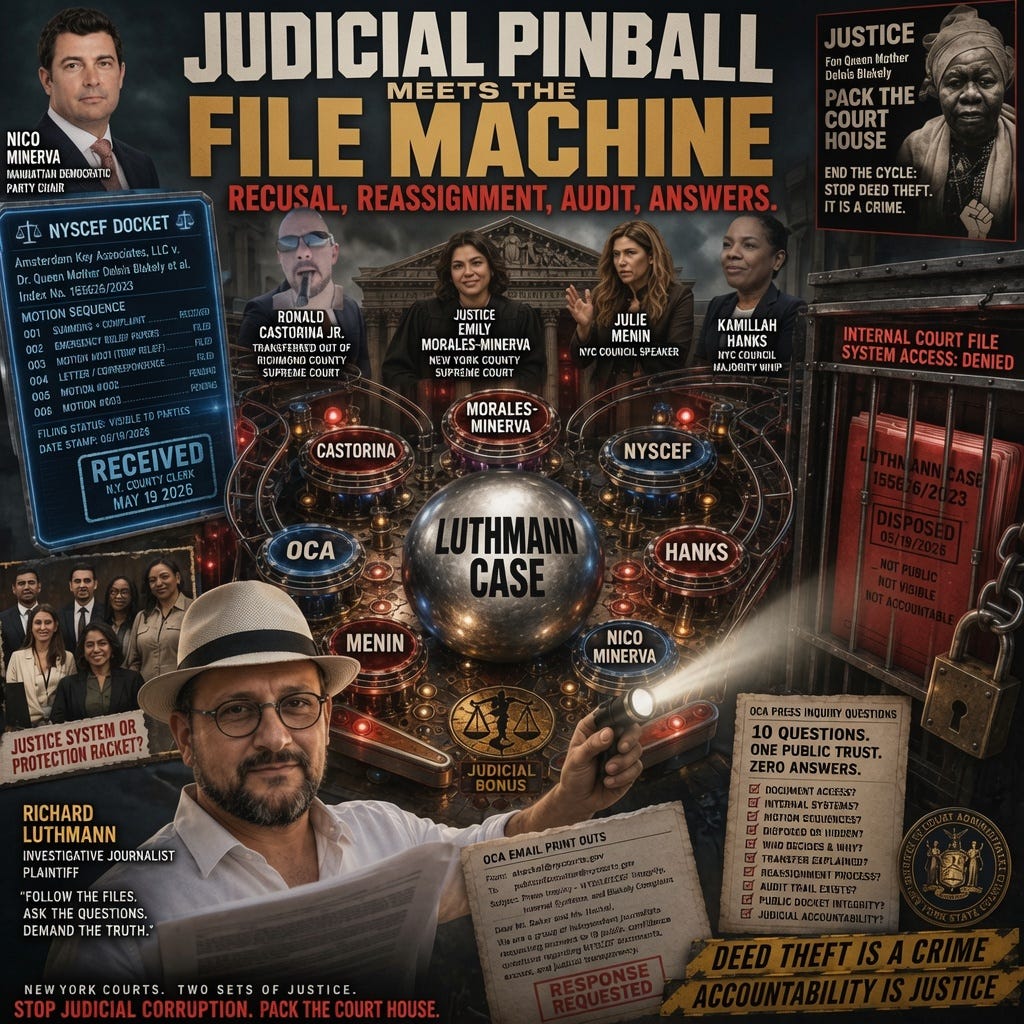
LUTHMANN NOTE: Justice must not merely be internally sincere. It must be publicly credible. That is the whole ballgame. Morales-Minerva may believe she can be fair. That is not enough anymore. The case now involves a journalist-plaintiff investigating the courts, a Manhattan Democratic power household, a Council Majority Whip, a sitting judge-defendant reportedly moved into the same county courthouse, NYSCEF integrity questions, and OCA silence. If the file is clean, certify it. If the judge saw everything, say it. If the system has two sets of books, expose it. But do not insult the public by pretending this still looks normal. This piece is “Judicial Pinball Explodes.”



By Rick LaRiviere, Frankie Pressman, and Richard Luthmann
The Recusal Fight Just Went Nuclear
Richard Luthmann’s latest supplemental filing in Luthmann v. Hanks et al., New York County Supreme Court Index No. 100012/2024, does not politely ask Justice Emily Morales-Minerva to step aside. It builds a public-integrity pressure cooker and dares the New York court system to explain why the lid should stay on.
Filed July 10, 2026, the supplemental CPLR 2106 affirmation says the issue is not whether Morales-Minerva privately believes she can be fair. The issue is whether a reasonable member of the public, fully informed of the facts, would question her continued role in a politically radioactive case brought by a journalist now reporting directly on her courthouse ecosystem, NYSCEF integrity, court-file manipulation allegations, and Manhattan judicial politics.
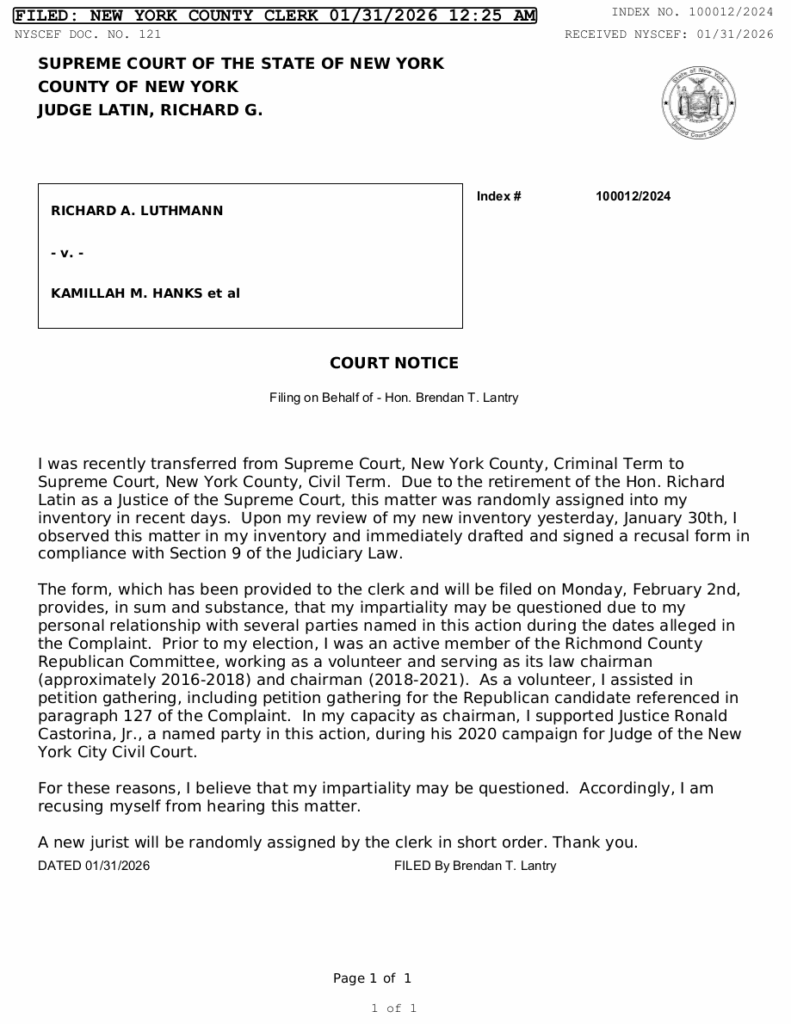
The filing says the answer is obvious: yes. Luthmann leans on Justice Brendan Lantry’s prior recusal as the benchmark. Lantry, according to the filing, stepped aside because his impartiality “may be questioned” due to personal relationships and political activity involving defendant Ronald Castorina Jr.
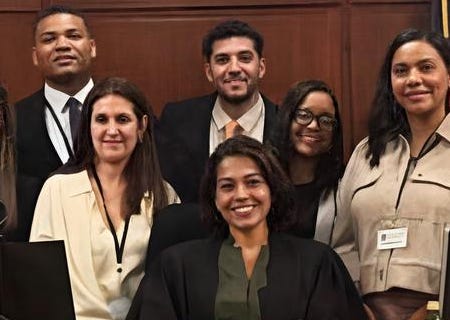
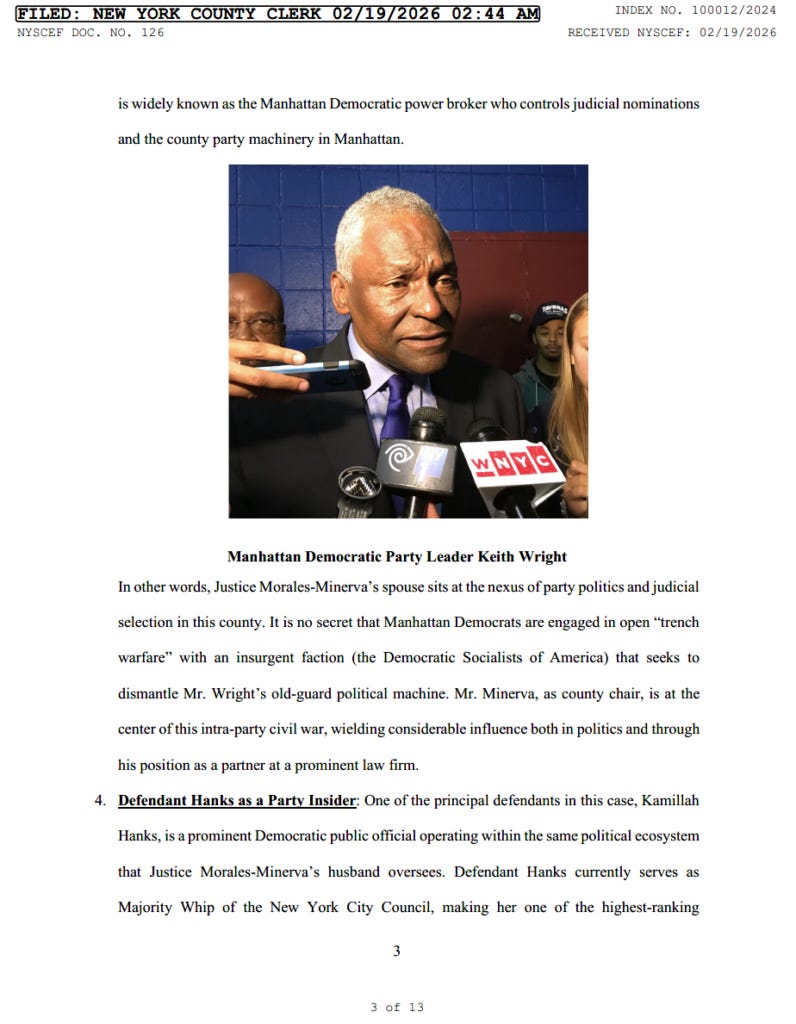
Luthmann argues that if Lantry’s attenuated connections required recusal, Morales-Minerva’s situation is worse: her husband, Domenico “Nico” Minerva, chairs the Manhattan Democratic Party, and the case involves Democratic power players, a City Council Majority Whip, a sitting judge-defendant, and now Luthmann’s own published investigation of New York County court machinery.
This is no longer just an old fee dispute. It is a courthouse legitimacy test.
Judicial Pinball Explodes: Luthmann Says Journalism Changed The Case
The new filing’s strongest pivot is press status. Luthmann says he is not merely a pro se plaintiff trying to collect an old $86,000 legal bill. He is a bona fide journalist and publisher whose work is protected by New York Civil Rights Law § 79-h, Article I, § 8 of the New York Constitution, and the First Amendment.
The filing says he regularly publishes on New York courts, family courts, lawfare, court corruption, political retaliation, institutional misconduct, and public-integrity issues through TheFamilyCourtCircus.com, Luthmann.Substack.com, NYNewsPress.com, and related platforms.

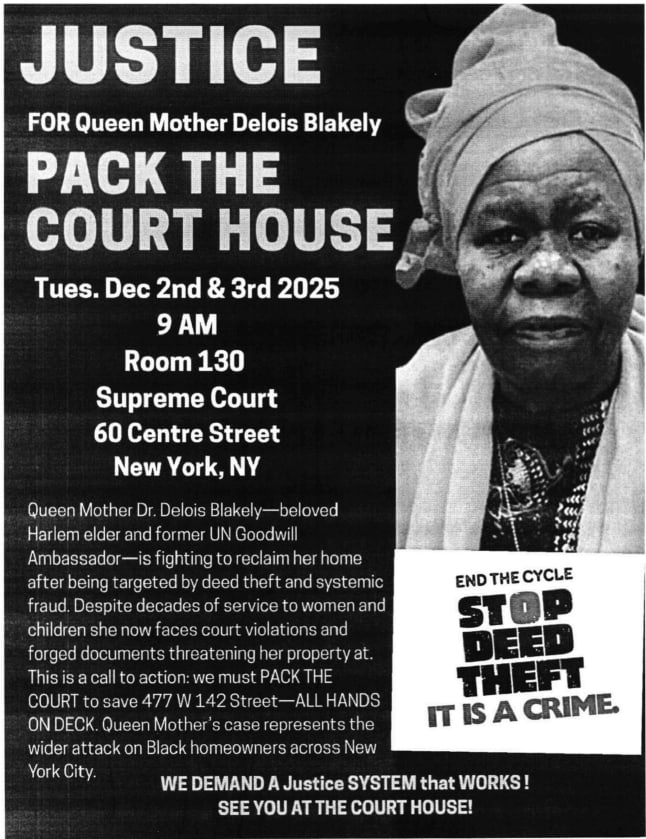
That matters because on July 9, 2026, Luthmann published “The File Is The Weapon,” a direct investigative piece alleging NYSCEF irregularities and court-file manipulation in the Amsterdam Key Associates v. Queen Mother Delois Blakely case, a matter involving Justice Morales-Minerva.
In the supplemental affirmation, he argues that any ruling by Morales-Minerva in his own case will now be viewed through a new public lens: if she rules against him, critics may see retaliation against a journalist investigating the courts; if she rules for him, critics may see institutional damage control. Either way, he argues, the appearance of neutrality is gone.
The attached exhibits show the article was filed into NYSCEF as Exhibit A and Exhibit B, complete with the headline, the “two sets of justice” poster, and the allegation that NYSCEF may be a public storefront while internal court systems hold the real file.
Judicial Pinball Explodes: The NYSCEF Question – Is The Judge Seeing The File?
The most dangerous part of the filing is not the political argument. It is the NYSCEF question. Luthmann’s article and exhibits hammer Louann Larsen’s allegation that New York’s public-facing court docket may not match the internal court-management system judges actually use.
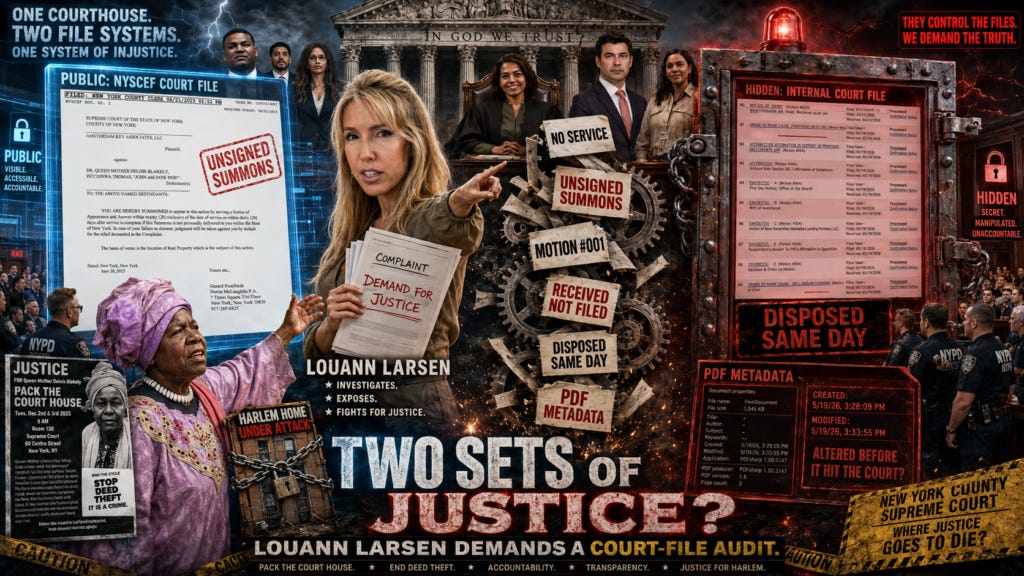
In the Blakely exemplar, Larsen alleges no affidavit or affirmation of service for the summons and complaint, an unsigned summons, “zero” motion numbers, a judgment marked “received” rather than publicly accessible in ordinary filed form, pro se filings allegedly visible in NYSCEF but not processed internally, metadata concerns, and a same-day “disposed” case after emergency relief was submitted.
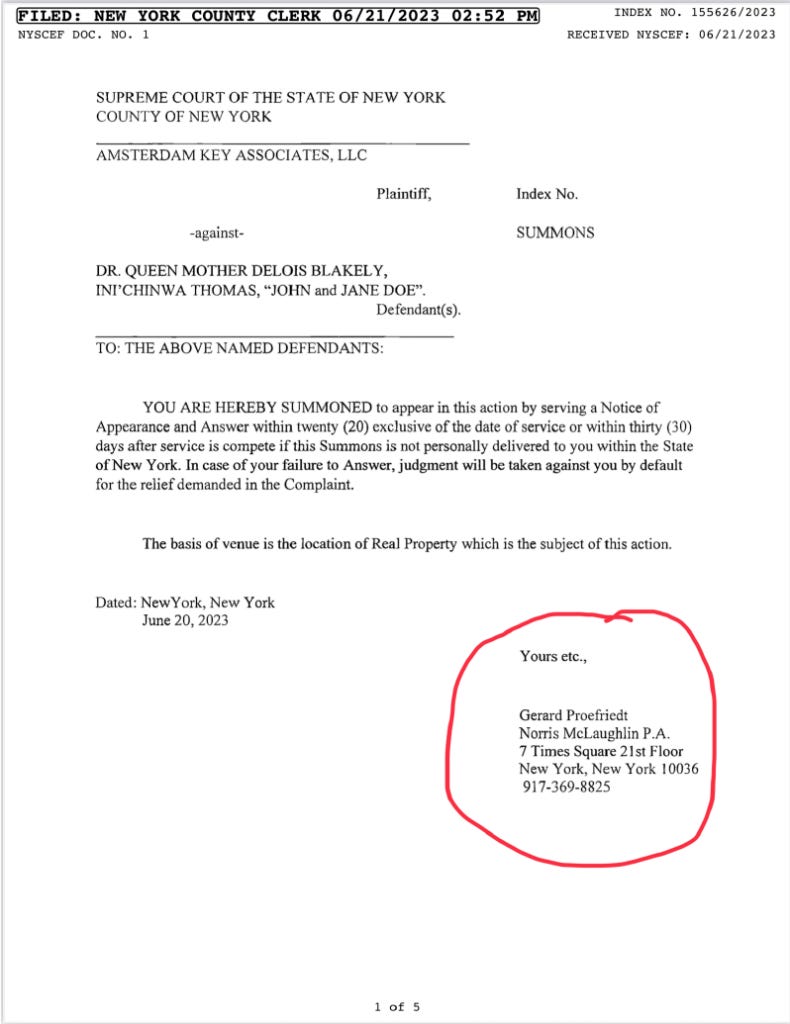
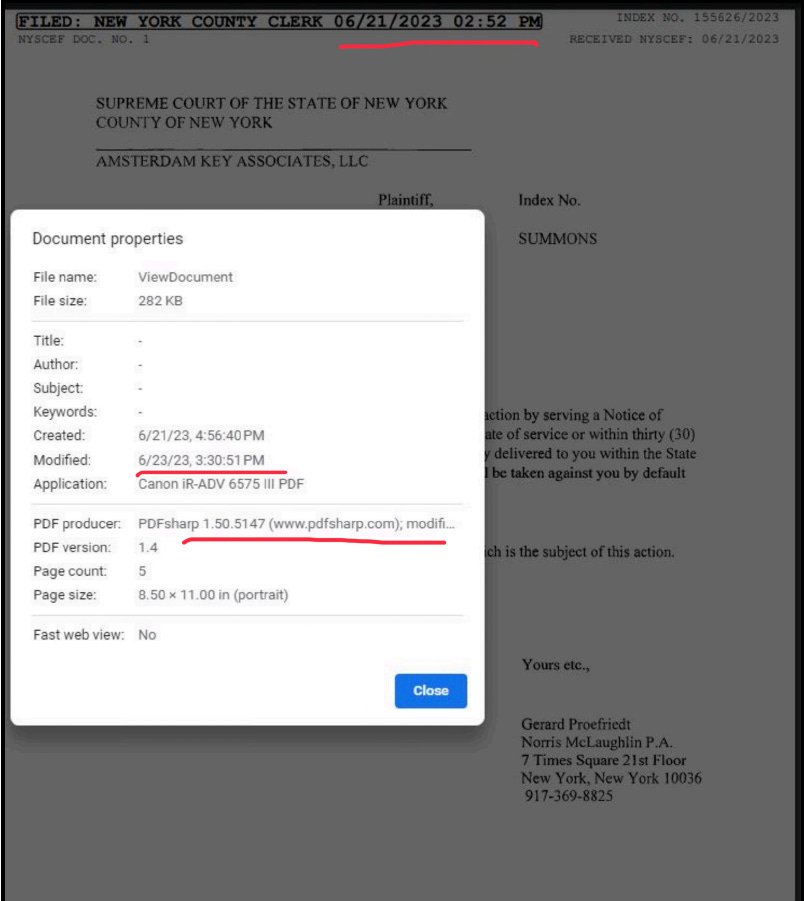
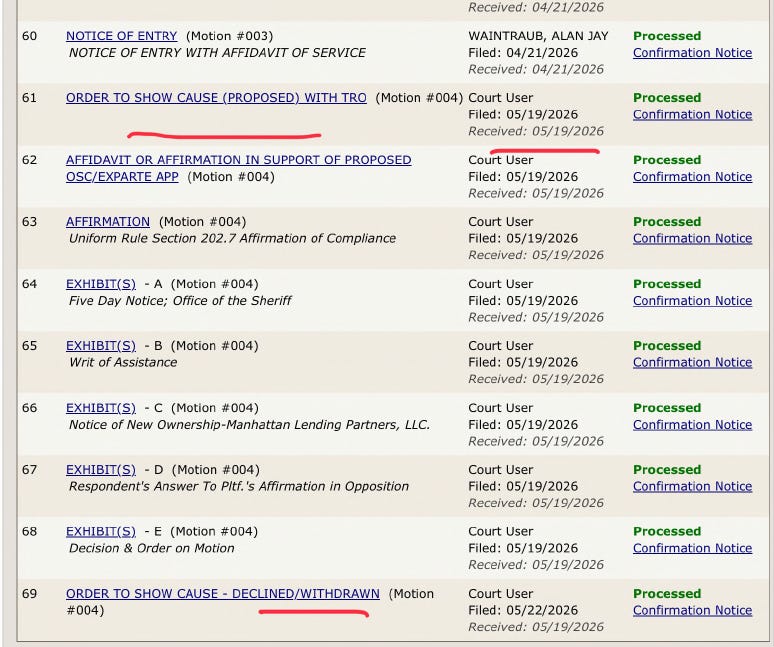
The exhibits include screenshots showing the Blakely docket with Motion #001, #002, and #003 prefixes; a judgment entry described as “Judgment — signed by Court to County Clerk”; and docket activity surrounding the May 19, 2026 emergency filings.
The press inquiry to OCA, sent to Al Baker and Arlene Hackel, asked the question every litigant should want answered: can every NYSCEF user be assured that every filed document is transmitted to and available for review by the assigned judge? It also asked whether a document can appear on the public docket while failing to appear in UCMS, CourtNet, or another internal judge-facing system.
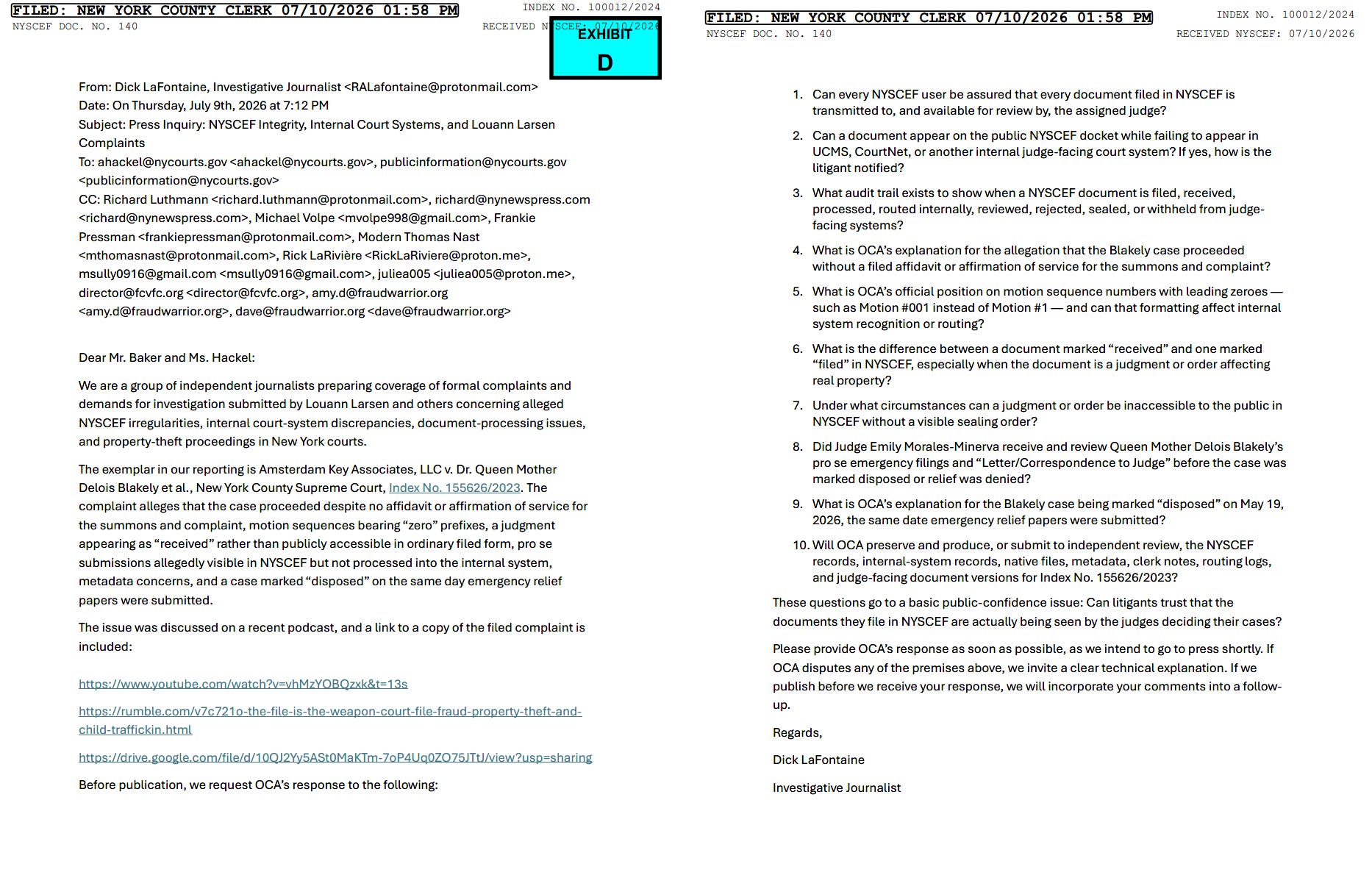
As of the article, OCA had not answered. That silence is not a footnote. It is gasoline.
A court system that will not explain whether judges see the same file the public sees cannot keep demanding trust.
Judicial Pinball Explodes: Castorina’s Manhattan Move Makes The Optics Worse
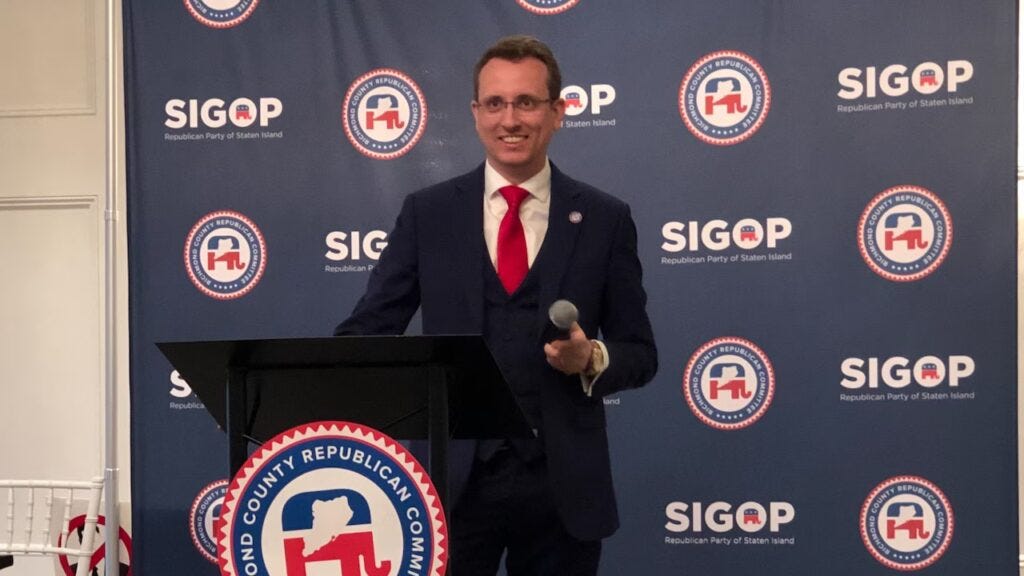
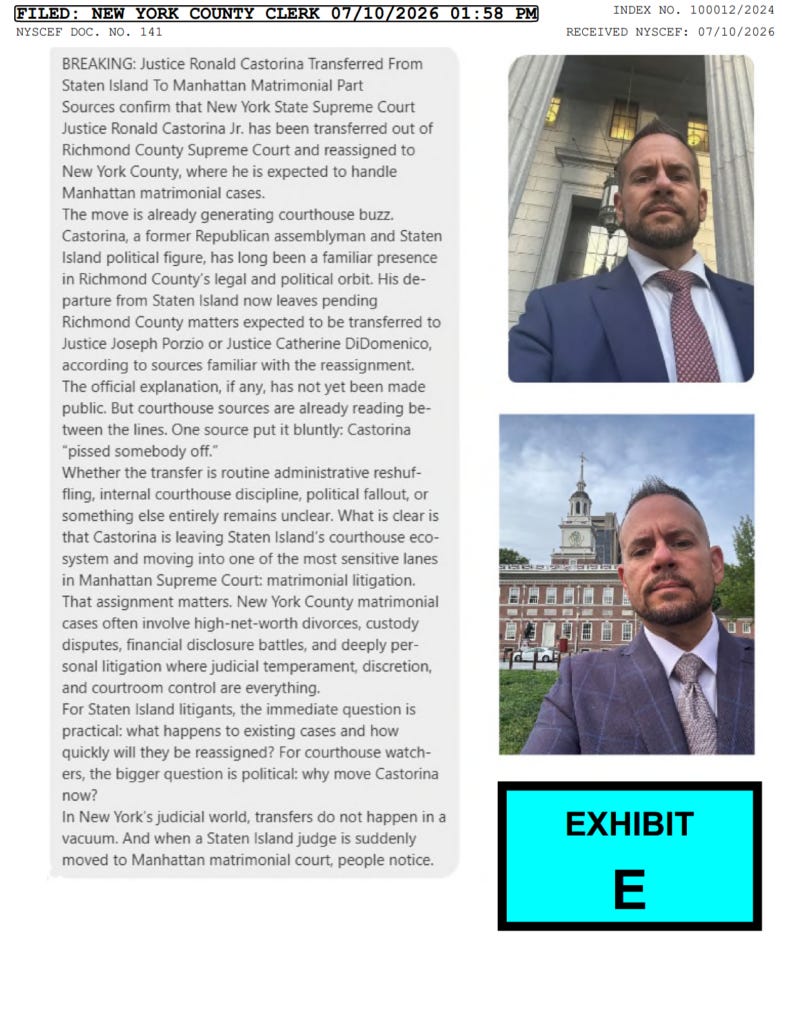
Then comes the courthouse grenade: Ronald Castorina Jr., a named defendant in Luthmann’s case and a sitting New York State Supreme Court Justice, has reportedly been transferred from Richmond County Supreme Court to New York County, where he is expected to handle Manhattan matrimonial matters.
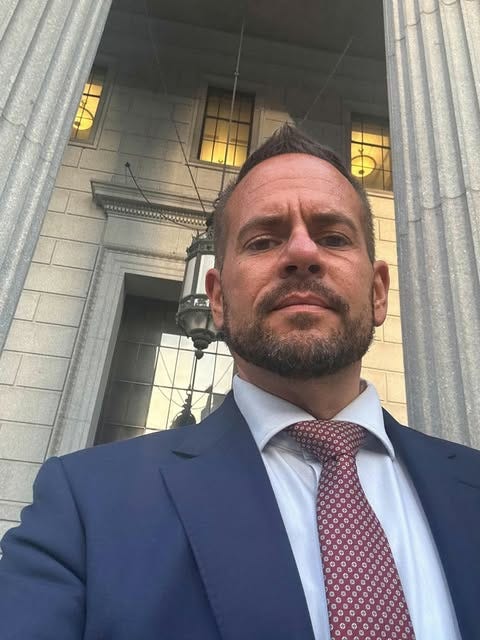
The supplemental affirmation says this materially worsens the appearance problem because the Court is now being asked to let Morales-Minerva, a New York County Supreme Court Justice, rule in a case involving a judge-defendant reportedly moving into the same courthouse ecosystem.
Exhibit E frames the transfer bluntly: Castorina is leaving Staten Island’s courthouse world and entering one of Manhattan Supreme Court’s most sensitive lanes, matrimonial litigation, where custody, high-net-worth divorce, financial disclosure, and judicial discretion collide.
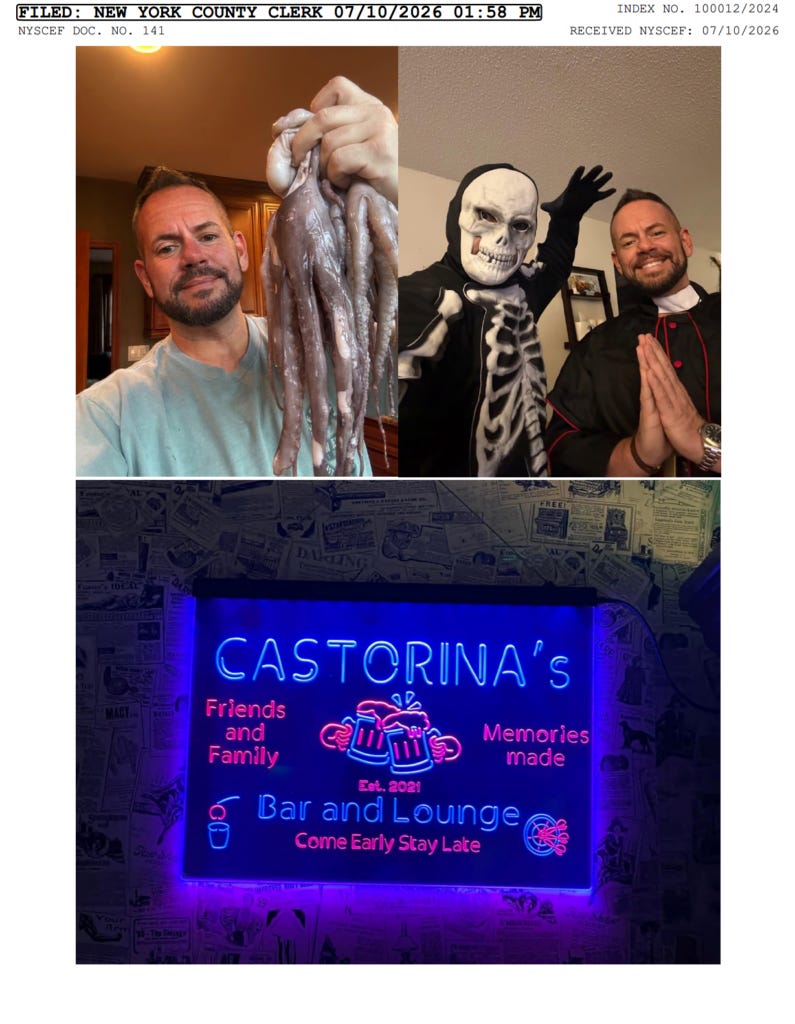

Luthmann argues no ordinary litigant should have to wonder whether his claims against a sitting judge-defendant are being judged by another judge who may now share courthouse administration, personnel, meetings, or institutional loyalties with him.
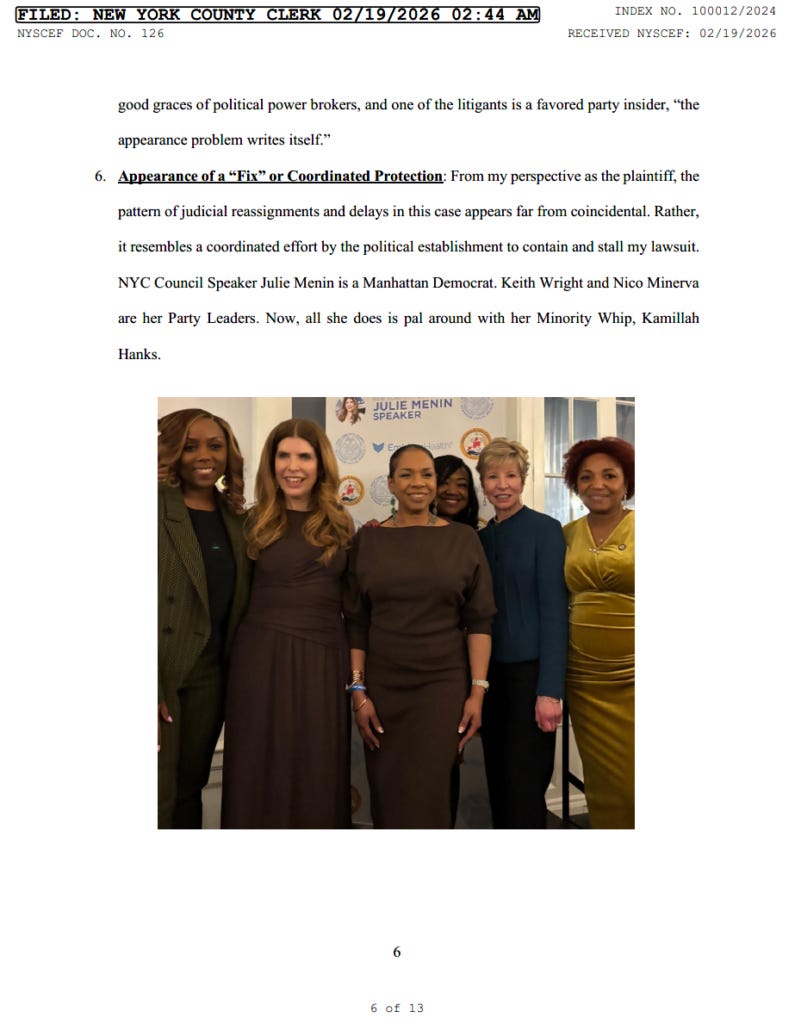
Add Manhattan Democrat politics, and the room gets hotter. Morales-Minerva’s husband remains the Manhattan Democratic Party chair. Defendant Kamillah Hanks is a New York City Council Majority Whip. Hanks is politically aligned with Speaker Julie Menin’s orbit, and Menin operates inside the same Manhattan Democrat ecosystem Nico Minerva leads.

Luthmann’s answer to the expected defense cry that he “chose the venue” is simple: venue is assessed at filing; recusal is assessed as facts develop.
The facts have overtaken the original filing decision.
The Only Cure is Sunlight
In the end, Luthmann’s supplemental filing leaves New York’s court system with a choice it can no longer dodge. Either Justice Emily Morales-Minerva steps aside, and the case is reassigned beyond the reach of courthouse politics, or every ruling that follows carries the stink of the machine.
Either OCA explains whether NYSCEF filings actually reach judges in the same form the public sees, or the silence becomes part of the story.
Either Castorina’s sudden Manhattan landing is irrelevant, and the courts can prove it, or it becomes one more piece of the judicial pinball pattern.
This is not about one angry litigant. It is about whether a journalist can investigate court corruption while litigating in the same system without being punished, buried, or routed into procedural fog.
Justice must satisfy the appearance of justice. Right now, the appearance is a mess.
The only cure is sunlight: recusal, reassignment, file certification, NYSCEF audit, and answers under oath.
