

The File Is The Weapon
Louann Larsen says New York’s court docket is not just broken — it may be hiding the machinery of property theft and child trafficking.


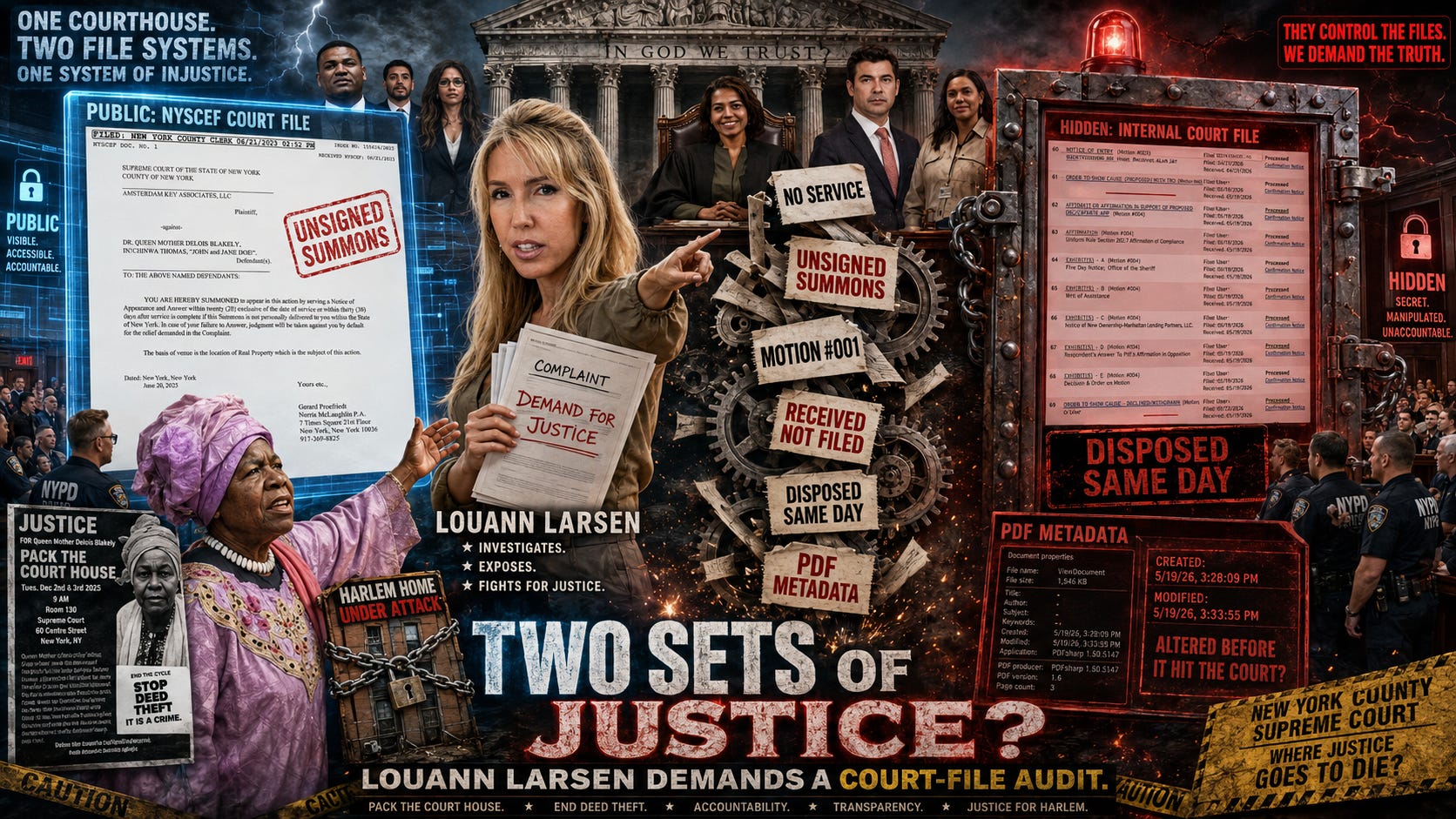
LUTHMANN NOTE: The court file is supposed to be the clean record of justice. Louann Larsen says it has become the weapon. That claim is bigger than one Harlem elder, one judge, one docket, or one NYSCEF screenshot. It goes to the central question: can ordinary people trust a court system whose internal records they cannot see? If the answer is yes, prove it. Audit the files. Certify the dockets. Produce the internal records. Explain the missing service, the zero motions, the hidden judgment, the same-day disposal, and the metadata. If the file is clean, show America. If it is dirty, then stop pretending procedure is justice. This piece is “The File is the Weapon.”


By Dick LaFontaine and Richard Luthmann
The Docket Is The Crime Scene
(NEW YORK, NEW YORK) – Louann Larsen did not come on Richard Luthmann Live to complain about losing a motion. She came with a map of what she alleges is a court-file manipulation architecture hiding in plain sight inside New York State’s electronic court system.
Her allegation is as simple as it is explosive: the file is the weapon.

Larsen says New York State’s public-facing court docket, NYSCEF, can become a polished storefront while the real action happens in internal systems the public never sees. In her telling, litigants may believe their filings are before a judge because they appear on the public docket. But the judge may be working from a separate internal file, with a different document path, different routing, different processing, and possibly different versions of key papers.
The exemplar is Amsterdam Key Associates, LLC v. Dr. Queen Mother Delois Blakely et al., New York County Supreme Court Index No. 155626/2023. Larsen’s formal complaint names Judge Suzanne Adams, Judge Emily Morales-Minerva, attorney Gerard Proefriedt, attorney Alan Waintraub, and Deputy Sheriff Defalco. It was sent to court officials, prosecutors, inspectors general, political offices, and other public authorities.
The complaint alleges “egregious court fraud, document falsification, and systematic property theft” in connection with a case involving Queen Mother Delois Blakely’s home.
Larsen’s core point is not that she dislikes a court ruling. It is that the alleged fraud happened before any ruling — at the filing level, where due process either begins or dies.
The File Is The Weapon: The Blakely Exemplar
The Blakely case, according to Larsen, contains the key ingredients of the scheme: a summons and complaint filed without a proper affidavit or affirmation of service; an unsigned summons; motion sequence numbers bearing “zero” prefixes; a judgment entry that appeared as “received” but not properly public or clickable; pro se papers visible to the public but not processed into the internal system; metadata Larsen says indicates later alteration; and a case marked “disposed” the same day emergency relief was sought.
That is a lot. But the heart of it is easy to understand.
A lawsuit begins with notice. A defendant must be served. Proof of that service must be filed. Without service, the defendant is not properly brought into court. Without notice, there is no meaningful opportunity to be heard. Without notice and an opportunity to be heard, “due process” becomes courthouse wallpaper.
In the Blakely exemplar, Larsen points to NYSCEF Document No. 1, the summons and complaint, filed June 21, 2023. She says the public docket does not show a legally sufficient affirmation or affidavit of service for the summons and complaint. Instead, months later, filings appear under Motion #001. Larsen’s complaint argues that an affidavit of service for a later motion is not an affidavit of service for the original summons and complaint.

The complaint specifically cites the lack of an affirmation/affidavit of service as the “fatal flaw” and says the case could not legally proceed without it.
This is not a technicality when a home is at stake. It is the front door of justice. Larsen says that door was never lawfully opened.
The File Is The Weapon: No Service, No Due Process, No Excuse
On the live show, Larsen told Richard Luthmann that the “most basic” requirement for a summons and complaint is service. She emphasized that an affidavit of service “commences an action and demands an answer.” A case, she said, cannot legally proceed if the defendant was never served and the court lacks proof of service.
Luthmann translated it into plain English: the two pillars of due process are notice and an opportunity to be heard. If Queen Mother Delois Blakely was not served with the initiating papers, then the courthouse machinery should have stopped before it touched her home.
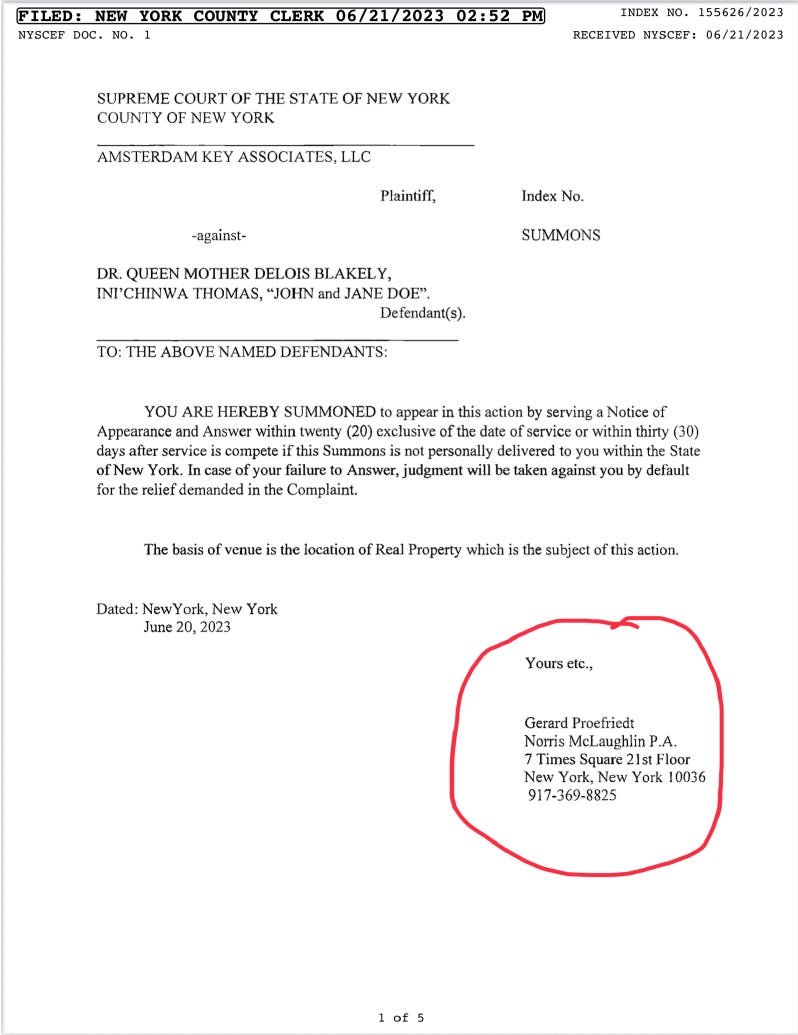
Larsen’s complaint goes further. It alleges that the summons itself was not signed by an attorney. The complaint points to the filed summons and states that the signature area was left blank or not properly executed, while citing 22 NYCRR 130-1.1a and CPLR 2101(d) as relevant rules. The included image of the summons shows the June 21, 2023 county clerk filing stamp and the attorney contact block, while the complaint argues that the document was not signed in the manner required.
One can imagine the absurdity in any other setting. A citizen gets a parking ticket without an officer’s signature, and the case gets tossed. But in this case, Larsen says a court file lacking foundational service proof and carrying an unsigned summons still advanced toward taking an elderly woman’s home.
If OCA disagrees, it should say so clearly and produce the certified record.
The File Is The Weapon: The “Zero” Motion Problem
The next tell is the “zero” motion sequence.
Larsen says motion numbers such as Motion #001, Motion #002, and Motion #003 are not harmless docket formatting. She calls them a “hallmark sign of fraud.” Her complaint alleges that the zero prefix permits motions to appear in NYSCEF for public consumption while failing to exist properly in the internal court case-management system.
That claim should be tested immediately. OCA can either confirm that leading zeroes are a harmless system convention or explain what they do. Court IT can produce logs. Clerks can certify internal routing. Judges can say whether every motion visible on NYSCEF was also visible to them in their judge-facing system.
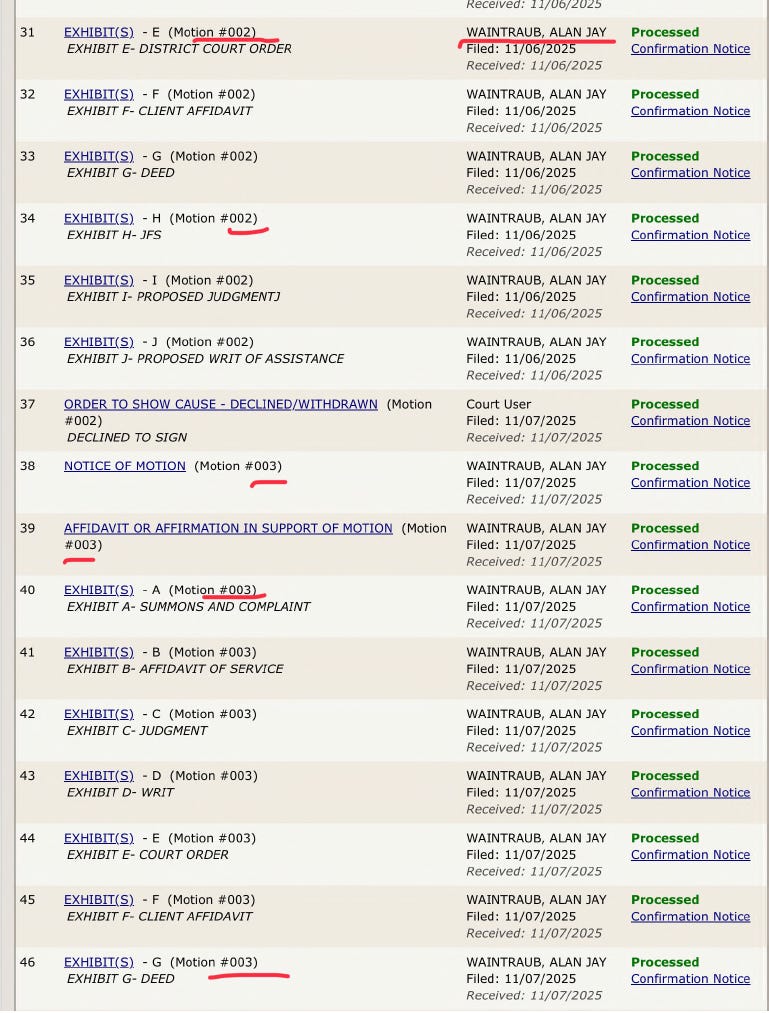
The Blakely complaint says every motion in the case bears the zero-prefix pattern. It includes docket screenshots showing documents listed under “Motion #001,” “Motion #002,” and “Motion #003.” Larsen argues that there is no court rule or protocol permitting selective use of that zero prefix, and she alleges the effect is to create a public docket narrative while preventing proper internal recognition.
This is where the story moves from law to architecture. If Larsen is wrong, OCA should demolish the claim with one clean technical explanation. If she is right, NYSCEF is not merely an e-filing system. It is a stage set.
A public docket that lies by omission is worse than no docket at all.
The File Is The Weapon: The Secret Judgment
Then comes the judgment.
Larsen points to NYSCEF Docket No. 21, described as “Judgment — signed by Court to County Clerk.” According to the complaint, the entry appeared as “received” but not “filed,” lacked a clickable link to the public document, and had no visible sealing order. The complaint contrasts that with other docket entries that show both filed and received information. It argues that a judgment used to affect property rights should not be hidden behind a non-clickable entry or treated as inaccessible without a formal sealing basis.
This is the kind of fact pattern that makes ordinary people stop trusting courts.
A judgment is not a rumor. A judgment is not a secret handshake. A judgment is the paper the state uses to enforce power against a citizen. If that paper threatens a home, the defendant should be able to see it, challenge it, serve it, appeal it, and trace its authority from filing to enforcement.
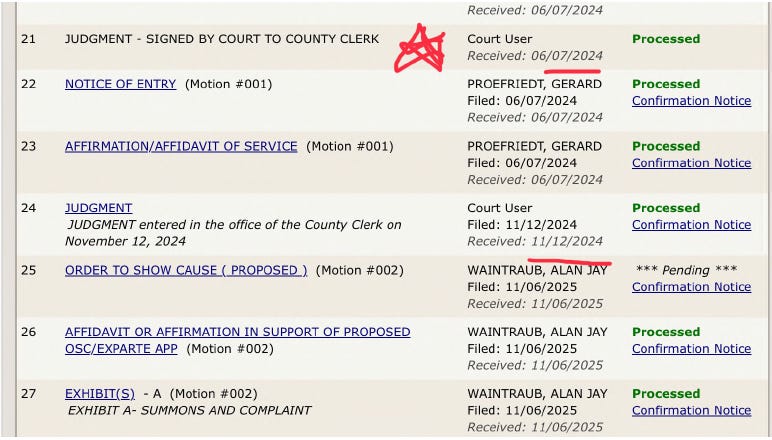
Larsen’s complaint also alleges missing notice-of-entry and affidavit-of-service problems tied to the judgment. That matters because notice of entry can trigger appellate time limits and establish enforceability. If the judgment is not properly filed, not properly accessible, not properly served, and not properly entered, then the proceeding is not merely ugly. It is constitutionally radioactive.
A court system that cannot produce a clean, public, certified, internally consistent judgment file cannot demand blind trust.
It can demand an audit.
Queen Mother’s Plea
The human center of the case is Queen Mother Delois Blakely, an elderly Black woman, community servant, and longtime figure who has supported women and children for decades.

A flyer included in the materials calls on supporters to “Pack the Court House” for Queen Mother Delois Blakely and describes her as a Harlem elder and former UN Goodwill Ambassador fighting to reclaim her home after deed theft and systemic fraud.
The most devastating document is Blakely’s own handwritten emergency filing. In the papers shown in the complaint, Blakely states that she was unaware of the case before judgment because of improper notice or service.
She says new owners installed an intercom system that interfered with mail and reliable delivery of court correspondence. She says she is 84 years old and the sole caretaker of a 47-year-old daughter who is nonverbal and has cognitive and physical disabilities. She asks the court to stay a five-day notice to vacate, vacate the decision and order, and schedule a new hearing.
That is not legal noise. That is a distress flare.
A functioning court should read that twice. It should check service. It should confirm notice. It should verify the judgment. It should ask whether an elderly pro se litigant and disabled dependent are about to be crushed by a defective file.
Larsen says the system did something else.
The File Is The Weapon: The Same-Day Disposal
The Blakely case was marked disposed on May 19, 2026 — the same date Blakely’s emergency order to show cause with TRO papers were filed, according to the complaint and supporting docket screenshots.
Larsen says this was not a coincidence. She says marking the case disposed prevented the pro se filings from being properly found in the internal case-management system.
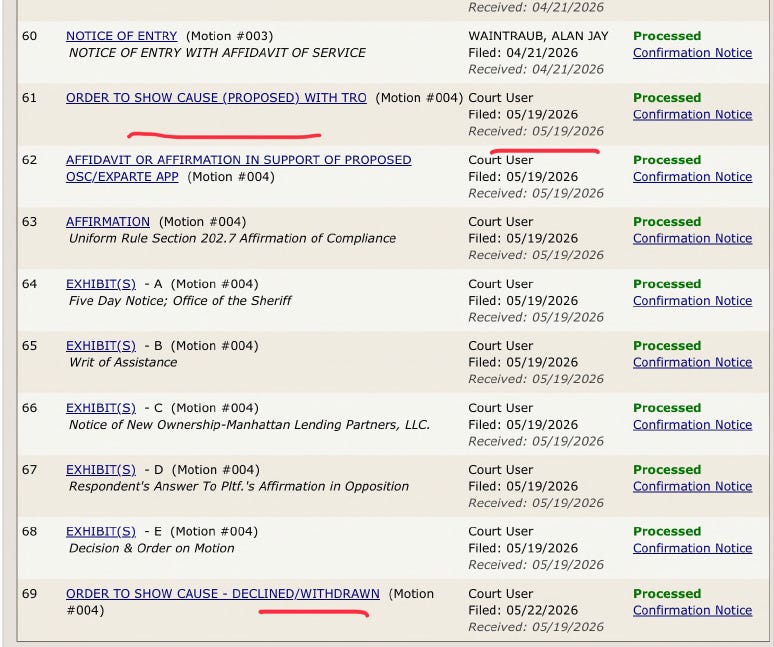
That is an allegation OCA can answer.
Who marked it as disposed? At what time? At whose direction? Did Judge Emily Morales-Minerva see Blakely’s emergency papers before the disposition or before relief was denied? Did the “Letter/Correspondence to Judge” visible on NYSCEF reach the judge-facing internal system? Are post-disposition filings routed differently? Are litigants told if their papers fail to reach the judge’s actual working file?
These questions are not hostile. They are basic.
The complaint says Blakely’s “Letter/Correspondence to Judge,” NYSCEF Docket No. 54, was e-filed by a court employee but never stamped and processed with date and time on the pages, leaving the judge without access to the substance of her plea. It also alleges that her May 19 filing stated she never received the summons and complaint — a claim Larsen says is corroborated by the absence of a summons-and-complaint service affidavit in NYSCEF.
If an elderly pro se woman says she was never served, and the file shows no service affidavit, and the case is disposed of the same day she seeks emergency relief, then “trust the process” is not an answer.
The File Is The Weapon: Metadata And Two Sets Of Books
Larsen’s allegation becomes more technical, and more dangerous, at the metadata stage.
She says NYSCEF documents were modified after their visible filing timestamps and that the modified versions were routed through the hidden internal court system. The complaint points to metadata for NYSCEF Docket No. 1, the summons and complaint, saying it was filed and processed on June 21, 2023 at 2:52 p.m., but document properties showed later modification on June 23, 2023 at 3:30 p.m. It also points to NYSCEF Docket No. 62, filed May 19, 2026 at 2:50 p.m., with document properties showing creation at 3:28 p.m. and modification at 3:33 p.m., including references to PDFSharp.
Metadata alone is not a conviction. But metadata is a lead. And in a court-integrity case, leads matter.


The answer to a metadata challenge is not “trust us.” The answer is native files, audit logs, conversion records, clerk notes, routing records, sealing history, and a side-by-side comparison of the public NYSCEF version and the judge-facing internal version.
On the show, Larsen described it as two sets of books: NYSCEF for the public, internal systems for the court. The complaint says judges receive documents via the court internal system, while pro se litigants and the public see the original NYSCEF versions. If that is false, OCA should say so. If it is true, then New York has a public-confidence crisis sitting inside its e-filing system.
A court file that cannot be audited cannot be trusted.
The File Is The Weapon: Generational Wealth And The Political Courtroom
Larsen’s complaint frames the Blakely case as part of a wider attack on elderly homeowners, Black homeowners, and generational wealth.
The language is hot because the consequences are cold: homes taken, legacies destroyed, minority communities stripped, and public officials issuing deed-theft rhetoric while, according to Larsen, the court-file machinery keeps running.
The Blakely story is just the tip of the iceberg.
Larsen, herself, has identified DOZENS of victims, most elderly, Black and brown. We have reviewed a sample of them and found the irregularity claims to be meritorious and typical:
FORMAL COMPLAINT & DEMAND FOR INVESTIGATION OF JUDGE FRANCIS A. KAHN III
FORMAL COMPLAINT & DEMAND FOR INVESTIGATION OF JUDGE KEVIN MCCLANAHAN & ATTORNEY PAMELA SMITH
FORMAL COMPLAINT & DEMAND FOR INVESTIGATION OF JUDGE JOSEPH ESPOSITO
FORMAL COMPLAINT & SECOND DEMAND FOR INVESTIGATION OF JUDGE JAVIER ORTIZ AND ATTORNEY PAMELA SMITH
On the live show, Luthmann raised the political dimension. Judge Emily Morales-Minerva, assigned to the case after Judge Suzanne Adams, does not sit in a vacuum. She is married to Manhattan Democratic Party Chair Nico Minverva.

New York judges are elected, but in Manhattan the ballot often begins inside party machinery. Judicial screening, county committees, political alliances, and courthouse power are not academic abstractions. They shape who wears the robe.
Luthmann flagged Morales-Minerva’s political context because court legitimacy depends not only on fairness but the appearance of fairness. When a politically connected judicial system presides over cases involving file manipulation, property theft, and vulnerable homeowners, public skepticism is not conspiracy thinking.
It is civic hygiene.
The question is not whether a judge’s political connections prove misconduct. They do not. The question is whether a court system saturated in political patronage can credibly police itself when dozens of litigants credibly allege the file itself was manipulated.
That is why OCA’s silence matters. A court bureaucracy that refuses direct technical questions about filing integrity only deepens public suspicion.
Courts cannot demand public trust while rejecting public scrutiny.
OCA Was Asked. OCA Has Not Answered.
Before publication, independent journalists sent the New York State Office of Court Administration a press inquiry directed to Al Baker and Arlene Hackel. OCA was asked ten basic questions. They were not rhetorical. They went to the heart of public trust. Here is what we asked:
From: Dick LaFontaine, Investigative Journalist <RALafontaine@protonmail.com>
Date: On Thursday, July 9th, 2026 at 7:12 PM
Subject: Press Inquiry: NYSCEF Integrity, Internal Court Systems, and Louann Larsen Complaints
To: ahackel@nycourts.gov <ahackel@nycourts.gov>, publicinformation@nycourts.gov <publicinformation@nycourts.gov>
CC: richard.luthmann@protonmail.com, richard@nynewspress.com, mvolpe998@gmail.com, frankiepressman@protonmail.com, mthomasnast@protonmail.com, RickLaRiviere@proton.me, msully0916@gmail.com, juliea005@proton.me, director@fcvfc.org, amy.d@fraudwarrior.org, dave@fraudwarrior.org
Dear Mr. Baker and Ms. Hackel:
We are a group of independent journalists preparing coverage of formal complaints and demands for investigation submitted by Louann Larsen and others concerning alleged NYSCEF irregularities, internal court-system discrepancies, document-processing issues, and property-theft proceedings in New York courts.
The exemplar in our reporting is Amsterdam Key Associates, LLC v. Dr. Queen Mother Delois Blakely et al., New York County Supreme Court, Index No. 155626/2023. The complaint alleges that the case proceeded despite no affidavit or affirmation of service for the summons and complaint, motion sequences bearing “zero” prefixes, a judgment appearing as “received” rather than publicly accessible in ordinary filed form, pro se submissions allegedly visible in NYSCEF but not processed into the internal system, metadata concerns, and a case marked “disposed” on the same day emergency relief papers were submitted.
The issue was discussed on a recent podcast, and a link to a copy of the filed complaint is included:
https://rumble.com/v7c721o-the-file-is-the-weapon-court-file-fraud-property-theft-and-child-traffickin.html
https://drive.google.com/file/d/10QJ2Yy5ASt0MaKTm-7oP4Uq0ZO75JTtJ/view?usp=sharing
Before publication, we request OCA’s response to the following:
1. Can every NYSCEF user be assured that every document filed in NYSCEF is transmitted to, and available for review by, the assigned judge?
2. Can a document appear on the public NYSCEF docket while failing to appear in UCMS, CourtNet, or another internal judge-facing court system? If yes, how is the litigant notified?
3. What audit trail exists to show when a NYSCEF document is filed, received, processed, routed internally, reviewed, rejected, sealed, or withheld from judge-facing systems?
4. What is OCA’s explanation for the allegation that the Blakely case proceeded without a filed affidavit or affirmation of service for the summons and complaint?
5. What is OCA’s official position on motion sequence numbers with leading zeroes — such as Motion #001 instead of Motion #1 — and can that formatting affect internal system recognition or routing?
6. What is the difference between a document marked “received” and one marked “filed” in NYSCEF, especially when the document is a judgment or order affecting real property?
7. Under what circumstances can a judgment or order be inaccessible to the public in NYSCEF without a visible sealing order?
8. Did Judge Emily Morales-Minerva receive and review Queen Mother Delois Blakely’s pro se emergency filings and “Letter/Correspondence to Judge” before the case was marked disposed or relief was denied?
9. What is OCA’s explanation for the Blakely case being marked “disposed” on May 19, 2026, the same date emergency relief papers were submitted?
10. Will OCA preserve and produce, or submit to independent review, the NYSCEF records, internal-system records, native files, metadata, clerk notes, routing logs, and judge-facing document versions for Index No. 155626/2023?
These questions go to a basic public-confidence issue: Can litigants trust that the documents they file in NYSCEF are actually being seen by the judges deciding their cases?
Please provide OCA’s response as soon as possible, as we intend to go to press shortly. If OCA disputes any of the premises above, we invite a clear technical explanation. If we publish before we receive your response, we will incorporate your comments into a follow-up.
Regards,
Dick LaFontaine
Investigative Journalist
As of press time, OCA had not responded. We will publish a follow-up if it does.
But the question remains: Can litigants trust that the documents they file in NYSCEF are actually being seen by the judges deciding their cases?
Right now, OCA has not given New Yorkers a public answer.
The File Is The Weapon: Where Property Theft Meets Child-Trafficking Allegations
The most explosive turn in the live broadcast came when Larsen connected defective property cases to child-safety and trafficking concerns. She showed that many targeted properties are near schools, transit points, or useful access corridors, and she described tunneling concerns tied to properties taken through defective proceedings.
These are extreme claims. They are also the kind of claims that cannot be responsibly resolved by eye-rolling. They require verification, inspection, subpoenas, sworn testimony, and forensic file review.
Jill Jones Soderman, founder and executive director of the Foundation for the Child Victims of the Family Courts, joined the show and connected the theme to family court, ACS, CPS, DCF, foster-care systems, protective parents, and what she calls a child-trafficking architecture.
Soderman said the system is “not broken” but “built,” describing a protocol of discrediting protective parents, moving children, and generating cash flow through courts, experts, agencies, and affiliated actors.
Luthmann brought up the term “designer child trafficking,” coined by David Weigel, founder of the Family Court Fraud Warrior Project. The framework is simple: children are commodities inside systems that bury records, alter transcripts, weaponize procedure, and profit from custody chaos.
That is the black heart of the story. Court-file manipulation is not merely administrative rot if it can take homes, move children, bury parents, and protect institutions. It becomes the operating system of human control.
Allegations are not findings. But when the file, the house, and the child appear in the same pattern, the only honest answer is investigation.
The New York State Office of Court Administration is on notice.
Her allegation is that New York State’s public court docket can become theater — a polished NYSCEF storefront while the real action happens in hidden internal systems the public never sees.

I wish I could say unbelievable but I've seen too much while doing billing research and education to not believe it