

Junk Science Wears Robes
Experts, invoices, and recycled legal citations keep bad science alive.

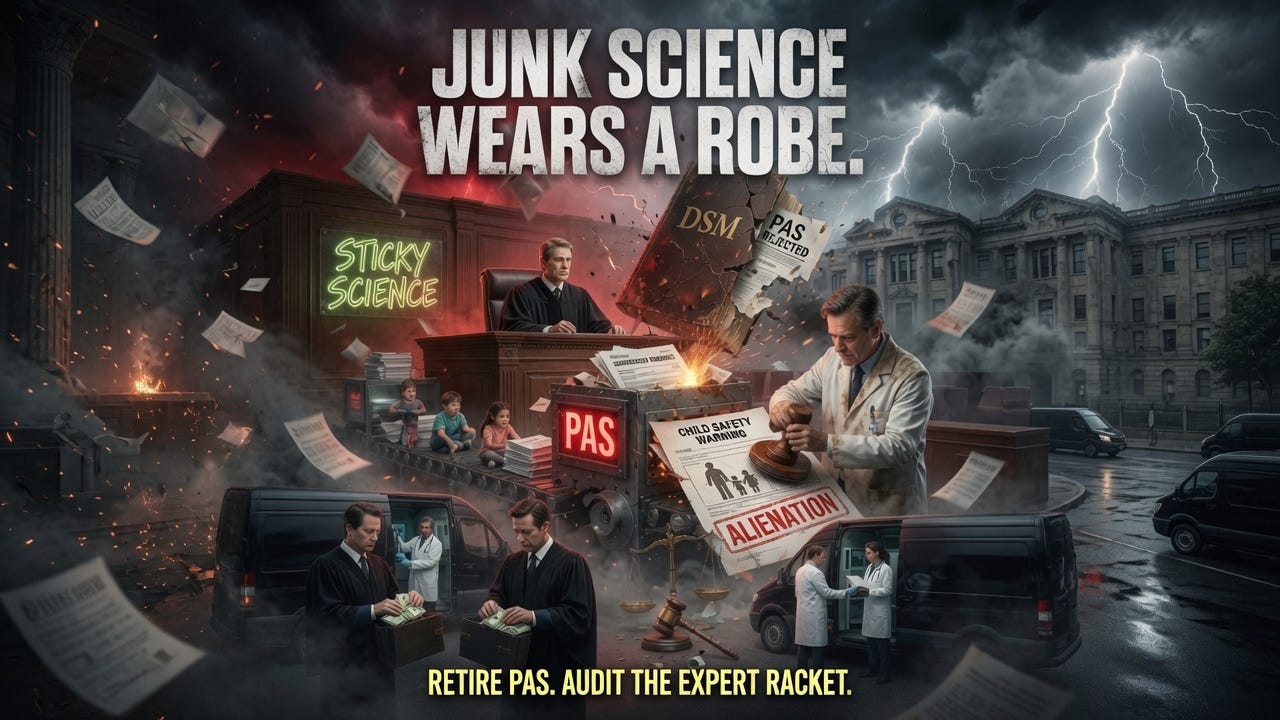
LUTHMANN NOTE: The fight is not men versus women, fathers versus mothers, or abuse claims versus alienation claims. That is the trap. The fight is evidence versus ideology. Family Court should not be a theater where one side yells “alienation,” and the other side yells “coercive control” until a child disappears into a billing pipeline. Prove the conduct. Prove the pattern. Prove the abuse. Prove the interference. But stop letting experts sell slogans as science. PAS is not sacred because courts repeated it. The robe does not make junk science holy. A special thanks to Martin G. Cawley for sending me the Nebraska Law Review article discussed below. This piece is ” Junk Science Wears Robes,” first available on The Family Court Circus.

By Richard Luthmann
The Junk Science Machine
I have watched Family Court perform the same magic trick again and again: turn fog into doctrine. Take a theory, dress it up in expert language, give it a billing code, repeat it in enough custody evaluations, and suddenly it walks into court wearing a lab coat. That is how junk science survives in the family-court machine. Not because it proves itself. Because the system finds it useful.

Parental Alienation Syndrome, or PAS, is the perfect specimen. H.A. Spitzer’s 2026 Nebraska Law Review article, “Sticky Science in Court,” explains the disease inside the courthouse: scientific ideas do not always enter court through peer-reviewed research. They slip in through expert reports, briefs, law-review citations, treatises, self-published materials, and recycled judicial opinions.
Frye, Daubert, and Rule 702 mostly police expert testimony, but they do not adequately police every side door by which pseudoscience becomes “authority.”
That is not an academic quibble. It is a custody grenade.
PAS was introduced in the 1980s as a theory that one parent could brainwash a child into rejecting the other parent, even to the point of fabricating abuse allegations. Spitzer notes that PAS “never had widespread scientific legitimacy,” was never included in the DSM, lacked empirical validation, and drew criticism for failing basic scientific standards.
Yet courts kept citing it anyway.
That is the Family Court trick. First, call it science. Then call it precedent. Then call the parent who objects unstable, hostile, alienating, or “high conflict.”
By the time the record catches up, the child is gone, the money is spent, and the expert has moved on to the next invoice.
Junk Science Wears Robes: The Courtroom Gospel
I do not have to invent the indictment. The American Bar Association already put it in plain English. Its Judges’ Journal article called PAS “30 Years On and Still Junk Science.” The ABA article says efforts were made to legitimize PAS by getting it into the DSM, but the theory has no objective way to verify its clinical claims and should not be admitted under established evidentiary standards.

That matters because Daubert is supposed to ask real questions: Can the theory be tested? Has it been peer reviewed? Is there a known error rate? Is it generally accepted?
PAS collapses under that pressure. It is too circular, too subjective, and too dependent on whoever gets to narrate the custody war first.
The broader public argument has now moved into two opposing trenches. On one side, critics of PAS argue that “alienation” can become a weapon against protective parents, especially when abuse allegations are reframed as manipulation.
On the other side, critics of the domestic-violence industry swallow ideology from the opposite direction: grant-funded narratives, activist training materials, gender-war assumptions, and one-size-fits-all “coercive control” scripts that can turn ordinary custody conflict into presumed abuse before the evidence is tested.
Still, some, like Don Dutton, challenge the claim that intimate-partner violence is always a one-way, gendered crime, emphasizing research on bilateral conflict and closer male/female rates of unilateral abuse than the mainstream often admits.
My point is not to replace one cartoon with another. Men can be abusers. Women can be abusers. Children can be manipulated. Children can also be telling the truth.
The courtroom sin is the shortcut. PAS is one shortcut. Ideological domestic-violence boilerplate can be another.
Family Court should not be running on slogans. It should be running on evidence.
Junk Science Wears Robes: Coercive Control, VAWA, And The New Witch’s Brew
The family-court machine loves moral panics because moral panics produce power, funding, trainings, task forces, experts, and fresh excuses to suspend ordinary proof.
That does not mean coercive control is fake. It means coercive-control claims, like alienation claims, need evidence, boundaries, and due process before they become custody dynamite.

Bettina Arndt’s piece “Coercive Control Con Job” attacks coercive-control laws as a new weapon against men and argues that the concept was promoted after evidence complicated the old men-as-perpetrators, women-as-victims model. She specifically criticizes Evan Stark’s theory and claims the law criminalizes poorly defined conduct on flimsy evidence.
That is one side of the debate, and it should be read as advocacy, not gospel.
The other side is not imaginary. Coercive control can be real, brutal, and hard to prove because it is often a pattern, not a punch.
A 2024 Guardian courtroom report described how English prosecutors struggle to distinguish criminal coercive control from ugly but noncriminal marital conflict, noting that these cases require evidence of patterns through texts, emails, records, and witnesses.
That is exactly the line Family Court keeps botching. The answer is not to treat every father as a batterer. The answer is not to treat every protective mother as an alienator.
The answer is to stop laundering ideology into science.
If coercive control is alleged, prove the pattern. If alienation is alleged, prove the conduct. If abuse is alleged, screen it seriously. But do not let any expert sell the judge a theory that outruns the facts.
Junk Science Wears Robes: Follow The Money, Find The Lab Coat
Family Court is a financial ecosystem built on confusion, endless motions, fake experts, custody evaluations, reunification therapies, supervised visitation, billing fights, and court-adjacent professionals who thrive when the conflict never dies.

Marketed “syndromes” are not just psychology. They are billing accelerants.
This is where the PAS racket becomes bigger than one theory. Family Court does not merely tolerate junk science. It creates a market for it.
A parent accused of abuse has an incentive to claim alienation. A custody evaluator has an incentive to diagnose complexity. A reunification therapist has an incentive to recommend expensive intervention. Lawyers have an incentive to litigate the mess until everyone is broke except the professionals.
The Wall Street Journal has reported on court-ordered reunification therapy that separates children from a parent they love, noting that parental alienation syndrome has never been officially recognized by major medical or psychiatric associations and that costs for programs can run from $8,000 to around $40,000, with aftercare fees layered on top.
There it is. The theory becomes the invoice.
Once the court buys the label, every normal act of protection can be reinterpreted as interference. Saving texts becomes obsession. Calling police becomes sabotage. Believing a child becomes coaching. Asking for supervised visitation becomes proof that the parent is “alienating.”
The theory does not illuminate the facts. It eats them. And once it eats them, the machine burps out a custody order, a payment schedule, and another child told that the adults in power know better than his own fear.
Burn The Lab Coat
Family Court does not need PAS. It needs evidence. Real evidence.
Specific conduct. Actual abuse screening. Competent forensic accounting. Qualified domestic-violence expertise. Medical documentation where appropriate. Judges who know the difference between science and salesmanship.
The fix is simple, but the industry will hate it.
No more syndrome labels unless they satisfy real evidentiary standards. No more custody flips based on pseudo-diagnostic jargon. No more “reunification” orders that cut children off from safe parents to repair relationships with dangerous ones. No more allowing court-appointed professionals to use scientific language without scientific discipline.
Courts can still examine whether one parent interfered with the other parent’s relationship. That is conduct evidence.
Did the parent block calls? Violate orders? Coach the child? Hide information? Make false reports?
Fine. Prove it.
Courts can also examine coercive control. Was there isolation, intimidation, financial domination, surveillance, threats, or punishment for noncompliance?
Fine. Prove that too.
Congress has already recognized the danger zone. Kayden’s Law, enacted through the 2022 VAWA reauthorization, creates incentives for states to improve custody procedures in abuse cases, restrict unsafe reunification programs, require better expert qualifications, and train courts on abuse dynamics.
The deeper problem is what Spitzer called “sticky science”: once bad science enters the legal network, courts repeat it, lawyers cite it, experts monetize it, and nobody builds a clean exit ramp. Spitzer’s article says PAS continued to influence legal outcomes after scientific rejection because courts filtered, repeated, and reinforced scientific claims over time.
The robe does not make pseudoscience sacred. The expert invoice does not make it true. The custody order does not make it safe.
Retire PAS. Audit the expert racket. Stop calling child safety “alienation.”

The biggest problem the biggest problem is right about when you start figuring out what the hell is going on it’s too late doesn’t take very long then you might as well just give up and you can’t live with yourself. Ain’t no one coming to rescue your children, but you that’s the fucking problem.