
Nicaea’s Echo – The Creed
Bishops, Emperors, and Eternal Truths Forged The Creed That Built the West

NOTE: This piece is also available at FLGulfNews.com.

By Greg Maresca
Anniversaries recall pivotal times. They are society’s way of dusting off selective memories and polishing them with partisan varnish, while romanticizing about collective harmony.
2025 has witnessed its share of significant anniversaries, including the 80th observance of the end of World War II and the dropping of the atomic bombs. The 60th birthday of the Voting Rights Act. The 50-year remembrance of the first summer blockbuster movie that transformed Hollywood: Jaws. The 45th anniversary of the U.S. hockey team’s Olympic upset over the Soviets and the 30th anniversary of Windows 95, which reconditioned computing.
One anniversary that received less recognition than all of them combined was the 1700-year observance of the Council of Nicaea and its resulting Nicene Creed, which not only advanced Christianity but also laid the foundation of Western Civilization.
In the fourth century, Arius led a movement that denied the divinity of Jesus Christ. To denounce the heresy, the Church convened a council of nearly 300 bishops from across the Roman Empire, with Emperor Constantine playing a pivotal role in organizing and supporting the proceedings at Nicaea in 325 (present-day Iznik, Turkey).
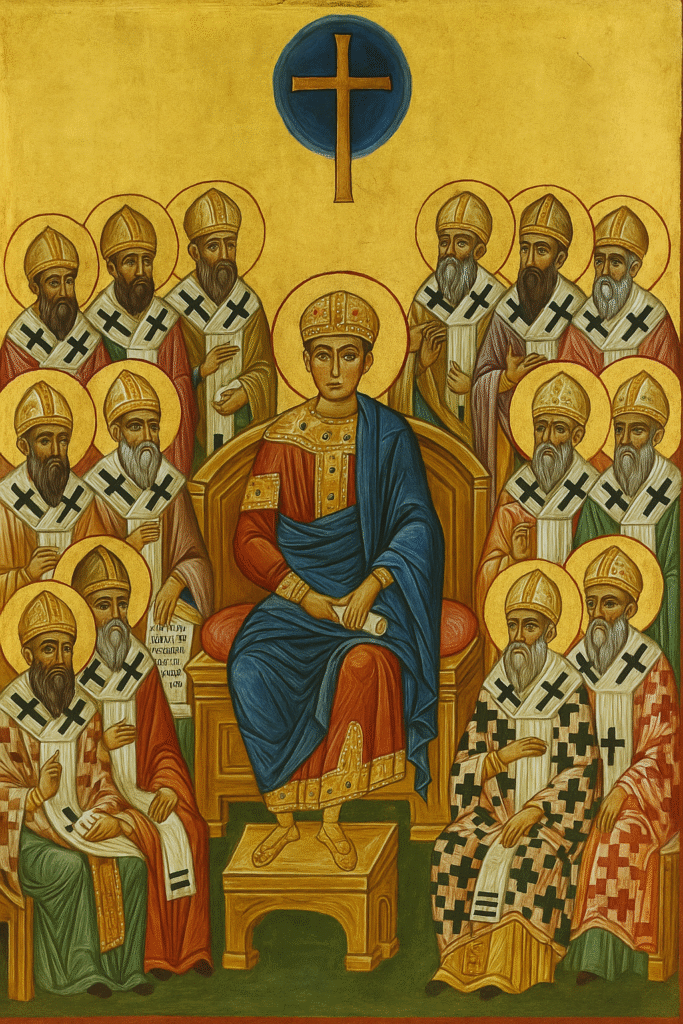
The Nicene Creed was the fruit of that council, having been born of scripture and tradition and forged in the fires of dogmatic debate; it is central to Christian doctrine. The Council Fathers codified Christian dogma, declaring that Jesus embodies both full divinity and full humanity.
“I believe in one God, the Father almighty, Maker of heaven and earth, of all things visible and invisible.” These opening words of the Nicene Creed are among the most important and oldest statements of Christian belief outside the Bible. In the Gospel of John, the first sentence clarifies that the Son is the agent of creation and the eternal God Himself.
C. S. Lewis describes this as the central event of human history, when the Son took on humanity in the form of a mortal body from the Virgin Mary and a soul untainted by Adam’s sin. Esus is the fulfillment of the ancient promise, “My dwelling place will be with them. I will be their God, and they will be my people.”
For a 4th-century declaration, the Nicene Creed serves as a foundational anchor for Christian doctrine across denominations.
Creeds endure because human nature desires clarity, cohesion, and continuity. Whether religious, philosophical, or political, creeds distill complex ideas into concise statements as formal declarations of shared values and truths. Creeds are concise enough to memorize and profound enough to shape and unify.
To the early Christians and to those who follow today, the Nicene Creed serves as the means by which believers are recognized amidst an array of pagans and heretics, while demonstrating unity with Christians around the world and throughout the centuries.
In a disposable, consumerist culture, the creed preserves ancient tradition, and reciting it is countercultural. In a world that encourages novelty, we repeat words spoken through the ages. In a society that often avoids commitment, the creed binds people together in a covenant with God and with one another. In an age that denies absolutes, we claim truths so vital that they must be repeated.
When we profess the Nicene Creed, we are part of that countless multitude throughout the centuries stretching back to the Upper Room in Jerusalem. This includes courageous martyrs, valiant theologians, heroic saints, and selfless missionaries — all of whom share the tradition given to us by the Apostles and handed down in the Church.
In November, Pope Leo XIV and Ecumenical Patriarch Bartholomew of the Eastern Orthodox Church will journey to Iznik, Turkey, to commemorate the council. While Catholic, Eastern Orthodox, and Protestant Christians still disagree on certain doctrines, this anniversary serves as a reminder of the bedrock truths that unite all Christians.
To believe is to belong.
A long time ago, a young Marine was informed by a Navy Chaplain that the Rifleman’s Creed will save your grove thing, while the Nicene Creed will save your soul.
Western Civilization has systematically divorced itself from the Nicene Creed. Among the pagan West, if the Nicene Creed were put to a vote, it wouldn’t pass. Anything less than a relationship with God will not sustain a soul or a civilization. The truths embedded in the Nicene Creed have the power to save the West, provided we believe and proclaim them.
 | A guest post by
|
Wonder what happened to Arius...
As a Jew I'm skeptical of the benefits of any aspect of Christendom and feel that Civilization occurred despite it not because of it and welcome a worldwide unified message of what the fuck. are we talking about as Christians today and who is the real Christianity considering there's 31,000 flavors it's overdue.
Trinitarianism is not monotheism nor is changing the day of the Sabbath following God's law and what's more the epitome of idol worship than statues of a dead Jew on a torture device worn on chains between ample breasts shown publicly or mounted to walls of christendoms varying entities worldwide.