

The Divorce That Never Ends
Michelle Feeney escaped the marriage in 2013. Connecticut Family Court keeps the war—and its professional ecosystem—alive in 2026.


LUTHMANN NOTE: A divorce decree is supposed to close a failed marriage, not establish a permanent government receivership over the family. Yet Michelle Feeney’s case survived every supposed ending: the 2013 judgment, later parenting agreements, professional interventions and repeated efforts at settlement. Each attempted solution generated new obligations, new disputes and new reasons for the same courthouse cast to remain involved. The machine did not extinguish the conflict. It processed it. It scheduled it. It appointed professionals around it. Then, in August 2025, an emergency ex parte order proved that thirteen years after the divorce, Connecticut could still turn Michelle’s parental life upside down without an ordinary evidentiary trial. This piece is “The Divorce That Never Ends,” first available on The Family Court Circus.

By Richard Luthmann
Final Judgment, Permanent Litigation
(STAMFORD, CONNECTICUT) – Michelle Feeney filed for divorce in 2012. The Connecticut Superior Court entered an uncontested dissolution judgment on February 19, 2013. By every ordinary understanding of the English language, the marriage was over. The parties were divorced. The judgment was final.
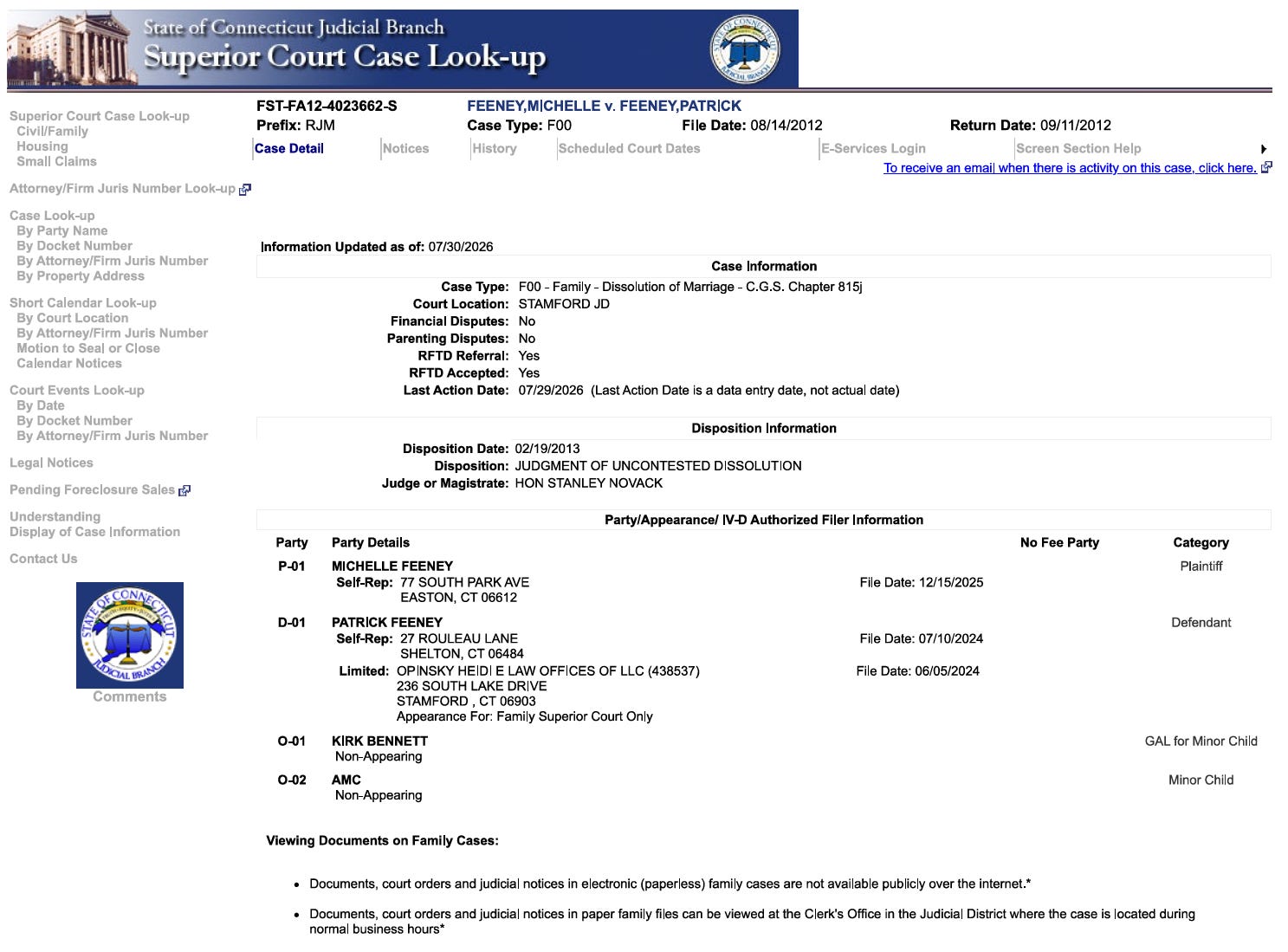
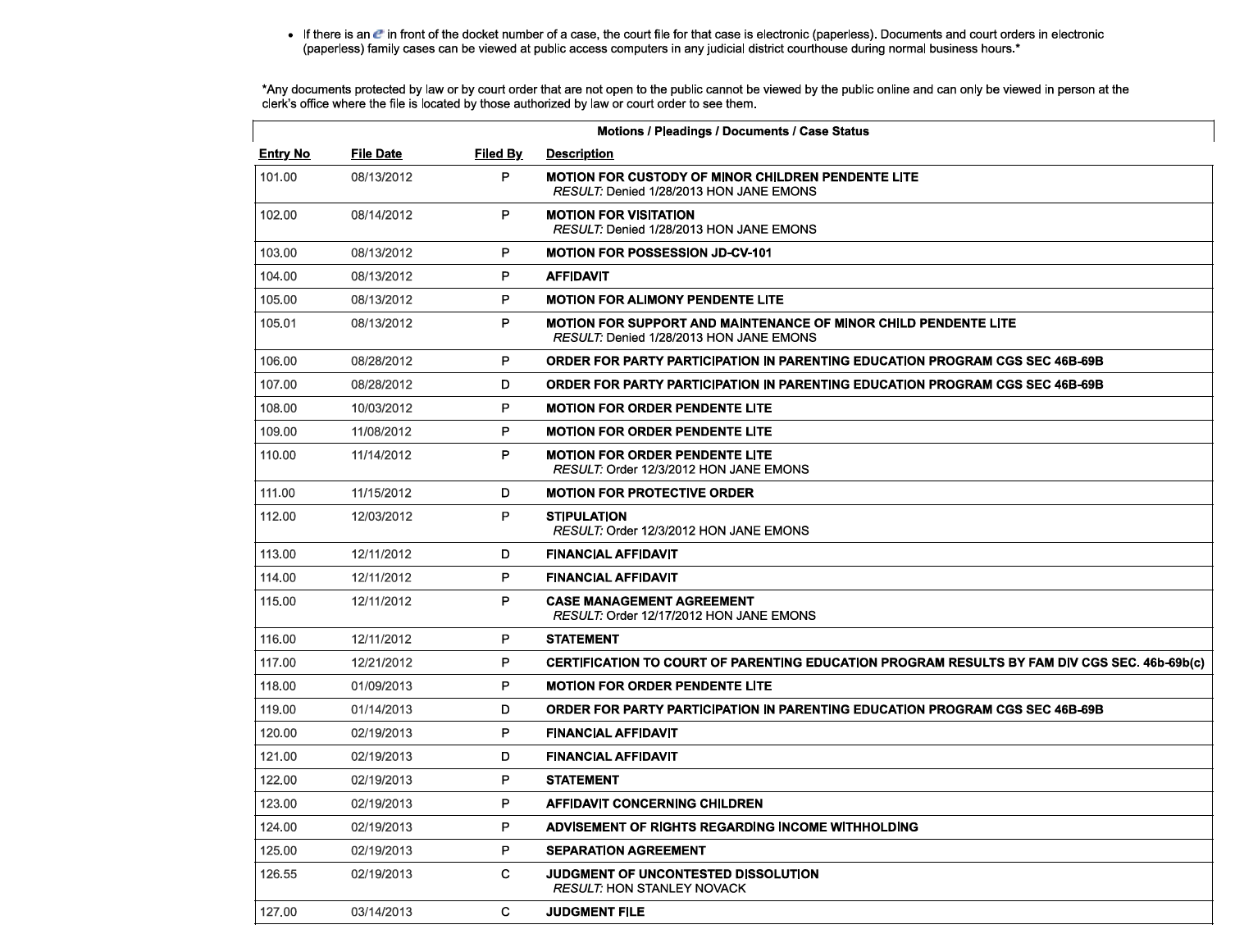
Yet thirteen years later, now in the summer of 2026, the same case remains active, still swallowing motions, affidavits, subpoenas, objections, contempt claims and requests for further judicial intervention. The docket has climbed past 500 entries. A case opened during Barack Obama’s first term was still producing hearings as America approached the 2026 midterms.
Connecticut called it post-judgment litigation. Michelle Feeney experienced it as a torture sentence without an expiration date.

The docket has become a decades-long battlefield of contempt motions, custody modifications, emergency applications, child representatives, lawyers, evaluators, therapists, parenting coordinators and repeated agreements that promised peace but delivered only another procedural checkpoint. The marriage ended, but the machinery built around the failed marriage kept expanding.
Every dispute could become a motion. Every motion could produce an objection. Every objection could trigger a hearing, continuance, professional appointment, new agreement or emergency request. The litigation became its own living institution, detached from the simple legal event that supposedly created it: the divorce.
The case did not simply involve Michelle and Patrick Feeney; it accumulated a professional cast around their child and their conflict:
Attorney Kirk Bennett appears in the docket as guardian ad litem for the minor child.
Heather Ehinger was written into the 2022 agreements as parent coordinator and family therapist—the professional the parties were repeatedly instructed to consult before returning to court.
Robert Horowitz was Michelle’s reunification therapist and required “substantial professional intervention” before disputes could supposedly become motions.
Dr. John Collins of New Haven, a psychologist, conducted the court-ordered custody evaluation. His underlying report is a central document.
Attorney Heidi Opinsky later entered a limited appearance for Patrick.
Attorney Scott Weston was designated in the California-relocation agreement to receive a $7,500 retainer to adapt the Connecticut arrangement to California law.
Attorney Nancy Aldrich, well known to avid readers of the Blog, urged additional legal action (surprise, surprise).
Matthew Maynard was Jack’s former therapist.
Tim Walsh was a later therapist.
Dr. John Samanich was a treating psychiatrist involved in medication communications.
These were not incidental bystanders. They formed the expanding ring of lawyers, child advocates, coordinators, evaluators and therapists through which a 2013 divorce remained institutionally alive more than a decade later.

Michelle’s central claim is blunt. Connecticut’s family-court system does not merely fail to stop destructive conflict. In cases like hers, she says, the process becomes the instrument through which conflict is prolonged, professionalized, and monetized.

The court does not extinguish the fire. It builds offices around it, schedules conferences beside it, and sends invoices through the smoke.
The parties may lose their savings, sanity, and children’s childhoods, but the case survives.
The Divorce That Never Ends: The Emergency Order That Changed Everything
The nightmare returned to full crisis mode in August 2025. Patrick Feeney filed an application for an emergency ex parte custody order alleging that Michelle had removed their son, Jack, from Connecticut, obstructed contact, failed to enroll him properly in school, neglected medical needs and isolated him from friends and activities.

The filing demanded immediate temporary sole legal and physical custody. It also sought severe restrictions on Michelle’s access and authority. The accusations were sweeping, urgent and framed in the language family courts are trained to fear: educational neglect, medical neglect, psychological harm and parental alienation.
The docket shows an August 20 application was denied. Nine days later, another emergency application was filed and granted.
In one stroke, a thirteen-year-old divorce case again became an emergency proceeding. Patrick obtained temporary custody without the ordinary full evidentiary contest that would accompany a final custody adjudication. Hearings were scheduled, moved, and continued.

Michelle says she appeared for dates that did not resolve the matter, then relied on the online docket, which indicated that an October hearing was marked off. She says Patrick later notified her by email that he had obtained sole legal and physical custody and did not intend to permit contact unless he approved it.
Michelle disputes the emergency allegations and says they can be disproved through school, medical, therapeutic, and communication records. This is precisely why the episode matters. A drastic order affecting the most fundamental relationship in a parent’s life was issued through an emergency process amid disputed facts, alleged notice failures, and procedural confusion.
The child became the territory. The docket became the weapon. A divorce finalized in 2013 had suddenly returned to the legal equivalent of martial law.
The Divorce That Never Ends: Peace Treaties Written on Court Paper
The August 2025 crisis did not erupt because the parties lacked agreements. They had agreements thick enough to stop a door. In February 2022, Michelle and Patrick entered a detailed modification governing custody, parenting time, exchanges, holidays, travel, education, medical care, communication and dispute resolution. The document said both parents would minimize Jack’s exposure to harmful parental conflict. It installed a parenting coordinator, established written decision-making procedures and provided that Michelle would retain final decision-making authority after the required consultation process had been exhausted.
The plan attempted to regulate nearly every foreseeable point of friction.

Months later, another sweeping agreement modified support and parenting arrangements in light of a proposed California relocation. That stipulation required Michelle to pay Patrick $300,000 as prepaid child support, fund a $15,000 annual travel account and assume extensive medical, educational and extracurricular expenses. It created procedures for travel, school schedules, vacations, baseball, missed parenting time, and professional intervention. It even required the parties to work through parenting coordination and mediation before returning to court.
Outstanding motions were supposed to be withdrawn. The document was not merely a parenting plan. It was a private constitution for a family that had already spent years being governed by judicial decree.
Yet the agreements failed at their central purpose. They did not end litigation. They became new sources of litigation.
Each detailed obligation created another potential allegation of breach. Each enforcement mechanism opened another route back to court. Each professional assigned to reduce conflict added another person, process, and expense to the architecture surrounding the family.

After the 2022 settlements came more emergency custody applications, contempt motions, clarification requests, caseflow filings, subpoenas and appeals; the ceasefire became another front.
Connecticut family court had accomplished the impossible: it transformed agreements designed to end litigation into fuel for continuing litigation.
The Divorce That Never Ends: Mental Illness, Money and Judicial Fuel
Michelle says the court’s gravest failure was its refusal to confront Patrick’s alleged psychiatric instability. Patrick disclosed mental-health diagnoses and suicidal ideation early in their relationship. She describes later episodes of paranoia, delusional thinking and extreme aggression, including an alleged 2018 episode involving beliefs that the FBI and business associates intended to harm him.

She further claims that a court-ordered custody evaluation identified bipolar disorder with psychotic features and recommended therapy before custody questions were revisited.
We contacted Patrick Feeney for comment. As of press time, we have received no response.
Michelle’s larger accusation is not dependent on armchair diagnosis. Her argument is that the system repeatedly treated extreme filings, serial emergency applications, courtroom belligerence and escalating accusations as ordinary “high-conflict” litigation. Instead of determining whether a litigant’s conduct reflected impairment, manipulation or genuine danger, the machinery accepted each new filing as another billable event to process.
Judges could schedule hearings. Lawyers could enter appearances. Guardians ad litem, coordinators, evaluators and therapists could remain embedded. The family could be placed under increasingly elaborate supervision without the system ever answering the most basic question: was continued litigation protecting the child, or feeding the pathology?
Money and power matter. A distressed litigant without resources eventually runs out of paper, lawyers, or stamina. A litigant with money can keep filing, hiring, and escalating.
The Connecticut model can reward endurance rather than truth because every new accusation forces the other parent to respond or risk losing by default.
Michelle’s case therefore raises a brutal institutional question. What happens when a wealthy and allegedly unstable litigant discovers that family court will convert every obsession into process? The answer may be sitting in a 500-entry docket.
The Connecticut Family-Court Machine
Michelle Feeney’s case is not merely a divorce story. It is a case study in how Connecticut family-court conflict can become self-perpetuating, with recurring emergency motions and repeat professionals keeping a family under continuing legal supervision long after the marriage itself ended.
The evidence is not hidden in rumor. It is visible in the docket’s sheer duration, the repeated emergency applications, the proliferating agreements and the continuing motion practice through 2026. Final judgment did not produce finality. It produced a permanent jurisdictional hook.
The court will say children’s circumstances change and custody orders must remain modifiable. That is legally true. No responsible person argues that courts should ignore genuine danger.
But continuing jurisdiction is supposed to be a safeguard, not an annuity. Emergency relief is supposed to address emergencies, not function as a recurring litigation strategy. Guardians, coordinators and evaluators are supposed to reduce harm, not become permanent fixtures around a child whose parents cannot escape the system’s orbit.
The Feeney series will examine how this happened. It will follow the post-judgment docket, the emergency custody pattern, the agreements that failed, the professional network surrounding the case and Michelle’s claim that allegations of mental instability were repeatedly subordinated to the family-court machine’s appetite for continued process.
It will test claims against documents, transcripts and witnesses.
It will identify what is proven, what is disputed and what the court never seriously addressed.
But the first fact requires no interpretation. Michelle Feeney divorced Patrick Feeney in 2013. In 2026, Connecticut was still administering their broken marriage.
The vows ended. The litigation did not.
And somewhere inside that contradiction is the business model of a system that claims to resolve families while keeping them permanently within reach.

Dickens wrote a story like this, but it was about probate court.
I’ve been a witness to this “dog and pony show” and it’s happening in every state…..every day….legalized extortion! Before anyone even thinks about getting a divorce they should watch a documentary called “DivorceCorp”. They explain how divorce in this country has become a billion dollar industry.