Luthmann Op-Ed: The Lawyers Blew It in NY-11 Redistricting
Nicole Malliotakis’ Inept Legal Team Hands Marc Elias the Keys to NY-11

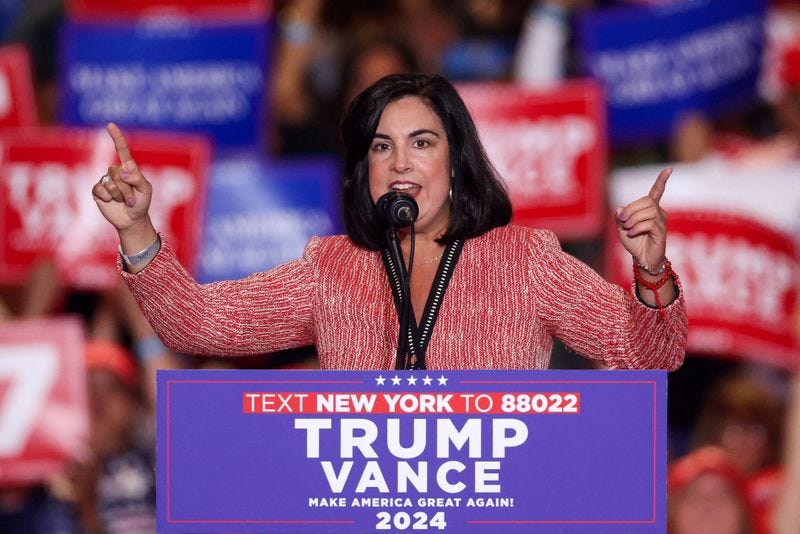
LUTHMANN NOTE: Let me be blunt: Nicole Malliotakis’ election lawyers got steamrolled by Marc Elias, and Staten Island is paying the price. This NY-11 redistricting ambush should’ve been removed to federal court on Day One. Instead, her lawyers left a constitutional fight in Manhattan state court, right in front of a Hochul-friendly judge, and watched Elias run the table. Now the map’s getting carved, the district’s tilting blue, and it’s fair to say “former Congresswoman” out loud. This wasn’t bad luck. It was legal malpractice in slow motion.

By Richard Luthmann
(STATEN ISLAND, NEW YORK) – Let’s get something straight right out of the gate: Nicole Malliotakis’ election lawyers got their lunch handed to them by Marc Elias — and it wasn’t even close. This wasn’t a knife fight. It was a surgical strike.
Elias walked into the New York Supreme Court with a clean, aggressive strategy. Bennet J. Moskowitz and Misha Tseytlin of Troutman Pepper Locke responded like guys still flipping through the rulebook.

They absolutely flopped this case.
This abject strategic failure is not hyperbole; it’s political malpractice with real consequences: if this redistricting decision stands, we might as well start calling Nicole the former Congresswoman of NY-11. They had an easy federal court win on removal grounds — a straight-up jurisdictional slam dunk — and they blew it.

Think about it: this was not some arcane state election dispute; this was a constitutional fight over a U.S. House seat. It directly alleges dilution of voting rights in a congressional district — the very thing federal courts are designed to decide.
Instead of hauling this case into a neutral federal forum and forcing the plaintiffs to prove their novel race-based theories under the Equal Protection Clause and the U.S. Voting Rights Act, Moskowitz and Tseytlin left it in the Manhattan Supreme Court of Jeffrey Pearlman — a judge with obvious political ties to Governor Hochul and the Democratic machine. That was strategic malpractice, plain and simple.

Now the political map is in shambles. Manhattan Supreme Court has ordered NY-11 redrawn — inserting lower Manhattan and carving out the Republican heart of Staten Island. This was done in the name of some highly dubious interpretation of the New York Constitution, basically the enshrinement of racial engineering and DEI in the electoral franchise.
That’s exactly where this case shouldn’t have been. A federal court would have thrown this out or at least set a stiffer bar: no sane federal judge is going to give plaintiffs a remedy that effectively hands a congressional seat to Democrats based on state law fictions.
But because Moskowitz and Tseytlin never sought removal, we’re staring at a decision that could flip what was once a safe Republican district.
Now it’s not too early for frank honesty: if this redistricting ruling stands, former Congresswoman Nicole Malliotakis is exactly what she’ll be. That’s not prediction, that’s arithmetic — the map as redrawn will almost certainly flip the district SAFE DEMOCRAT. Some say she’ll run against Chuck Schumer next; maybe that works out better for the GOP. Who knows? But right now, she’s a casualty of inept counsel.
It’s like watching your defensive line let the runner right through them and then complain about the scoreboard.
Here’s what her idiot lawyers should be saying right now: “We blew the removal. We blew the venue fight. We failed to protect our client’s federal rights. We own this.” Instead, they’re still pretending this was a fair state court fight.
Bullshit. It wasn’t.
It was lawfare cooked up by partisan operatives and validated by a judge planted right in the belly of the Democratic machine.
She should get her money back and tell these two idiots to f— off back to Chicago.
This could have been federal territory — where the Constitution, not political patronage, decides election disputes. They threw that chance away. And now Staten Island pays the price.
Let’s imagine for a moment that Moskowitz and Tseytlin weren’t morons. What could they say next?
Imaginary Memorandum of Law
Preliminary Statement
This imaginary memorandum is submitted in support of reversing the Decision and Order of the Supreme Court of New York County (NYSCEF Doc. No. 218) in Williams v. Board of Elections, Index No. 164002/2025 (Sup. Ct. N.Y. Cnty. Jan. 21, 2026). The trial court invalidated New York’s 2024 congressional map for the Eleventh Congressional District (“CD-11”), accepting Petitioners’ claim that the district’s configuration “unlawfully dilutes the votes of Black and Latino voters” in violation of Article III, § 4(c)(1) of the New York Constitution. Williams v. Bd. of Elections, Index No. 164002/2025, at __ (Sup. Ct. N.Y. Cnty. Jan. 21, 2026) (NYSCEF Doc. No. 218).
Article III, § 4(c)(1), adopted in 2014 as part of New York’s redistricting amendments, provides that legislative districts “shall not be drawn with the purpose or result of denying or abridging the voting rights” of any racial or language minority group. N.Y. Const. art. III, § 4(c)(1). The court concluded that, notwithstanding the growth of Staten Island’s combined Black and Latino population to approximately thirty percent—up from roughly eleven percent in 1980—minority voters are “routinely and systematically unable to influence” congressional elections in CD-11 due to racially polarized voting and the district’s continued configuration as a predominantly white, conservative-leaning constituency. Williams, Index No. 164002/2025, at __. On that basis, the court held that the existing configuration results in unconstitutional minority vote dilution and ordered CD-11 to be redrawn, endorsing Petitioners’ proposal to “pair Staten Island with voters in lower Manhattan to create a minority influence district.” Id.
Respectfully, the Decision and Order is legally erroneous. It extends the state constitution’s anti-dilution mandate beyond its intended scope, adopts a “minority influence” theory of voting rights that neither federal nor state law compels, and mandates a race-driven restructuring of congressional districts that violates the Equal Protection Clause of the Fourteenth Amendment. Petitioners’ own filings confirm that race is not merely a factor in their proposed remedy, but its central justification. The action explicitly demands a district configured along racial lines—joining Staten Island with Manhattan minority communities—for the express purpose of engineering an electoral coalition of minority voters.
Such a remedy would sever Staten Island from its longstanding geographic and political community of interest with Brooklyn and tether it to Manhattan, to which it is not even connected by land, solely to alter the racial composition of the electorate. This approach disregards traditional redistricting criteria—including respect for political subdivisions, geographic compactness, and communities of interest—and rests on precisely the type of racial stereotyping the Equal Protection Clause forbids: the assumption that voters of the same race think and vote alike. See Shaw v. Reno, 509 U.S. 630, 647 (1993).
The trial court’s ruling also raises serious federal constitutional concerns. Compelling the creation of a racially defined “influence” district where the minority population is well below a majority contravenes settled Supreme Court precedent. The United States Supreme Court has expressly held that § 2 of the Voting Rights Act “does not require” states to draw districts allowing a minority group of less than fifty percent of the population to “join with crossover voters to elect the minority’s candidate of choice.” Bartlett v. Strickland, 556 U.S. 1, 13–15 (2009). In Bartlett, the Court rejected mandatory crossover or influence districts and emphasized that a minority group unable to form a majority has “no better or worse opportunity to elect a candidate than any other group with the same relative voting strength.” Id. at 14–15.
Granting special legal protection to a thirty-percent minority group’s aspiration to form a winning coalition would impermissibly “grant special protection” not authorized by law. Id. The Decision and Order does precisely that, elevating a policy preference—maximizing minority electoral influence—into a constitutional entitlement. In doing so, the court not only misinterpreted New York law but also imposed a remedy that cannot survive strict scrutiny. A district drawn “for predominantly racial reasons” is presumptively unconstitutional. Miller v. Johnson, 515 U.S. 900, 916 (1995). Compliance with a state voting-rights policy, particularly one not required by the federal Voting Rights Act, does not license racial gerrymandering. Id. at 921.
As discussed below, even a sincere governmental interest in protecting minority voting rights must be “reasonably necessary under a constitutional reading” of the law; otherwise, race-driven redistricting “raises serious constitutional concerns” and fails the requirement of narrow tailoring. Id. at 921–22. Because no federal law required the creation of a minority coalition district in CD-11, the trial court’s race-centric remedy lacks any compelling justification and violates Equal Protection.
Finally, the proceedings below were marred by significant procedural defects that independently undermine the judgment. Petitioners filed this action in New York County by joining two Manhattan residents whose asserted grievance was that they “should be residing in” a Staten Island-based district. This tactic contravened New York’s statutory venue provisions governing apportionment challenges and constitutes blatant forum shopping. See Unconsol. N.Y. Laws § 4221. The proper venue for a challenge centered on Staten Island’s congressional district lies in the Second Judicial Department, such as Richmond or Westchester County.
By manufacturing venue in Manhattan, Petitioners deprived the case of a neutral, locally grounded forum—a concern expressly recognized in analogous redistricting litigation. See Harkenrider v. Hochul, 38 N.Y.3d 494, 523 (2022). Moreover, the Manhattan petitioners lack standing, as they do not reside or vote in CD-11. Their asserted interest in being moved into a different district to form a cross-borough coalition is not a cognizable injury under voting-rights jurisprudence, but a political preference. The inclusion of such nominal parties should not have conferred jurisdiction or dictated venue.
These procedural defects, combined with the substantive legal errors, independently warrant reversal or transfer. For the reasons set forth below, the Decision and Order should be vacated in its entirety.
The Trial Court Erred in Finding Racial Vote Dilution in Violation of Article III, § 4(c)(1)
No Legally Cognizable Vote Dilution Exists Because the Minority Population Cannot Form a Majority District.
Article III, § 4(c)(1) prohibits district lines drawn with the purpose or effect of “denying or abridging” the voting rights of a racial or language minority group. N.Y. Const. art. III, § 4(c)(1). This provision was modeled on, and intended to mirror, the protections of § 2 of the Voting Rights Act of 1965. In applying it, courts must adhere to the established framework for identifying actionable vote dilution, which requires, as a threshold matter, that the minority group be sufficiently large and geographically compact to constitute a majority in a single-member district. Thornburg v. Gingles, 478 U.S. 30, 50–51 (1986).
In Gingles, the Supreme Court recognized that where a minority group is too small or too diffuse to form a majority in a reasonably configured district, the electoral system cannot be said to have caused that group’s inability to elect candidates of choice. Id. at 50. New York’s 2014 constitutional amendment did not repudiate these principles; rather, it was understood as ensuring compliance with federal non-discrimination standards, not as creating a novel entitlement to electoral “influence” divorced from demographic reality.
Here, Petitioners did not demonstrate—and the court did not find—that Black and Latino Staten Islanders could form a majority of voters in any congressional district consistent with traditional redistricting principles. By the Petitioners’ own account, the combined Black and Latino population of Staten Island is approximately thirty percent. Even adding adjacent communities would not raise that figure anywhere near fifty percent. Thus, there is no configuration of CD-11 in which minority voters could outnumber white voters without importing a substantial number of external minority voters, precisely as Petitioners proposed by appending Manhattan.
Failure to satisfy the Gingles majority-minority precondition is fatal to a vote-dilution claim. The Supreme Court has unequivocally held that a minority group “must constitute a numerical majority of the voting-age population” before § 2 of the VRA requires creation of a remedial district. Bartlett, 556 U.S. at 18. Where a minority group comprises only thirty or forty percent of the population, it has “no better or worse opportunity to elect a candidate than any other group with the same relative voting strength.” Id. at 15.
The law guarantees equal opportunity, not proportional electoral success. Minority voters in Staten Island enjoy the same formal electoral opportunity as any other numerical minority: they may vote, organize, and seek coalitions, but they cannot demand that district lines be altered to ensure victory. Being outnumbered in a single-member district is not unlawful dilution; it is a demographic fact. Recognizing a dilution claim under these circumstances would grant a “special right to form political coalitions” not afforded to other voters. Id. at 15–16. Section 2 of the VRA “does not guarantee any possible electoral advantage that might accrue from minority voters’ unmet potential to join with other voters.” Id. at 14.
By disregarding this threshold requirement, the trial court entered legally unsound territory. Its reliance on the John R. Lewis Voting Rights Act of New York (“NYSVRA”) to excuse the absence of a majority-minority district was an error. The NYSVRA, enacted in 2022, cannot override constitutional and federal baselines. Article III, § 4(c)(1) does not mention influence or coalition districts; it addresses denial or abridgment of voting rights, concepts long understood to involve cracking or packing of cohesive minority communities.
No such conduct occurred here. Staten Island has historically been kept whole within a single congressional district due to its size, and the 2024 map preserves that configuration while pairing the borough with part of Brooklyn, consistent with geography and longstanding community ties. The map did not fracture or dilute any naturally majority-minority area; to the contrary, it preserved Staten Island’s largest minority community within CD-11. The fact that minority voters do not control election outcomes against a larger opposing electorate reflects demographics, not unlawful line-drawing.
Conclusion
The Supreme Court, New York County, erred as a matter of law and procedure. Its finding of minority vote dilution under Article III, § 4(c)(1) lacks a valid legal foundation, and its court-ordered remedy violates the Equal Protection Clause and fundamental principles governing congressional redistricting. The action was further compromised by improper venue and the inclusion of petitioners lacking standing.
Accordingly, this Court should reverse the Decision and Order in its entirety; uphold the validity of the 2024 congressional map for CD-11; vacate the injunction and remand order; or, in the alternative, transfer the matter to a proper venue for lawful consideration. The voters of New York are entitled to both fair representation and faithful adherence to constitutional limits. The decision below sacrificed the latter in pursuit of the former.