
The Man They Ran Out
Federal judge rejects DOE’s escape hatch in Frank Rose case


LUTHMANN NOTE: Make no mistake—this is a Biden-era scandal, top to bottom. Under the Biden administration, the Department of Energy decided that due process was optional and ideology came first. Frank Rose, a Senate-confirmed nuclear official with three decades of service, was not disciplined—he was politically purged. Seventeen days. No interview. No findings. No appeal. Just a shove out the door to satisfy optics and appease activists. That is not accountability. That is state-sponsored reputational destruction. The judge didn’t save Rose—he exposed a Biden bureaucracy that thought it could bypass the Constitution without consequences. Now discovery is coming, and the people who made those calls may finally have to answer under oath. This piece is “The Man They Ran Out,” first available on FrankReport.com.

By Frank Parlato
Last week, U.S. District Judge Paul L. Friedman denied the Department of Energy’s motion to dismiss Frank Rose’s lawsuit.
He ruled that Rose, the former second-in-command at the National Nuclear Security Administration, stated a valid claim that the government denied him due process.
As the case moves forward, the Department of Energy will have to account for a 17-day investigation that ended a 30-year career in national security.
The Man They Ran Out
Frank Rose is not a nuclear physicist. He is something arguably rarer—a 30-year national security veteran who understands both the weapons and the geopolitics that govern their use. As Principal Deputy Administrator at the NNSA, he co-led 60,000 personnel and a $24 billion budget. He negotiated missile defense agreements with NATO allies. Romania knighted him. The Defense and State Departments both awarded him their highest civilian honors.
He received the Department of Defense Exceptional Public Service Award (2001); the Office of Secretary of Defense Award for Excellence (2002); the Office of the Secretary of Defense Medal for Exceptional Civilian Service (2005); the State Department Superior Honor Award (2012); and the Ordinul National Serviciul Credincios (Knight) from Romania (2014) in acknowledgement for his role as the lead U.S. negotiator for the 2011 missile defense basing agreement.
In August 2021, Biden picked Frank Rose to be Principal Deputy Administrator of NNSA—the No. 2 position. The U.S. Senate confirmed him unanimously.
This is the man they ran out in 17 days over a joke and a lie.
The Oppenheimer Irony

Here is a grotesque irony.
In December 2022, Energy Secretary Granholm signed an order vacating the revocation of J. Robert Oppenheimer’s 1954 security clearance. It was symbolic; Oppenheimer had been dead for half a century.
Oppenheimer was the physicist who built the atomic bomb—the weapon that ended World War II and created the nuclear deterrence that has prevented great-power war ever since. However, after Hiroshima and Nagasaki, he urged restraint. He opposed the hydrogen bomb, arguing that a weapon a thousand times more powerful than the bombs he built had no legitimate military purpose—only the annihilation of cities. His caution did not fit the political moment. In 1954, the Atomic Energy Commission revoked his security clearance in a proceeding later recognized as a travesty of due process.
The order Granholm signed—spearheaded by Rose, who drafted the underlying memorandum—criticized the Atomic Energy Commission for denying Oppenheimer basic due process: secret communications with prosecutors, denial of access to evidence, and preventing him from answering the charges against him.
“Such political motives must have no place in our personnel security process,” Granholm said. “Living up to our ideals requires unerring attention to the fair and consistent application of our laws.”
Sixteen months later, the department’s handling of Rose’s case fell short of the standards Granholm herself had set. The man who helped write those standards became the test case for how seriously her department meant them.
The Man They Ran Out: Allegations—And Denials

Rose and his accuser, Kate Hewitt, had a history. Depending on whose version one believes, it was either that of an older boss and mentor to a young, ambitious, if not ruthless and devious woman, or a relationship where he was a lecherous, though not aggressive, dirty older man, and she, the victim of toxic masculinity.
Rose was Hewitt’s boss twice. One of them is lying.
First, they were together at the Brookings Institution, a Washington, D.C. policy research organization, in 2018-19.
According to Rose’s defamation lawsuit against Hewitt, she alleged that when at Brookings, Frank Rose:
“showed up in my cubicle at the Brookings Institution multiple times per day and stood uncomfortably close to me.”
“regularly read over my shoulder and purposely put his face within inches of mine.”
“made inappropriate comments about my appearance.”
“complimented my legs if I wore skirts or dresses.”
“showed an alarming interest in my love life and asked me about my dating life almost every day.”
“stared at my chest and legs during meetings and would occasionally reach over to touch my knee or leg.”
“came up behind me and touched my shoulder or back.”
“told me that he had inappropriate thoughts about me all the time.”
Rose says he never read over her shoulder or put his face within inches of hers, never made inappropriate comments, never commented on her legs or compared her to other women, never showed an interest in her love life, and never stared at her chest or legs. He denies ever touching her knee, leg, shoulder, or back, or telling Hewitt that he had inappropriate thoughts about her.
According to Rose’s complaint, Hewitt repeatedly bypassed supervisors at Brookings to get what she wanted. She went over her supervisor to a vice president to get her name on a report cover, violating established policy that research assistants’ credit appears in the acknowledgments.
When told to use personal leave for a conference, she bypassed her supervisor and went directly to the vice president again. This time, she did not get what she wanted.
In both cases, Rose counseled her to respect the chain of command. According to his complaint, Hewitt responded that she “didn’t need the administrative staff to tell her what to do.:
After Hewitt left Brookings in April 2019, Brookings promoted Rose to Co-Director—an unlikely outcome if a harassment complaint had been lodged against him.
Rose preserved two years of LinkedIn messages showing Hewitt sought his advice and help after she left Brookings—an unlikely pattern if Rose had harassed her.
Hewitt asked him for career advice and to meet. She sought, as the messages show, to use his connections and reputation to get ahead, including obtaining his reference, which, according to Rose’s complaint, “directly enabled her subsequent federal employment at the NNSA.”
To understand Hewitt and her possible justification for dishonesty, one needs to examine her professional philosophy, which she revealed once publicly on a panel about women in national security:
“This system, the National Security and the intelligence system, was not built by women, with women in mind. So the rules that we have to operate by were not made for us. And so I don’t feel like we should be held to them, to be totally frank with you. Women should not be held to the rules… You don’t have to play by the rules.”
Hewitt’s allegations arrived at a moment of institutional anxiety. Since the #MeToo movement, federal agencies have faced intense pressure to take harassment claims seriously and act decisively—pressure that, critics argue, has sometimes led to a presumption of guilt and the suspension of standard procedural safeguards.
Whether that pressure influenced how DOE handled Rose’s case is now a question for discovery.
The Timeline

Ironically, thanks in part to Rose’s reference, Hewitt was working at NNSA when Rose arrived as the agency’s second-in-command—her boss’s boss. For two years (2021-2023), while both of them worked at NNSA, Rose had no direct contact with Hewitt.
In 2023, Hewitt went on detail to the Department of Defense, on loan in effect. When her detail was coming to an end, Hewitt sought to extend it. NNSA’s communications office had 5 people doing the work of 10. Rose denied the extension due to staffing shortages.
Hewitt went around Rose to DOD leadership to find someone to pressure Rose into agreeing. Rose finally did extend her detail but put a cap on it—in effect requiring her to either get hired by the DOD, if that is where she wanted to work, or return to the NNSA.
Hewitt, in full retaliatory mode, claimed that Rose blocked her detail extension because she had once lodged a sexual harassment complaint she allegedly filed against him when they worked at Brookings.
Rose says he had never heard of any such complaint, for the probable reason that it never existed. The LinkedIn messages, which consistently sought his help, suggest Hewitt’s account is a fabrication.
It appeared that Hewitt was once again not following the rules, which she felt perhaps did not apply to her by virtue of her gender.
A DOE investigation into Rose began. It lasted 17 days. By April 2024, Rose chose to resign after receiving an explicit choice: Resign or be fired.
Days later, in May 2024, Hewitt went to Politico to tell her side of the story. She told them, then deleted her LinkedIn account and all the messages she had sent seeking Rose’s help.
She perhaps did not realize that Rose had screenshots of them.
The Man They Ran Out: Witnesses Saw Nothing

Hewitt had described a vulgar pattern of harassment at Brookings. Rose said it never happened.
Discovery in Rose’s lawsuits—he has one against the DOE, and another against Hewitt herself—will likely prove who the liar is.
There is evidence of a trail of lies: Hewitt worked in an open bullpen cubicle at Brookings, seated next to Adam Twardowski and Ariel Higuchi. Rose’s office was nearby, with Co-Director Mike O’Hanlon in the adjacent office. When Rose met with Hewitt in his office, “the door was open,” according to his complaint.
According to Rose’s legal filings, Twardowski, Higuchi, and O’Hanlon never “expressed any concerns with Rose’s behavior toward Hewitt or anyone else.”
Sources familiar with Rose’s workplace conduct told the New York Post that Hewitt’s allegations “surprised them” and “didn’t match their experience” with the “friendly, scholarly and at times ‘harmlessly awkward’” colleague.
“He had an open-door policy. He enjoyed kind of just mentoring relationships,” one source said. “I never observed anything that would suggest that there was any kind of harassing behavior.”
According to another source, Rose had never been informed of any wrongdoing at Brookings or NNSA.
The “Joke”

Beyond Hewitt’s allegations, the Politico article cited one, in the publication’s view, egregious incident. Politico reported:
“At an agency-wide meeting in December with hundreds of NNSA employees in a DOE auditorium or watching virtually, Rose recounted how a female foreign government counterpart had complimented NNSA’s work to him. He responded by telling her: ‘I love you, will you marry me?’ Some employees laughed at the remark, but it did not go over well with others who thought it was inappropriate.”
The Korean official to whom Rose commented was not present at the NNSA meeting where Rose told the story.
His point in telling it was that an official from another country appreciated how America’s nuclear role kept the entire world safe. He retold a remark he made, which he thought was mere repartee to her compliment. The Korean official reportedly laughed. She certainly did not complain.
No one would have known if Rose had not retold it himself.
If a woman had said ‘I love you, will you marry me?’ to a male counterpart who complimented her work, most likely no one would have blinked. The fact that this remark is treated as evidence of harassment reveals something about the climate in which Rose was judged.
The Man They Ran Out: The 17-Day Investigation
The DOE sought to avoid this lawsuit by arguing in court that Rose had resigned and therefore had forfeited his due process rights. Rose argued that on March 12, 2024, he was told the investigation was “completed.” No one would interview him. DOE Chief of Staff Christopher Davis wanted him “out” by the end of April. He could resign or be fired.
“What process was he supposed to wait for?” Rose’s lawyer asked the judge in their brief.
The Wrong Office
More than a little damaging to DOE’s case is that they picked—perhaps deliberately, as Rose’s lawyers argue—the wrong department to investigate Rose.
DOE has four offices with the authority to investigate harassment and misconduct allegations:
Anti-Harassment Program (AHP): Governed by DOE Policy Memorandum No. 102, it handles harassment complaints with established notice and response procedures.
Office of Civil Rights (OCR-EEO): Adjudicates discrimination-based harassment claims pursuant to 29 C.F.R. Part 1614, with complete EEO process and appeal rights.
Office of Inspector General (OIG): Under DOE Order 221.1D, investigates employee misconduct, abuse of authority, and retaliation.
NNSA Office of Internal Affairs (OIA): Conducts internal integrity and personnel-conduct investigations within the NNSA enterprise.
Each creates a record. Each has appeal mechanisms.
Instead, DOE assigned the Rose investigation to the Office of Hearings and Appeals (OHA)—whose jurisdiction is generally limited to FOIA appeals, security clearance hearings, whistleblower adjudications, and regulatory exceptions.
As Rose’s lawyers argued: “By bypassing the offices expressly empowered to manage harassment and misconduct complaints—the AHP, OCR-EEO, and OIG—and instead assigning OHA to conduct an unsanctioned ‘fact-finding,’ DOE acted outside its own governing framework and deprived Mr. Rose of the notice, response rights, and procedural safeguards those directives guarantee.”
The Man They Ran Out: Different Rules for Different Officials
Rose’s treatment becomes clearer when compared to that of other senior officials.

Guy Roberts (DoD, 2019): Accused of sexual harassment by multiple women. The DoD Inspector General took 10 months, interviewed 18 witnesses, reviewed 4,053 emails, interviewed Roberts personally, issued a Tentative Conclusions Letter, received his written rebuttal, and produced a 24-page report—even after Roberts resigned.
Rose’s investigation took 17 days. No emails reviewed. No interview despite four requests. No findings. No report.
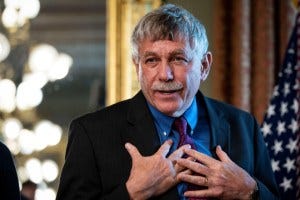
Eric Lander (White House, 2022): Accused of bullying. The Biden White House conducted a formal investigation. Lander was interviewed. Findings were issued with his resignation.

Sam Brinton (DOE, 2022): Arrested for three felony luggage thefts in three states. Video evidence. Search warrant. Stolen items recovered. DOE’s response? Brinton “departed the agency.” Three plea deals, zero jail time.
Roberts got 10 months. Lander got an investigation. Brinton got three plea deals. Rose got 17 days and a shove out the door.
Contradictions DOE Will Have to Explain
On March 12, NNSA Administrator Jill Hruby told Rose that the investigation was “completed” and that he would not be interviewed.
On April 10, Deputy General Counsel Jocelyn Richards said it “has not been completed.”
On May 29, Richards said it was “rendered moot by Mr. Rose’s retirement.”
Rose’s lawyers argue this contradiction proves DOE “had no intention of providing Rose with the process he was due prior to his constructive discharge.”
The Man They Ran Out: The Politico Story
Which brings us back to five days after Rose’s departure. Politico published “Sexual harassment allegations made against top Biden nuclear official,” citing “eight current and former government officials familiar with the matter, all of whom were granted anonymity.”
All eight sources are anonymous. Aside from Hewitt’s claims and the retold joke, the article cited no specific harassment incidents.
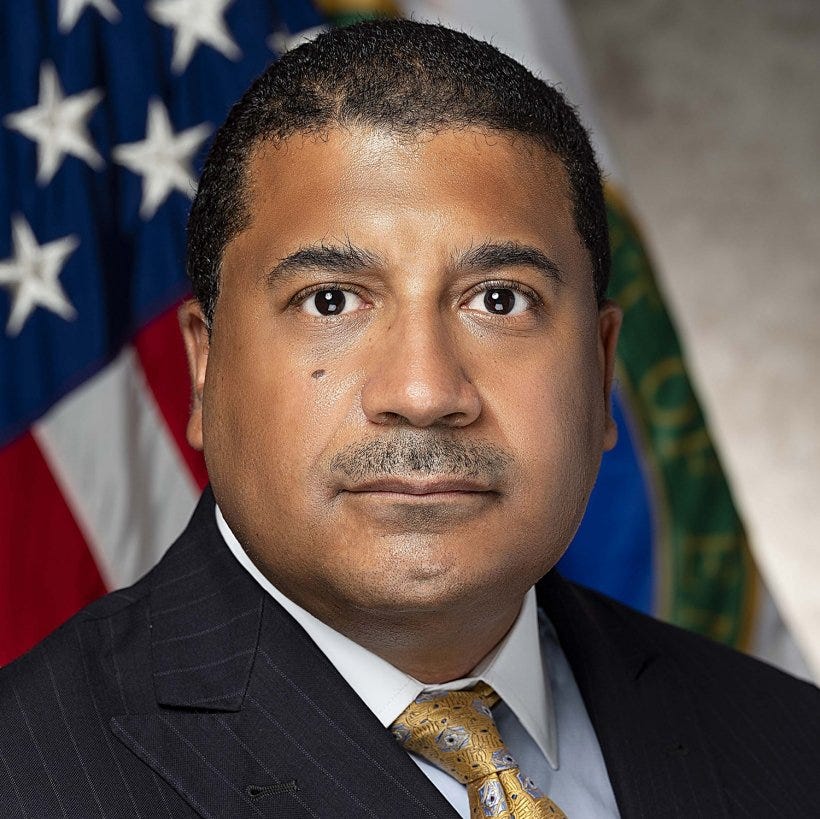
The article was reputationally ruinous, editorially sloppy, and dishonest.
Politico reported that Rose “delayed extending an intergovernmental detail of an NNSA employee who had lodged a sexual harassment complaint against him when they previously worked together at the Brookings Institution.”
Politico reported the Brookings complaint as fact. Brookings gave them no confirmation—only the standard “we don’t comment on personnel matters.” A responsible publication would have written: “Hewitt claims she filed a complaint; Brookings would not confirm or deny.”
The article gave Rose 137 words for his denial in a 1,100-word piece.
It never mentioned the best evidence that Hewitt was lying: The FBI background check.
Rose underwent a full FBI background investigation to secure the number two job at NNSA. Agents went to Brookings and elsewhere and found no record of any sexual harassment complaint.
How do we know? Because the results of the FBI investigation were provided to every one of 100 senators on both sides of the aisle. In a Biden administration, with its hotly contested policies, a man with workplace sexual harassment in his recent background would have stuck out as wildly controversial and unsuitable.
At his Senate confirmation, no formal vote was required. It was a voice vote, which means all 100 senators voted in favor of Rose.
What Discovery Will Reveal
With the procedural due process claim surviving dismissal, DOE will have to produce:
All documents related to the OHA “fact-finding.”
Communications between DOE officials about Rose.
The decision-making process for assigning OHA rather than OIG, AHP, or OCR.
Any findings, reports, or conclusions generated by the investigation.
Evidence of what was communicated to private sector employers.
Rose’s lawyers will be able to depose top Biden officials, such as:
NNSA Administrator Jill Hruby
DOE Chief of Staff Christopher Davis
Deputy General Counsel Jocelyn Richards
OHA Deputy Director Matthew Rotman
And perhaps former Secretary Jennifer Granholm herself.
The Man They Ran Out: Rose Was “Expendable”
NNSA, the agency responsible for America’s nuclear arsenal, is a semi-autonomous agency within the Department of Energy. Under Biden, the DOE, and hence the NNSA, shifted its priorities to diversity, equity, and inclusion. Rose focused instead on the core mission: designing, building, and maintaining nuclear weapons.
Biden’s DOE required every office to submit a formal “diversity plan,” a requirement that had not existed in previous administrations.
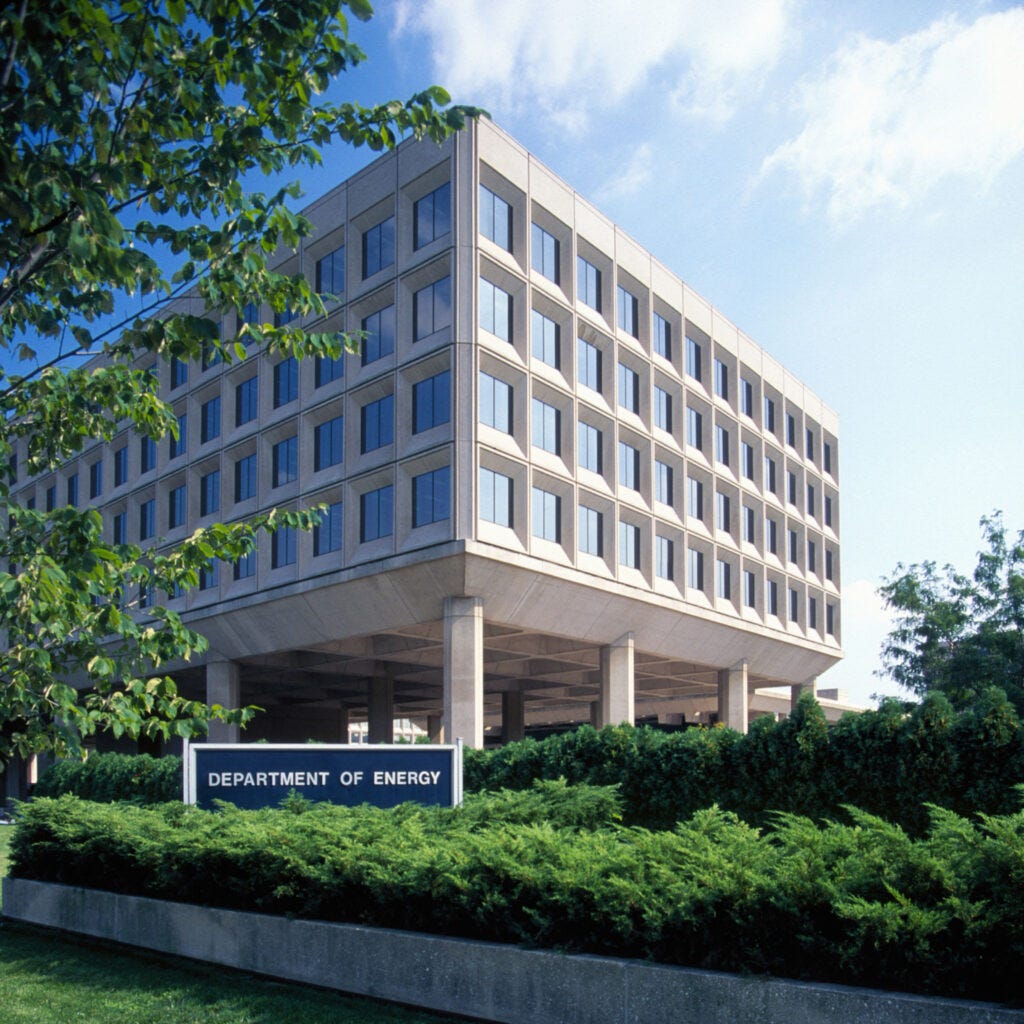
DOE’s Office of Defense Nuclear Nonproliferation conducted training on “neurodiversity” and other topics unrelated to nuclear weapons.
Within the Department, the vocabulary was changing. Training sessions appeared bearing titles that would once have seemed foreign to a weapons laboratory: “cognitive inclusion,” “workplace equity.”
The premise was that variation in temperament and perception should be accommodated rather than corrected.
Inside an agency built on exactness, where procedures exist because human variance is dangerous, Rose’s attitude was that nuclear work does not forgive error.
A warhead either functions as designed or it does not.
A protocol is followed or broken.
A mistake is not a lesson. It is a disaster.
There is no room for interpretation.
There is no margin for difference.
That is the culture Rose believed. It is why the weapons have never been used.
While Neurodiversity celebrates variation, nuclear deterrence survives by eliminating it. Rose’s position was not ideological. It was operational: Nuclear deterrence should not be a social experiment. The department’s Equity Office mandated DEI training for all senior managers. Rose never took it.
His view, of which he was, evidently, not shy about stating, is that when hiring people to maintain thermonuclear warheads, the government cannot compromise on competence. The talent pool is already tiny. If you add diversity requirements on top of security clearances, technical expertise, and psychological screening, you may end up with a pool of 0.
Nuclear weapons maintenance is one domain where the margin for error is so close to zero that even well-intentioned accommodation becomes an unacceptable risk.
Maybe do not let the dyslexic person (part of the neurodiversity inclusion efforts) who transposes letters read the arm/disarm instructions.
So, when Kathryn “Kate” Hewitt’s allegations surfaced, it is not improbable (and discovery may reveal it) that the Biden DOE leadership saw an opportunity to oust an official who had resisted their ideological program.
Granholm’s Vision

Behind this departure from defense and deterrence to social experimentation was Biden’s duly appointed Energy Secretary Jennifer Granholm.
Granholm had a curious record before Biden appointed her.
As Michigan governor, Granholm’s signature initiative was ‘green jobs.’ In 2006, she promised that in five years, Michigan’s economy would ‘blow you away.’ Six companies received $231 million to create 995 jobs; by 2013, they had produced 44. She promised 40,000 battery jobs by 2020; Michigan got fewer than 2,000. Under her leadership, Michigan led the nation in unemployment from 2006 through 2010.
She once held a press conference promoting $9 million in tax credits for a CEO who turned out to be a convicted embezzler living in a trailer. His parole officer saw the event and called the state.
Still, she was the “green leader” Biden chose to run the Department of Energy—an agency whose primary mission is maintaining America’s nuclear arsenal.
Granholm had no background in nuclear weapons. No national security experience. However, her passion was eliminating carbon emissions and building an “equitable economy,” and what better opportunity to lead the way than with the 60,000 people who are responsible for maintaining the nuclear arsenal?
At the time, China, which has no diversity programs, was engaged in the largest nuclear buildup since the Cold War. Russia, with its scant respect for neurodiversity, had suspended arms control agreements and threatened Ukraine. North Korea—with zero tolerance for gender fluidity—continued to expand its arsenal. Iran ignored inclusion in its nuclear efforts as it inches toward breakout capability.
Granholm’s nuclear department was different. One of her crowning achievements was the hiring of Sam Brinton, the genderfluid official she appointed to oversee nuclear waste storage. It was a milestone in inclusion. Brinton was later arrested in three states for stealing women’s luggage. Instead of solving where to store nuclear waste, he was solving where to store stolen women’s clothing.
Rose, on the other hand, supported mission-focused staff regardless of identity politics. He declined to participate in mandatory DEI training that had nothing to do with nuclear security.
The Man They Ran Out: The Course Correction
Granholm is gone. Her vision of a diversity-first nuclear department did not live beyond her tenure. The Trump administration reversed Biden’s DOE priorities.
Energy Secretary Chris Wright announced DOE is removing DEI requirements from contracting. “We just want the focus on technology and energy,” he said.
Wright’s NNSA Administrator, Brandon Williams, is a former Navy nuclear submarine officer who completed six strategic deterrent patrols aboard the USS Georgia.
In December 2025, NNSA completed the W88 nuclear warhead upgrade. Williams called it “the latest instance of NNSA delivering modernized nuclear weapons to the Department of War at the pace and scale needed to fulfill our deterrence requirements.”
“Restoring nuclear deterrence.” “Delivering modernized nuclear weapons.” “Pace and scale.” That’s mission focus.
It is what Rose was fired for insisting on.
The Secretary Who Signed Those Words
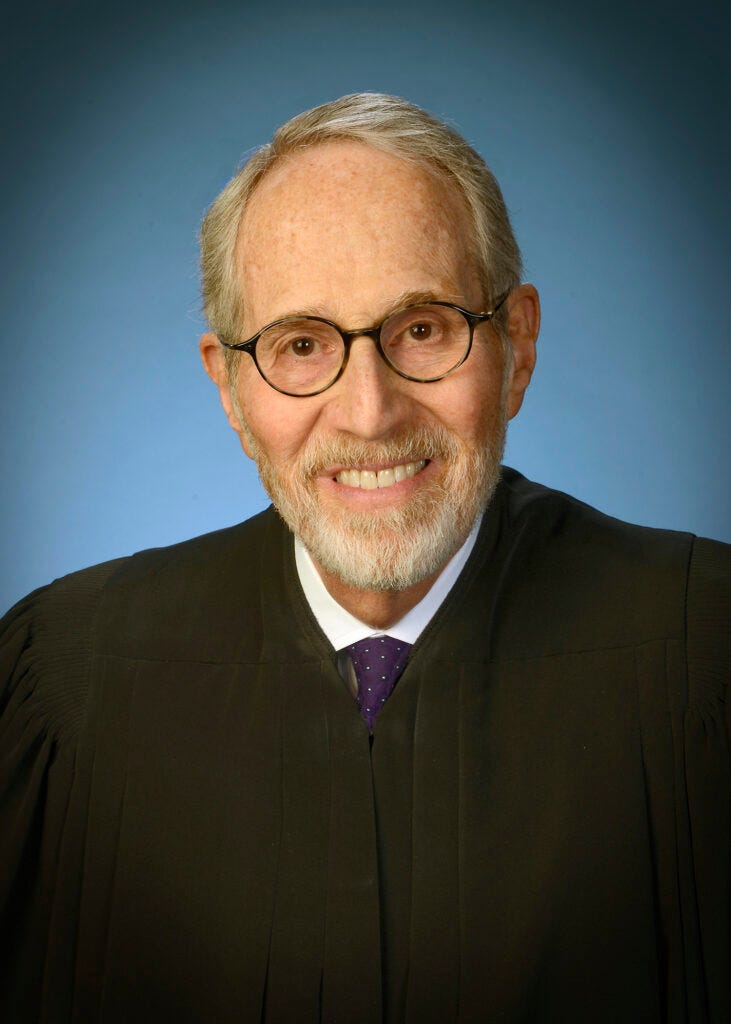
Judge Friedman’s ruling suggests he believes Rose’s questions deserve answers:
Can unsubstantiated allegations destroy a decades-long career in national security?
Does the government owe officials due process before destroying their reputations?
What happens when an agency deliberately routes a case to avoid the protections that jurisdiction would require?
Discovery will provide the answers.
If Granholm is deposed, she will have to reconcile the words she signed in December 2022—condemning the denial of due process to Oppenheimer—with what her department did to Frank Rose sixteen months later.
This is a deeper parallel. Oppenheimer built the bomb that ended one war and prevented others. Then he urged restraint on the hydrogen bomb—and was destroyed for it. His caution did not fit the political moment.
Rose spent 30 years ensuring the weapons that Oppenheimer made possible remained safe, secure, and ready. He urged focus on that mission and was fired for it. His priorities did not fit the political moment either.
Oppenheimer was rehabilitated 70 years too late. Rose is asking not to wait that long.

Previously published in our series.
