

Patrick Feeney’s Million Dollar Mystery
A crypto portfolio image appears to show more than $1 million. Family-court worksheets and medical reports tell a far less glamorous financial story, maybe one of dishonesty and mental illness.



LUTHMANN NOTE: Patrick Feeney of Shelton, Connecticut, submitted a gag motion that looks less like child protection and more like strategic censorship wrapped in the pretext of parental concern. His teenage son deserves genuine privacy; Patrick does not get immunity from scrutiny. A self-advertised hedge-fund and crypto expert cannot present modest support-income figures while a million-dollar portfolio screenshot hangs over the case, leave sworn concerns about his stability unanswered, and then demand that the courthouse punish future reporting. No court has adjudicated him a fraud or declared him mentally ill—not yet. But that makes evidence more necessary, not questions less permissible. Produce the financial records. Authenticate the crypto account. Address Matthew Maynard’s affidavit. Supply the relevant adult evaluation or a competent rebuttal. After thirteen years of family-court warfare, Judge Kowalski should protect the child without turning him into a human privacy shield. The courthouse cannot gag arithmetic—and Patrick Feeney cannot litigate his way out of answering the questions. This piece is “Patrick Feeney’s Million Dollar Mystery,” first available on The Family Court Circus.


By Rick LaRivière with Richard Luthmann
The Divorce That Would Not Die—And the Motion to Make Questions Disappear
(STAMFORD, CONNECTICUT) — Michelle and Patrick Feeney’s divorce sits before Superior Court Judge Ronald Kowalski in Stamford under docket FST-FA12-4023662-S. The Superior Court previously entered an uncontested dissolution judgment on February 19, 2013. Thirteen years later, the case remains trapped in postjudgment warfare, its docket swollen beyond 500 entries with contempt motions, emergency custody applications, professional appointments, discovery disputes and repeated attempts to renegotiate a family that Connecticut supposedly divorced long ago.
Now Patrick Feeney wants a gag order.

In an August 5 motion, he asks Judge Kowalski to prohibit Michelle from discussing broad categories of the family litigation with journalists while postjudgment proceedings remain pending. He seeks restrictions on medical, therapeutic, educational and custody information concerning their minor son; removal or requested removal of certain future publications; six months of parenting classes for Michelle; and a proposed $2,500 fine for every new article—or even a repackaged version of an existing one—that allegedly violates the order.
Patrick says the motion is about protecting his teenage son’s privacy and emotional welfare.
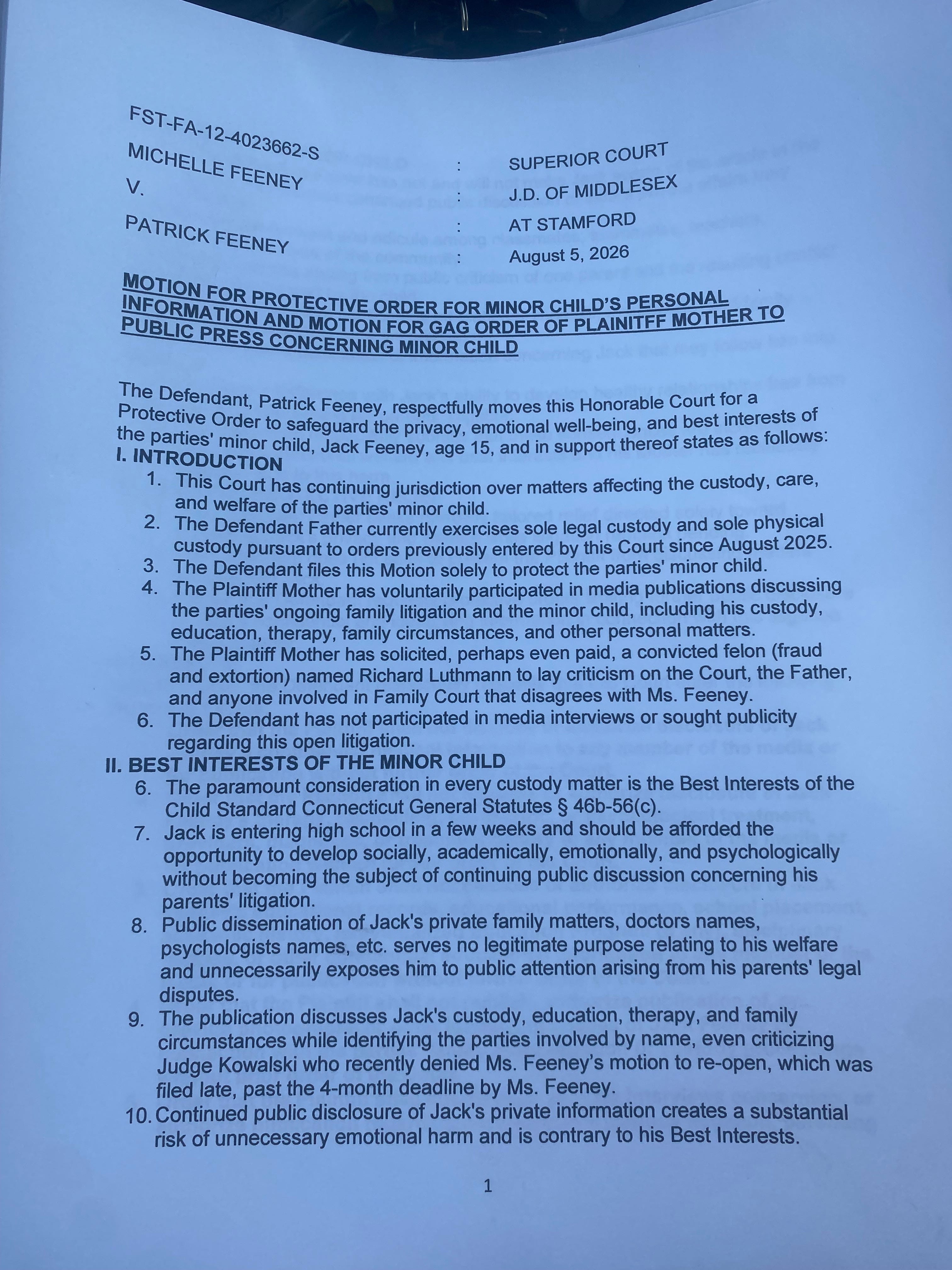
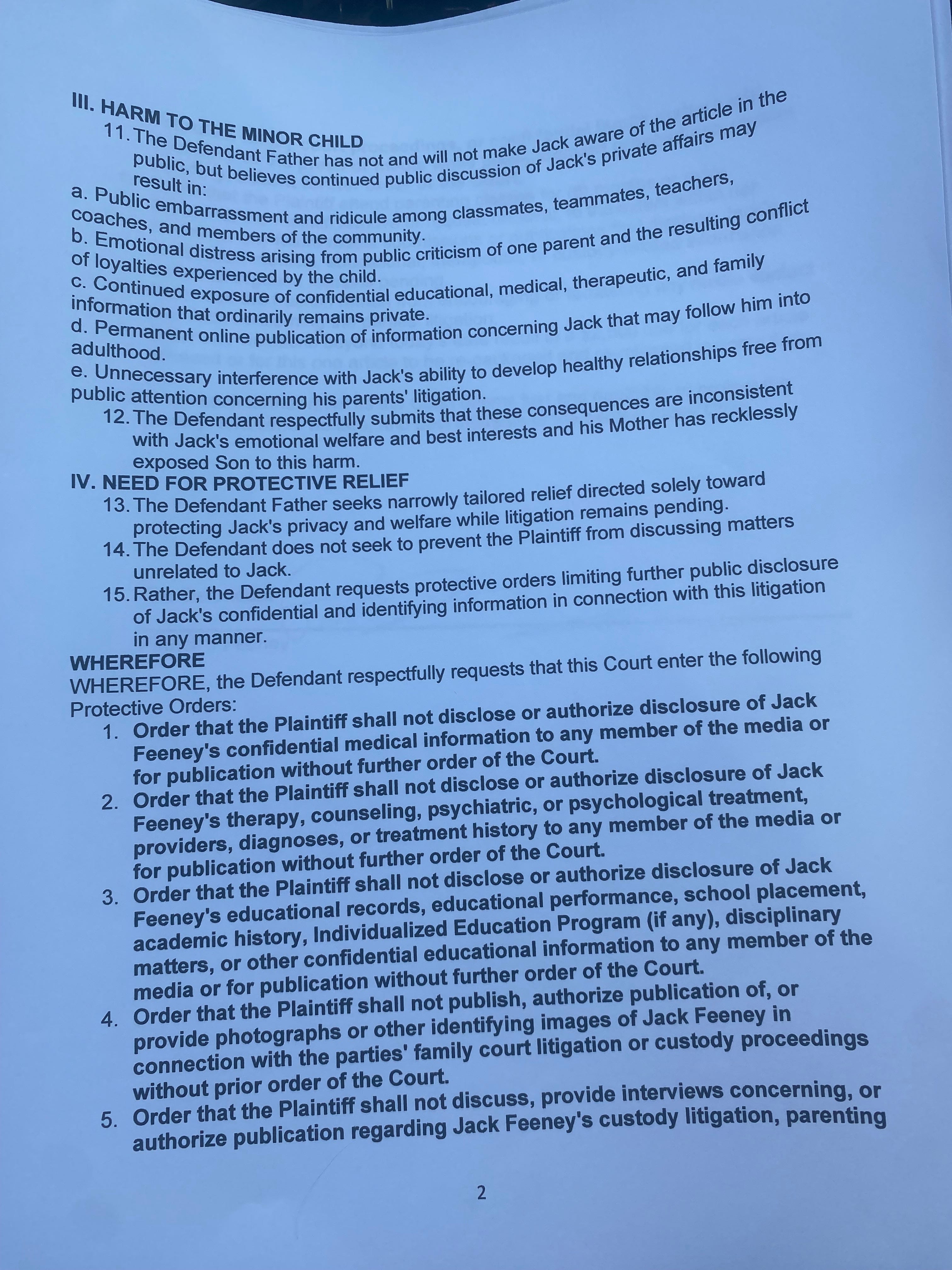
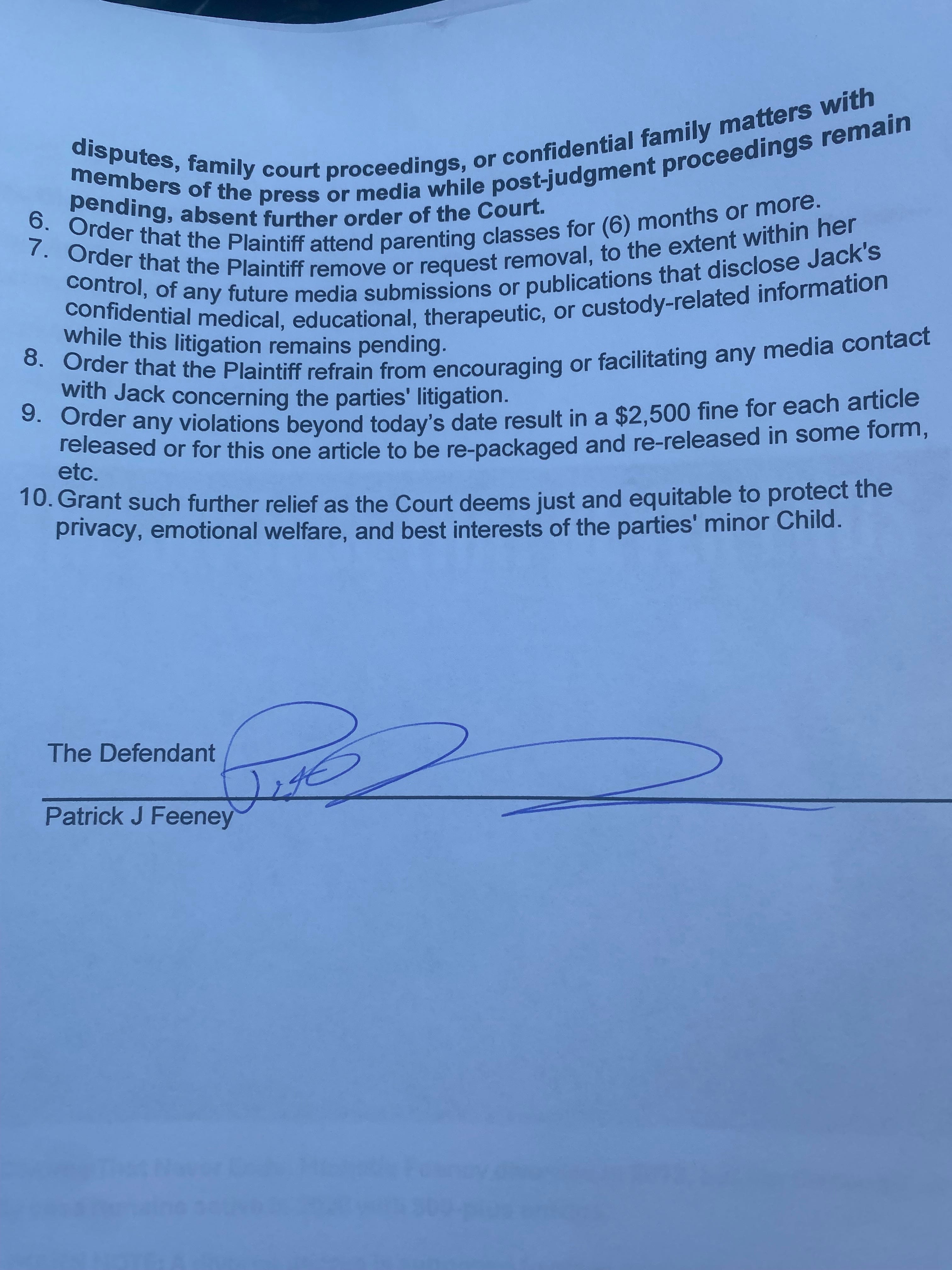
But Patrick’s motion reaches further. It attacks Michelle’s participation in media coverage, accuses her of having “perhaps even paid” journalist Richard Luthmann, and attempts to place future reporting under a judicial threat.
After thirteen years of litigation, the obvious question is unavoidable: Is Patrick protecting his child—or trying to make the questions about Patrick disappear?
Patrick Feeney’s Million Dollar Mystery: The Screenshot and the Poverty Math
Patrick publicly presents himself as a sophisticated money man. His “Feeney Factor” profile boasts more than 20 years trading at hedge funds and promises “proprietary algorithms” for stocks and crypto. It is also larded with pictures of him and his teenage son—the same one he asks Judge Kowalski to “protect” with a gag order.

Another profile says he created and sold Bitcoin Nation within ten months. Blockworks described him as a former quantitative hedge-fund portfolio manager.
The family-court numbers tell a less glamorous story.
A Blockfolio portfolio screenshot from 2021 shows a “Total Portfolio Value” of approximately $1.01 million, including $215,000 in U.S. dollars, 9.19 bitcoin, and approximately 135 ether.

Professional analysis shows that Patrick Feeney is worth millions.

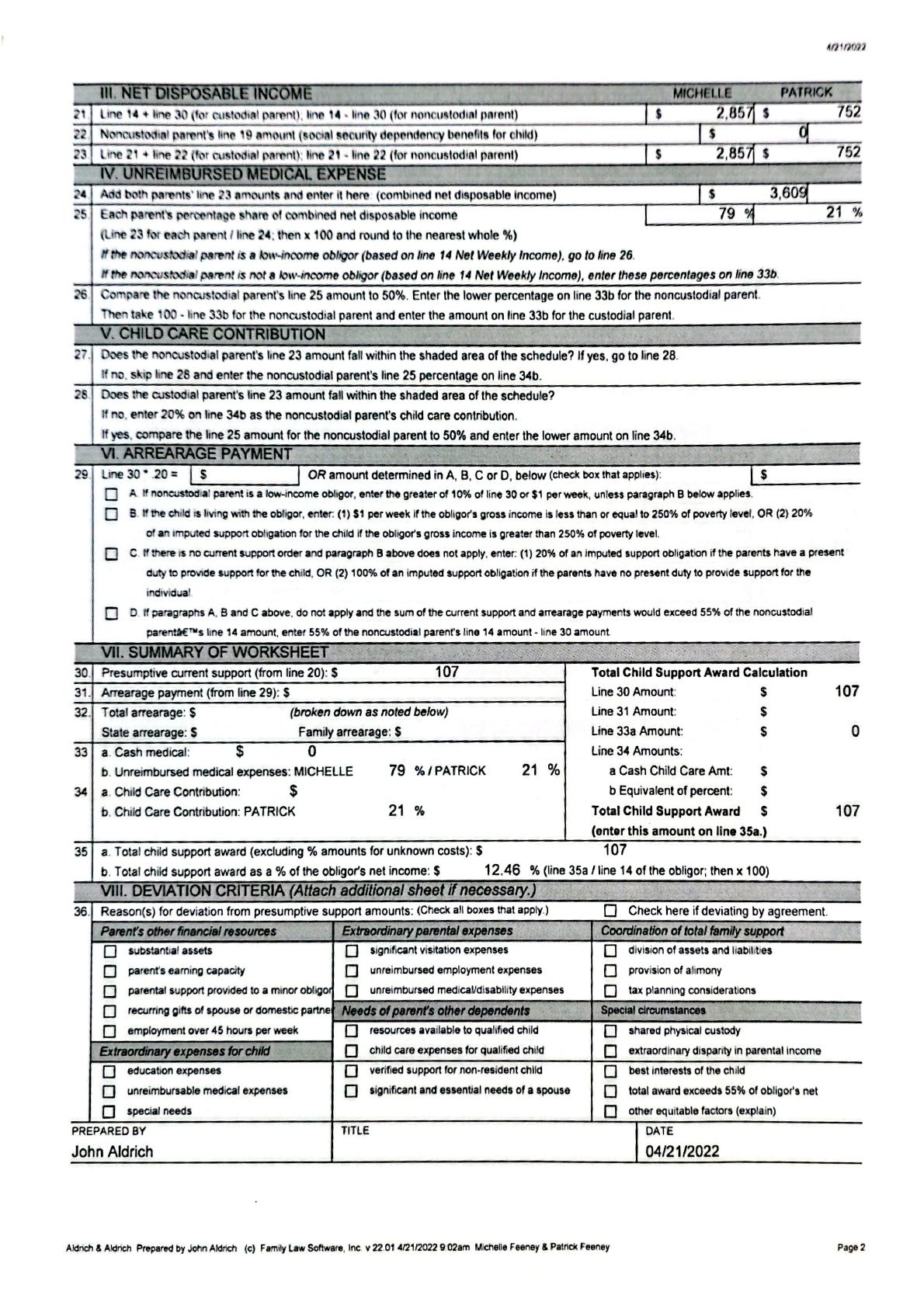
Meanwhile, in child-support worksheets from April 2022, Patrick used a gross weekly income figure of $1,096.

Michelle’s April 2022 contempt motion separately alleged that Patrick owed $5,736 in child support, $38,295.25 for his share of extracurricular expenses, $21,705.50 in guardian-ad-litem fees and other amounts. Another motion alleged that he failed to produce documents by a court-ordered January 4, 2022 deadline and had not updated a November 2021 financial affidavit.
Assets are not income, and a million-dollar display does not, by itself, prove fraud. But when a self-advertised trading expert presents modest support income while his former spouse produces a seven-figure portfolio image and alleges obstructed discovery, “trust me” is not an accounting method.
In Connecticut, “trust me” is a demand for forensic disclosure. It’s also Yiddish for “F-You.”
Patrick Feeney’s Million Dollar Mystery: The Mental-Health Record
Patrick also wants the court to stop Michelle from discussing treatment providers, diagnoses, and other psychological information involving their son, while Patrick uses the same teenager as a marketing tool.
In reality, it is Patrick’s own condition and conduct that is squarely at issue.

In a notarized 2019 affidavit, licensed marriage and family therapist Matthew Maynard wrote that he was “concerned about Patrick Feeney’s stability.” Maynard described Patrick’s speech as pressured, his focus and expression as tangential and defensive, and his reactions as increasingly “hostile and extreme.” He recommended a custody study. Those are sworn professional observations. They are not, standing alone, a psychiatric diagnosis.
In November 2022, parenting coordinator Heather Ehinger withdrew, describing an “unhealthy atmosphere” in which she felt “uncomfortable, threatened, harassed” and unsafe. Her letter was addressed to both parents and did not identify which one caused the atmosphere. It cannot be pinned exclusively on Patrick, but raises an additional red flag.

Michelle makes more explosive claims. She alleges that Patrick disclosed a cyclothymic diagnosis and suicidal ideation, later exhibited paranoia and delusional behavior, and was identified in a court-ordered custody evaluation as having bipolar disorder with psychotic features. She says the evaluator recommended treatment.
That distinction matters. “Mentally ill” remains a disputed question, not a published diagnosis. Yet Maynard’s affidavit is not gossip, Dr. Ehinger’s concerns cannot be lightly dismissed, and thirteen years of emergency filings cannot be erased by shouting “privacy.” Patrick can rebut the allegations, authorize release of his own relevant adult records, or identify contrary findings.
A gag order answers none of these concerns.
Patrick Feeney’s Million Dollar Mystery: The Crypto Prophet, the FTX Myth, and the Price of Silence
Patrick’s financial persona depends on projection: veteran trader, algorithm builder, bitcoin entrepreneur and market seer. CryptoSlate reported that he claimed he had escaped the FTX collapse by studying Sam Bankman-Fried’s body language.


An Instagram capture contains an FTX-sponsored advertisement. Patrick’s November 6, 2022 caption says: “FTX sign up? Nah. Head for the door.” That evidence tends to show that he avoided the SBF scandal and probably retained substantial crypto assets, none of which have been disclosed to Judge Kowalski.
The evidentiary record establishes an unmistakable collision between Patrick’s public branding and an unresolved family-court record: sworn professional concern about his conduct, disputed mental-health allegations, and a thirteen-year litigation campaign now accompanied by a request to restrict future speech.
Connecticut’s Supreme Court has warned that a gag order can improperly penalize future expression as a prior restraint. See Lafferty v. Jones, 336 Conn. 332 (2021) (discussing the danger that a gag order may improperly penalize future speech as a prior restraint).
Child privacy can justify narrow protections. It does not automatically justify suppressing scrutiny of an adult litigant who himself comes to the court with unclean hands.
Patrick Feeney’s Million Dollar Mystery: Questions Unanswered
Patrick Feeney did not respond to a request for comment before publication of “The Divorce That Never Ends.” We sent detailed questions and gave him every opportunity. Here is what we asked:
From: Richard Luthmann <richard.luthmann@protonmail.com>
Date: On Monday, July 27th, 2026 at 2:57 PM
Subject: REQUEST FOR COMMENT: “The Divorce That Never Ends” — Feeney v. Feeney
To: patrickfeeney@hotmail.com
CC: RickLaRiviere@proton.me, RALafontaine@protonmail.com, mthomasnast@protonmail.com, frankparlato@gmail.com, frankiepressman@protonmail.com, mvolpe998@gmail.com, juliea005@proton.me, msully0916@gmail.com
Mr. Feeney:
We are a group of independent journalists preparing a reported series on Feeney v. Feeney, Connecticut Superior Court docket FST-FA-12-4023662-S.
The working title is: THE DIVORCE THAT NEVER ENDS – Michelle Feeney escaped the marriage in 2013. Connecticut Family Court keeps the war alive in 2026.
The Divorce That Never Ends

LUTHMANN NOTE: A divorce decree is supposed to close a failed marriage, not establish a permanent government receivership over the family. Yet Michelle Feeney’s case survived every supposed ending: the 2013 judgment, later parenting agreements, professional interventions and repeated efforts at settlement. Each attempted solution generated new obligations, new disputes and new reasons for the same courthouse cast to remain involved. The machine did not extinguish the conflict. It processed it. It scheduled it. It appointed professionals around it. Then, in August 2025, an emergency ex parte order proved that thirteen years after the divorce, Connecticut could still turn Michelle’s parental life upside down without an ordinary evidentiary trial. This piece is “The Divorce That Never Ends,” first available on
The public docket shows that the divorce was filed in 2012, finalized by uncontested judgment in February 2013, and remained active through 2026 with more than 500 docket entries. Those entries include repeated contempt motions, custody modifications, emergency ex parte applications, subpoenas, professional appointments, parenting agreements, and continuing post-judgment proceedings.
We intend to report extensively on the August 2025 custody episode. Court records show that an emergency application filed on August 20 was denied and that another application filed on August 29 was granted, resulting in temporary sole legal and physical custody being awarded to you. Michelle Feeney disputes the allegations in your application and claims that school, medical, therapeutic, and communication records contradict them. She also alleges that notice and scheduling problems prevented a timely, meaningful contest before her relationship with her son was drastically restricted.
We are offering you a full opportunity to respond.
Please address the following:
1. Why did you seek emergency sole custody in August 2025, and what evidence supported each allegation of educational, medical, and psychological harm?
2. Why was a substantially similar application filed nine days after the August 20 application was denied?
3. What materially changed between the denied application and the application that was granted?
4. Did you inform the court that the earlier application had been denied? Please identify where that disclosure appears in your filing.
5. Michelle claims that the child was attending school, activities, and treatment and that your allegations can be disproved by third-party records. What is your response?
6. Why did you seek to prevent or sharply restrict Michelle’s contact with the child rather than request narrower relief pending a full hearing?
7. When and how did you notify Michelle that you had obtained temporary sole custody?
8. Did you oppose unsupervised telephone, electronic, or in-person contact between Michelle and the child? On what factual and clinical basis?
9. The docket reflects numerous emergency custody applications over several years. How many did you file, how many were granted, and why was emergency relief repeatedly necessary in a case governed by detailed parenting agreements?
10. The 2022 agreements required parenting coordination and, in some circumstances, mediation before renewed litigation. Did you complete those procedures before filing the August 2025 application? If not, why not
11. Michelle alleges that you have used repetitive filings, wellness checks, reports and emergency applications to continue the conflict long after the divorce ended. What is your response?
12. Michelle has also made serious allegations concerning your mental-health history, including prior suicidal ideation, paranoia, psychiatric diagnoses and findings allegedly contained in a court-ordered custody evaluation. Do you deny those claims? Did the evaluation recommend that you participate in therapy before custody was reconsidered?
13. Do you authorize release of the relevant portions of the custody evaluation, treatment recommendations and hearing transcripts so the public can assess those competing claims?
14. How much have you spent on lawyers, evaluators, therapists, coordinators and other family-court professionals since the 2013 judgment?
15. Do you believe thirteen years of post-judgment litigation has served your son’s best interests? What, in your view, would finally end the case?
Please provide any responsive court orders, transcripts, school records, medical communications, emails, or other documents you believe correct the record. Material submitted on the record may be quoted or published.
We will accurately report your position and will distinguish established facts, disputed allegations, and personal opinion. A refusal to respond will also be noted.
Please reply as soon as possible, as we seek to go to press soonest. If we do not hear from you until after press time, we will incorporate your responses into a follow-up.
Thank you for your attention to this matter!
Regards,
Richard Luthmann
Writer, Journalist, and Commentator
Tips or Story Ideas:
(239) 631-5957
richard.luthmann@protonmail.com
LINKTREE
Muck Rack Profile
Substack: This is For Real.
Editor-In-Chief: FLGulf.news
Editor-In-Chief: NYNewsPress.com
Editor-In-Chief: TheFamilyCourtCircus.com
Contributor: Frank Report
Contributor: Sun Bay Paper
Follow Me on Facebook X Instagram LinkedIn TRUTH Rumble Newsbreak SPOTIFY YouTube
Sent with Proton Mail secure email.
Patrick Feeney’s August 5 motion is now his loudest documented response: stop Michelle from talking, constrain the press pipeline, and attach a price tag to future coverage.
That is not exoneration. It is gasoline.
A Family-Court ‘Forever War’ With No Exit Strategy
Patrick Feeney’s motion does not close this file. It opens another front. A divorce entered in 2013 has consumed thirteen years of postjudgment motions, emergency applications, evaluators, therapists, coordinators, lawyers and labor. Now the courthouse is being asked to supervise what Michelle may say about the machinery that kept the conflict alive.

That is mission creep with a docket number. Every supposed ceasefire produced another dispute. Every professional intervention became another layer of process. Every emergency filing forced a response, another appearance and another expenditure.
The original marriage ended; the war acquired its own bureaucracy, vocabulary and survival instinct.
“If Patrick Feeney wants the questions to end, the answer is not censorship. Produce the financial records. Address the affidavit. Supply the adult evaluation or a competent rebuttal. And explain the discrepancies,” Richard Luthmann said. “This case has the feel of a family-court ‘Forever War,’ dragging on with no purpose and no end in sight. Everyone wants answers.”
The demand is not complicated. Patrick can authenticate or disprove the million-dollar portfolio screenshot. He can identify what assets were disclosed and when. He can answer Maynard’s sworn observations with competent evidence. He can produce the relevant adult evaluation, identify contrary findings, or explain why Michelle’s account is false. Connecticut law already has the mechanism in place.

Billington v. Billington, 220 Conn. 212 (1991) fits Patrick Feeney’s financial record with uncomfortable precision. Connecticut’s Supreme Court held that parties in domestic relations matters owe the court and each other “full and frank disclosure,” and that a material misrepresentation of assets or income strikes at the heart of the judicial process.
If the million-dollar portfolio screen is authenticated—and if Patrick failed to disclose those assets when submitting financial affidavits, negotiating support agreements, or obtaining financial orders—the court should not limit itself to calculating obligations prospectively. It should go back and examine every stipulation and order materially affected by the alleged nondisclosure, particularly the 2022 support proceedings.
Billington eliminated any argument that Michelle Feeney should lose because she failed to discover the deception sooner: the duty belonged to the person legally required to disclose the assets. Silence, concealment, and false financial affidavits cannot become permanent merely because the courthouse once relied upon them.
None of that requires exposing the child’s confidential school or treatment records. Patrick is entitled to contest every accusation. He is entitled to seek narrowly tailored protection for his son.
He is not entitled to transform “child privacy” into an evidentiary blackout over his own finances, behavior, or public claims. Nor is child privacy a shield for fraud on the court.
A family court is supposed to decide disputed facts, not make the questions disappear.
Patrick Feeney seeks a protective order, but he cannot ask Judge Kowalski to sanction the truth from coming out while he has unclean hands in his own disclosures. The courthouse cannot gag arithmetic—and silence cannot audit a million-dollar screenshot.
