


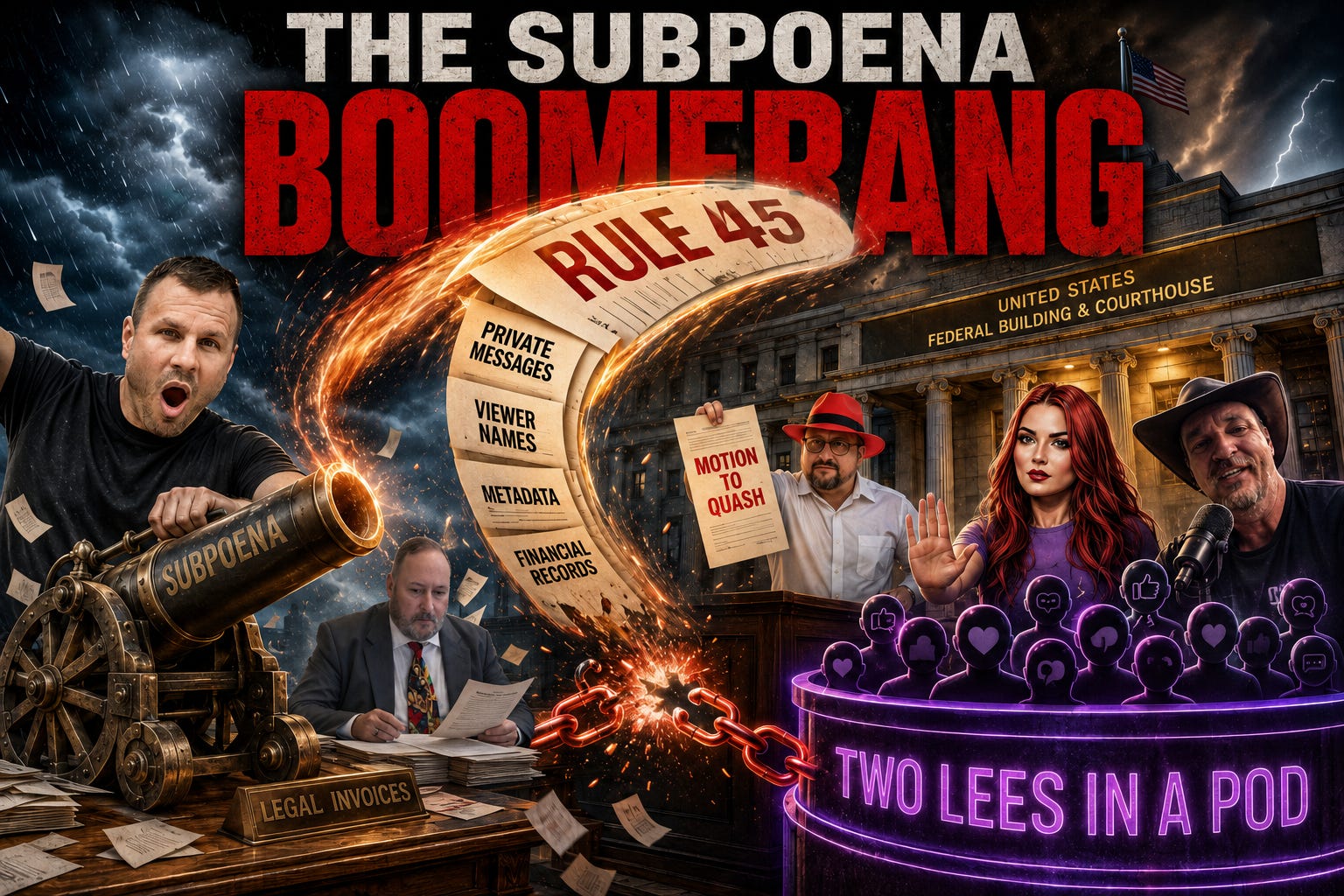
LUTHMANN NOTE: This is what litigation by exhaustion looks like when it reaches the newsroom door. Jeremy Hales and Randall “Randy” Shochet did not merely seek a broadcast or ask whether Lynette Michelle Preston received an appearance fee. Their subpoena, as challenged by Lisa Lee, demanded private messages, financial records, editorial materials, metadata, and viewer identities. That is not tailored bankruptcy discovery. It looks like an attempt to turn federal process into a private intelligence operation against a journalist, her guests, and her audience. Rule 45 protects nonparties from undue burden. It does not hand angry litigants a crowbar. Hales cast the net. Now the subpoena is coming back.

(FLORIDA, USA) — Richard Luthmann joined Lisa Lee and Robbie Keszey on Two Lees in a Pod to read, dissect, and occasionally ridicule Lee’s latest filings in the Northern District of Florida bankruptcy proceeding involving Lynette Michelle Preston. Lee said she filed two documents: detailed objections to a subpoena issued by attorney Randall “Randy” Shochet on behalf of Jeremy Hales, and a motion asking the bankruptcy court to quash it.
The filings, as presented during the broadcast, preserve Lee’s position that she was never properly served while challenging virtually every category of information demanded.
Lee maintains that process server Mark Newby left the subpoena on a patio table after approaching her husband, Gabriel Weeks. According to Lee, Weeks was not authorized to accept federal process, and Lee never told Newby that he could leave the papers with him. Her objections were filed protectively, without conceding that service was valid or that any compliance period began.
The larger fight concerns scope. The subpoena reportedly seeks months of communications, financial information, platform records, scripts, drafts, metadata, promotional materials, and information identifying viewers, subscribers, and purchasers. Luthmann characterized that as an extraordinary burden imposed upon a journalist and nonparty.
Luthmann explained that Hales appears in Preston’s bankruptcy as a creditor, not as a plaintiff with unlimited authority to investigate critics. In his analysis, the relevant question should concern the bankruptcy estate: Was Preston paid for appearing on Lee’s July 11 broadcast, or did she receive some other undisclosed thing of value?
Lee stated that Preston was not paid. Her filings offer a narrow alternative: an electronic copy of the broadcast, if Hales cannot obtain one elsewhere, and a sworn statement addressing whether Preston received compensation. That would answer the apparent bankruptcy question without opening Lee’s newsroom, devices, accounts, and audience to Hales.
Viewer identities became one of the broadcast’s sharpest fault lines. Lee’s objections contend that the names, usernames, email addresses, account details, and transaction identifiers of audience members do not establish whether Preston was compensated. The filings further argue that disclosure could chill people from watching, supporting, or commenting upon journalism about Hales and his litigation.
Luthmann emphasized that affected viewers have received no notice and no opportunity to defend their privacy. If financial information were ultimately deemed relevant, he argued that aggregate, anonymized figures would answer the question without identifying individual supporters. The subpoena, as described, contains no meaningful safeguard against collateral use, public disclosure, additional litigation, or direct contact with viewers.
The conversation then turned the subpoena around.
Lee asked why Hales’ own revenue from years of Preston-related content should not be examined if he insists that her program’s revenues belong in the bankruptcy dispute. Her point was rhetorical, not a report that she had issued such a subpoena. Still, it exposed what Lee and Luthmann described as the one-sided premise behind the demand: Hales wants discovery into Lee’s business while his own monetization remains outside the frame.
Keszey questioned how Lee, who is neither the debtor nor a creditor, became entangled in the proceeding. Luthmann answered that nonparties may be subpoenaed for relevant evidence, but he maintained that Rule 45 requires reasonable steps to avoid undue burden and expense. He also suggested that the court could examine whether the disputed discovery unnecessarily increases the administrative costs of the bankruptcy estate. That remains Luthmann’s legal commentary, not a judicial finding.
The program closed with a replayed Michael Volpe confrontation challenging Hales-aligned commentator Jay Hip to identify an occasion when he mocked Hales for courtroom defeats. Volpe’s thesis was blunt: commentary stops being comedy when the favored figure becomes immune from the joke.
The bankruptcy court will determine what, if anything, Lee must produce. For now, her filings put defective service, relevance, proportionality, journalistic privilege, audience privacy, expense, and procedural authority squarely before the judge.
Hales cast the net. Lee has asked the court to inspect the fishing license.