

Wildman Enters The Fight
Thirteen Arizona family court bills died in committee. Parents want answers—and so does Shawn Dell Wildman.


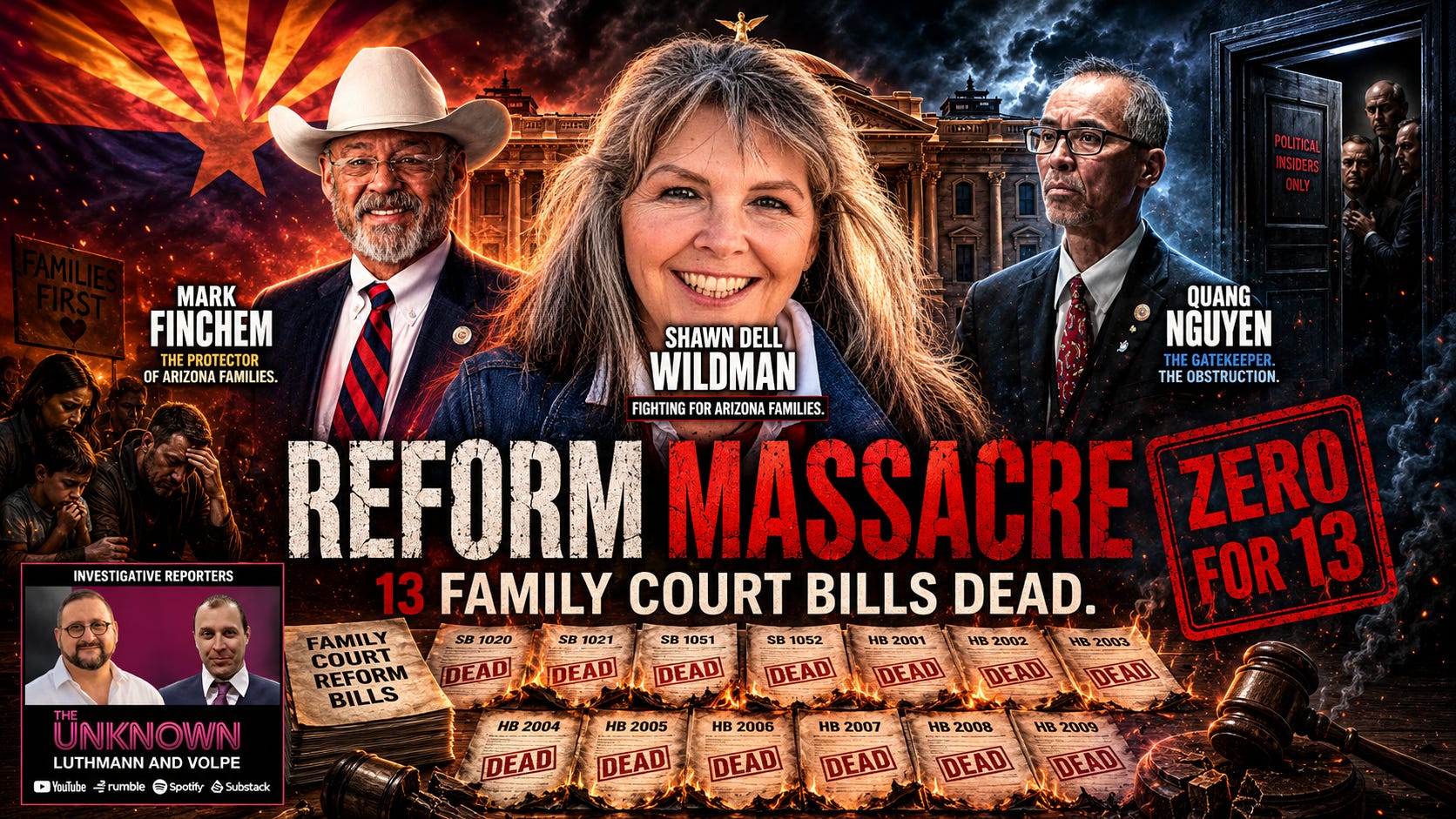
LUTHMANN NOTE: Zero for thirteen is not a statistic. It is a confession. Thirteen family court reform bills went into the Arizona Legislature, and not one came out alive. That does not look like careful lawmaking. It looks like a system protecting itself. Shawn Dell Wildman walked into The Unknown Podcast and put the issue where it belongs: children, parents, ballots, courts, and public trust are all part of the same fight. Quang Nguyen can talk process. The parents heard the message. The family court machine is still in charge — unless Arizona voters decide otherwise. This piece is “Wildman Enters the Fight,” first available on The Family Court Circus.

By Richard Luthmann with Michael Volpe
Quang’s Interview And The Zero-For-Thirteen Question
(PRESCOTT, ARIZONA) – Arizona politics has a new number burned into its forehead: zero for thirteen. That is what happened when a package of family court reform bills went into the legislative meat grinder and came out as ash.
Thirteen bills. Thirteen chances to protect children, restrain judicial abuse, expose the court-appointed industry, and give Arizona families a fighting chance.
Not one survived. Not one was salvaged. Not one was amended into something workable. Not one was allowed to become the beginning of a real reform conversation.

Before Shawn Dell Wildman joined hosts Michael Volpe and Richard Luthmann on The Unknown Podcast, the show had already dealt directly with Representative Quang Nguyen.
Quang did not like the heat. He did not like being asked why every one of Senator Mark Finchem’s family court reform bills went down. He did not like the tone. That is usually what politicians complain about when the facts are ugly, and the question is fair.

Quang Nguyen falsely claimed Lisa Fink and Rachel Keshel wanted the family court reform bills killed, when the record showed they sought amendments — a normal legislative fix, not a political execution.
The real question was never personal. It was institutional. How does a Republican committee chairman look at a reform package built from years of parent testimony, advocate work, and legislative effort, then conclude that nothing — absolutely nothing — was worth moving?
Quang’s defenders can talk process all day. That is what gatekeepers do. They bury the corpse under procedure.
But bills are written on paper, not stone. They can be amended. Language can be narrowed. Definitions can be fixed. Bad provisions can be stripped. Good provisions can be advanced.
That is the whole point of a legislature.
Zero for thirteen does not look like careful review. It looks like a message.
And the message was heard by every Arizona parent who has been chewed up by the family court machine: the insiders are still in charge.
Wildman Enters The Fight: Arizona Families Versus The Family Court Machine
The people who showed up for family court reform in Arizona were not playing political theater. Many were parents and grandparents who had already lost years, money, health, and peace inside a court system that can turn a family dispute into a financial execution.
They were not fighting only for themselves. In many cases, their own court orders were already written. Their own children had already been dragged through the process. Their own futures had already been damaged.
They came for the next family.
That is what the permanent political class never understands. These parents are not lobbyists with lunch reservations.
They are survivors.
They have seen how the court-appointed ecosystem works: attorneys billing until the weaker party collapses, therapists and evaluators becoming unelected power brokers, judges leaning on the same familiar faces, and children reduced to evidence packets in a war of attrition.
Wildman understood that immediately. She is a mother, grandmother, and longtime Yavapai County publisher. She spoke like someone who knows that local trust still matters and that ordinary people are tired of begging for representation from politicians who remember them only at election time.
The family court reform package was aimed at real problems: mandatory abuse reporting, runaway fees, evidentiary standards, jury-trial concepts, parental access, and limits on a system that too often treats children as leverage and parents as revenue sources. Every reform did not need to be perfect. No serious person argues that.
But every reform did deserve a hearing, a debate, and, where necessary, a serious amendment. Instead, Arizona families got the committee choke point.

That is why this fight is bigger than one politician. Quang Nguyen became the face of the blockade. He is a villain because the bills died on his watch, not because of policy, but because of petty politics.
But the deeper villain is the family-court machine itself — the courthouse economy, the judicial discretion racket, and the professional class that profits when families stay broken, confused, afraid, and paying.
Wildman Enters The Fight: The 50/50 Presumption
The sharpest policy debate on the show was the 50/50 parenting presumption.
This issue divides reformers because it touches the hardest question in family law: how do lawmakers protect children from real abuse without letting false claims, lawyer tactics, or court insiders destroy good parents?
Wildman defended 50/50 as a starting point, not a final command. That distinction matters. A presumption is supposed to begin the conversation from a place of parental equality. It should not force children into unsafe homes. Police reports, medical records, testimony, domestic violence findings, expert evidence, and child-safety concerns must be weighed.
Nobody serious wants children handed to abusers because a statute says “equal time.”
But the current system has its own danger. Without a strong presumption, one parent can weaponize money, allegations, delay, and the professional machinery of family court to erase the other parent. The richer spouse can bury the weaker spouse. The connected lawyer can steer the case into expensive fog. The judge can default to the familiar insiders. The child becomes the prize in a courthouse siege.
Volpe pushed the counterargument hard, citing concerns that equal-parenting presumptions can become automatic defaults, particularly in high-conflict cases where domestic violence or abuse is alleged. That is a real concern and should not be brushed aside. Australia’s experience, and criticism of shared-parenting presumptions there, shows that sloppy drafting can create dangerous confusion.
But that is exactly why amendments matter. Fix the bill. Tighten the exceptions. Define domestic violence carefully. Protect against coercive control being abused as a magic phrase. Guard against false claims while protecting real victims. Use jury trials or stronger evidentiary hearings where facts are contested.
The answer to a complicated family law problem is not to kill the entire reform package. The answer is to legislate like adults.
Wildman Enters The Fight: Election Integrity And The Larger Arizona War
The Wildman interview widened into election integrity because, in Arizona, every reform issue eventually runs into the same wall: public trust.
Family court requires trust. Elections require trust. Legislative committees require trust.
Once citizens believe insiders are managing outcomes behind closed doors, the whole system starts to look rigged even when officials insist the forms were followed.
That is the danger Arizona faces. It is not merely that people disagree over policy. It is that millions of Americans increasingly believe the ruling-class machine does not care what they think, how they vote, what they suffer, or what evidence they bring.
Wildman spoke about ballot security, chain of custody, mail-in voting, dirty voter rolls, rural election concerns, and the need for elections that are not only secure but visibly secure. Volpe challenged her on signature verification and evidence. That was useful. Good journalism is not cheerleading.
But Wildman’s broader argument landed: if Arizonans do not trust the custody of ballots, they will not trust the winners. If they do not trust the winners, they will not trust the laws. If they do not trust the laws, every court order, agency decision, and committee vote becomes another brick in the wall of managed decline.
That is why the family court fight and the election integrity fight are connected. Both are fights over whether ordinary citizens still control their government.
Wildman’s campaign message was simple: strengthen what remains, restore what was taken, and remind citizens they are worth the fight. That is citizen-legislator language, not consultant sludge.
Arizona now faces a choice. It can keep recycling the same political class that kills reform in committee and calls it process. Or it can elect fighters who understand that children, parents, ballots, borders, land, courts, and constitutional rights are all part of the same battle.
Zero for thirteen was not the end.
It was the warning shot.

 | A guest post by
|
Michigan Family Court modus operandi:
https://www.judicialcriminal.com
https://clutchjustice.com/2025/10/13/michigan-family-court-24-years-whistleblower-ignored/