


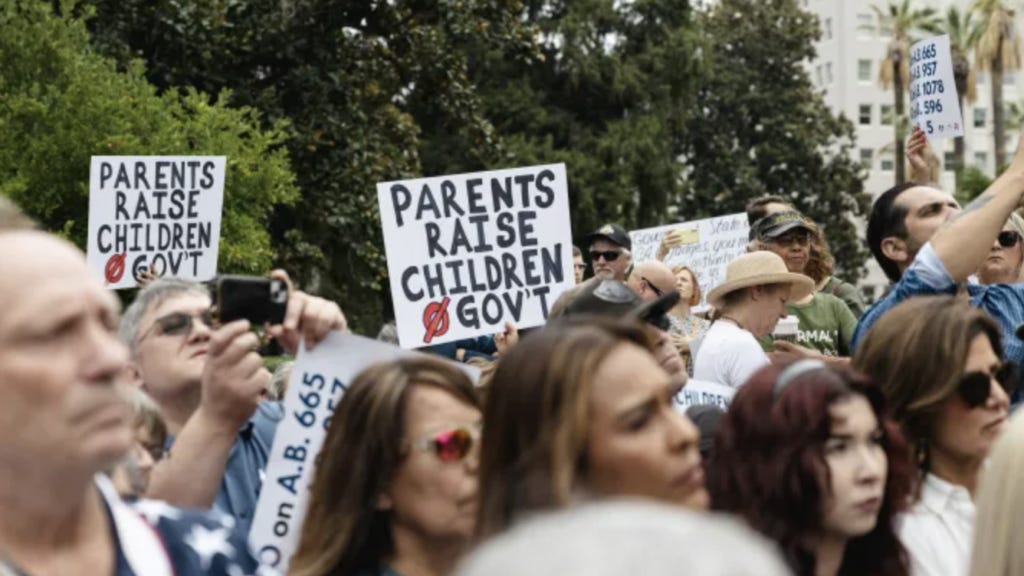
LUTHMANN NOTE: Julie Holburn joined Mike Volpe and me to discuss the judicial recall that didn’t come out of nowhere. It came from years of sealed hearings, ignored abuse, punished parents, and judges who learned there are no consequences. Appeals are a mirage. Oversight bodies are a joke. So parents did the only thing left—they went to the voters. When judges close courtrooms, weaponize HIPAA, sideline disabled parents, and treat scrutiny as insubordination, they forfeit moral authority. Judicial independence does not mean judicial immunity. Orange County’s family court didn’t just fail families—it dared them to respond. Now the bench is learning a hard lesson: sunlight is not interference. It’s accountability. Judges Face Historic Recall was first published on TheFamilyCourtCircus.com. The Unknown Podcast is available on YouTube and Rumble.


By Richard Luthmann with Michael Volpe and Julie M. Anderson Holburn
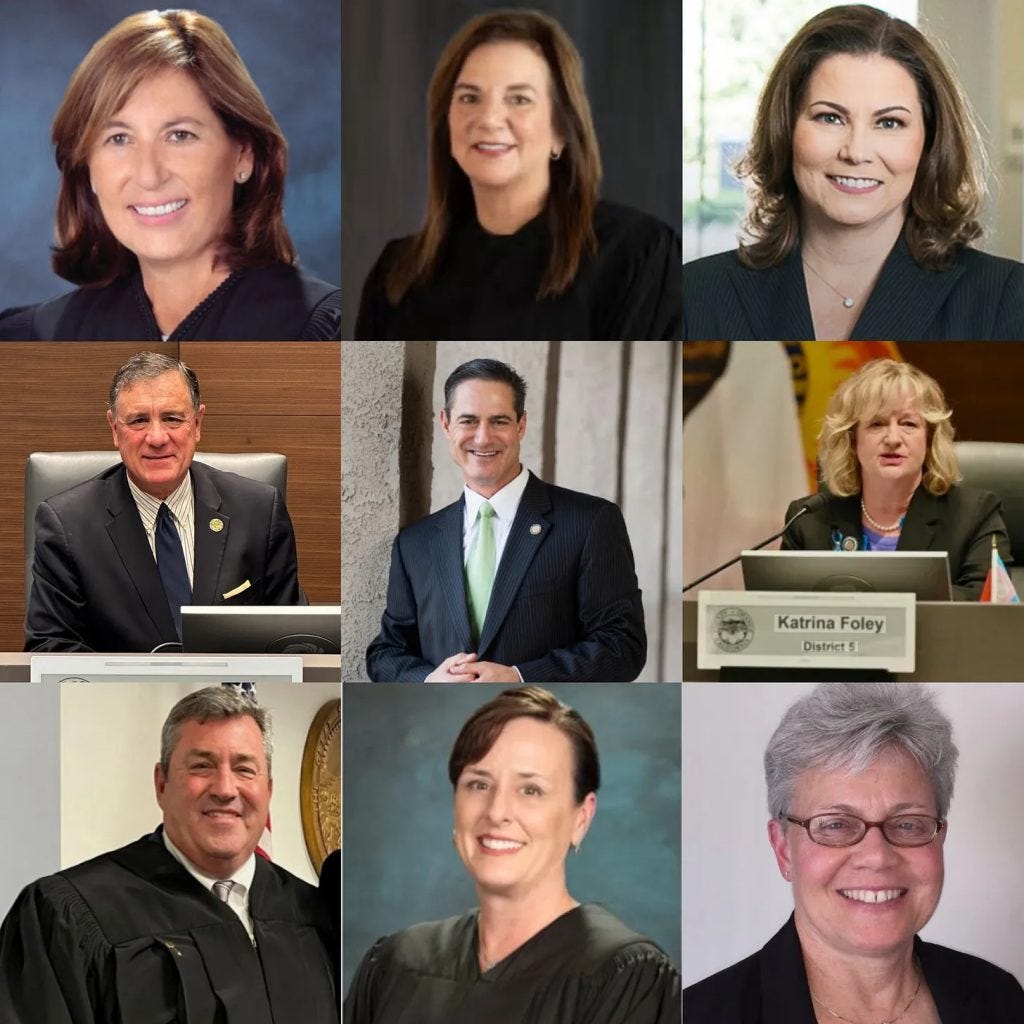
(ORANGE COUNTY, CA) – In a sensational push unprecedented in California, six Orange County Superior Court judges are facing a coordinated recall campaign amid allegations of corruption and abuse of power. Judge Mary Kreer “Vera Papapapa” – dubbed the “nepo judge” for inheriting her retired father’s seat – tops the list. Joining her are Judge Carol Henson, Judge Steven Hicklin, Judge Julie Palafox, Judge Kimberly Maynard Carasso, and Presiding Judge Maria D. Hernandez.
Together, these six hold sway over the family court, and now they’re all under fire. Seasoned investigative reporter Michael Volpe calls this recall “the most [dramatic] judicial story of 2026,” describing a system in turmoil.
The recall effort’s initial salvo – formal Notices of Intent to Recall – has already garnered roughly 240–260 signatures per judge, far above the legal minimum. Organizers submitted those signatures to the county Registrar, along with scathing statements of each judge’s alleged misdeeds, to clear the next hurdle for an official recall petition.
Once approved, the real battle begins: activists must collect tens of thousands of voter signatures to force a recall election for each judge. Volpe notes that even gathering a few hundred signatures is “not that simple,” underscoring the outrage fueling this campaign.
With Orange County’s top judge and five colleagues in the crosshairs, a courthouse long shrouded in secrecy is about to face an unprecedented public judgment.
Judges Face Historic Recall: Grassroots Revolt Fueled by Fear and Fury
This recall isn’t the handiwork of politicians – it’s a grassroots uprising led by aggrieved parents, court watchdogs, and a fledgling advocacy group called California Family Law Naked Truth. Investigative journalist Julie Holburn Anderson, who reports on family court malfeasance (and is herself a litigant in Orange County), helped spark the effort.
She recalls a parent court-watcher asking why no one had tried to recall bad judges. This lightbulb moment spread to parent organizers, court watchers, and California Family Law Naked Truth. And here we are today.”
Volunteers fanned out to gather initial signatures, often hearing enraged stories from citizens “disgusted” by what goes on in family court. Some were so happy someone was finally taking action, Holburn noted – while others were “terrified and refused to sign” for fear of retaliation by the judges.
That fear isn’t unfounded: Orange County’s judiciary has a reputation for retribution and high-level cronyism. The recent Anaheim corruption scandal involving former county Supervisor Andrew Do deepened public mistrust. Do, whose wife was a top family court judge, went to federal prison for a $13 million bribery scheme.
Tellingly, the six judges have lawyered up with Do’s own attorney, Mark Rosen, fueling perceptions of a courthouse coterie circling the wagons. Holburn personally delivered the recall notices at the courthouse – and met open hostility. One bailiff in Judge Palafox’s courtroom thumbed through the paperwork and flatly declared, “I’m not gonna serve this… not gonna give this to her,” as if a public petition were contraband.

Over at Judge Henson’s door, a clerk slammed it shut and shoved the papers back at Holburn. When Holburn walked away, the clerk chased after, heckling that sheriff’s deputies would be summoned – until Holburn fired back, “You’re on camera, and you’ve been served.”
Despite these intimidation tactics, the recall proponents remain undeterred. Armed with social media and steely resolve, this ragtag band of parents-turned-activists is doing what was once unthinkable: confronting judges at the ballot box.
As co-host Richard Luthmann observed, modern organizing via social media has “allowed people to organize in ways they’ve never been able to do before… [for] grassroots-funded” campaigns like this. If Orange County’s fed-up families have their way, these judges will soon be held to account in a very public circus.
Judges Face Historic Recall: Secret Hearings, Abuses, and Outrageous Misconduct
What could drive a community to rebel against its own judges? Years of alleged misconduct in family court – brazen, bizarre, and devastating in its impact. The charges read like a laundry list of judicial sins: closed courtrooms, sealed evidence, violated rights, and children left in harm’s way. Judge Mary Kreer Varipapa (the “nepo judge”) epitomizes the complaints.
In one case, Varipapa sealed a court-ordered custody evaluation, held a curt closed-door hearing with no witnesses, then suddenly stripped a father of custody on an “emergency” basis.
“That’s not how emergencies work,” Volpe declared, calling it a “blatant violation of due process” – conjured from thin air to justify switching sole custody to the mother. No imminent danger, no due process, just a unilateral power play behind closed doors.
Varipapa’s tactics don’t stop there. When Holburn tried to observe another hearing remotely, the judge used HIPAA as a fig leaf to kick the public out.
“This portion…is deemed a closed proceeding… anyone here from the public…we’re going to put you in the waiting room,” Judge Varipapa announced, citing unspecified “HIPAA-protected” discussions.
Legal observers call that nonsense.
“Blanketly clos[ing] a courtroom because of HIPAA… ” It’s being used for an improper purpose,” Luthmann blasted, saying the judge’s excuse was nothing but a false pretext to hide her courtroom.
Judge Julie Palafox is accused of equally outrageous behavior. Volpe reported that Palafox stopped a hearing mid-stream and walked out to have an off-record chat – then returned only to appoint a guardian ad litem, effectively declaring a competent middle-aged father unfit to speak for himself.
“She repeatedly violated his rights under the Americans with Disabilities Act,” Volpe noted, explaining that Palafox used the man’s mild disability as an excuse to wrest control of his case.

Judge Kimberly Carasso’s tenure on the high-profile Tar Nolan divorce case has been similarly explosive. Holburn recounted how Carasso abruptly sealed the courtroom in the middle of testimony by a brain injury expert – a public proceeding up to that point – simply because the journalist had emailed asking why the hearing audio was suddenly blocked.
Carasso then threatened both parties with sanctions, even a mistrial, for supposed “media leaks,” effectively gagging everyone involved. Carasso’s handling of the disabled wife in that case was even more appalling: the judge chastised the woman for injuries that left her a quadriplegic, ignored ADA accommodations, and used the victim’s condition against her in a custody ruling.
“It’s absurd,” Holburn said, noting that being disabled is not a crime – yet Carasso treated this mother’s traumatic brain injury as grounds to curb her parental rights.
Across the board, activists say, these judges have shown a pattern: bending over backwards for abusers and hammering protective parents.
“They’re all…violating due process…closing courtrooms… and they like to give abusers custody,” Volpe observed bluntly.
California’s Family Code § 3044 is supposed to bar a proven domestic abuser from getting custody, but in Orange County, it might as well not exist.
“Oh yeah, it’s absolutely… being ignored,” Holburn said of the law, describing how judges routinely overlook documented abuse and “flip custody to the abusive parent” in case after case.
Even new reforms like “Piqui’s Law” – enacted to outlaw discredited “reunification” camps and stop courts from cutting off safe parents – are being flouted. Judges scoff at it and carry on with business as usual, Holburn reports.
In short, critics say Orange County’s family court has become a House of Horrors for families in crisis.
“They are not following the law…They are not protecting victims of abuse…whether it’s parents or children,” Holburn charged in disbelief. Instead, according to countless accounts, these judges retaliate against those who speak out, ignore evidence, and operate in secrecy – all while proclaiming their “commitment to fairness.”
Judges Face Historic Recall: Broken System Fights Back as Public Demands Justice
Orange County’s embattled judges aren’t taking this challenge lying down. In official statements dripping with indignation, they paint the recall as an attack on judicial independence by partisan malcontents. Judge Henson’s canned response warned citizens not to “waste… tax dollars” on a recall and cast herself and colleagues as dedicated public servants ensuring fair trials.
“This petition is an attack on judicial independence and fairness,” the judges argue, claiming “the entire bench…support[s]” the targeted six. Holburn finds that laughable.
The reality, she says, is that fairness has long been a farce in these courts.
“They’re not following the law… violating due process… ignoring perjury… ignoring fraud… prolonging litigation to deplete assets,” she fires back at the judges’ self-serving narrative.
When accused of bias, the system’s defenders reflexively tell litigants to appeal – knowing full well that’s a cruel joke.
“Appeals in family court…are prohibitively expensive” (often tens of thousands of dollars) and “move at a snail’s pace…18 to 24 months” while the damage to children continues.
Appellate courts rarely overturn even egregious decisions, and trial judges know it.
They “do whatever they want knowing…they’re not gonna get caught,” Holburn explains, noting that judges openly scoff, “you can take it to appeals,” because they expect rubber-stamp treatment upstairs.
California’s judicial watchdog is no better: in 30 years, the Commission on Judicial Performance has removed a grand total of 14 judges out of thousands, a statistic Holburn calls appalling. With traditional accountability failing, citizens are left to police the judges themselves – hence the recall.
“Judges must remain independent,” the officials plead.
But independence is not impunity. The recall proponents argue that when a court turns into a star chamber of unchecked power, democracy must step in. And despite institutional stonewalling, the truth is clawing its way into the light.
Holburn describes extreme pushback against her reporting: the court’s Public Information Office flat-out refused to recognize her as a journalist to dodge her questions. Officials delayed and denied her public records requests, slapping her with outrageous bills – including a jaw-dropping $132,000 fee for basic court contract data.
“Say that again,” Luthmann gasped on air, “the court sent you a bill for $132,000 just to see paperwork?”
It’s a blatant strategy to price out and shut up anyone who might expose their dealings. Even Holburn’s personal custody case appears to have been used as leverage: earlier this year, the court bizarrely assigned her own matter to Judge Carasso – one of the very judges she’d been reporting on. Holburn sought to disqualify Carasso for conflict of interest, especially after Carasso lied under oath, claiming not to know about Holburn’s work.
In reality, Holburn’s journalism was entered into the court record, and Carasso’s sworn denial amounted to perjury.
“That’s a big deal… enough to have that judge removed from the bench,” Volpe observed dryly.
From the clerk’s office to the courtroom, the message to reformers has been intimidation and stonewalling. But the recall campaign signals that Orange County’s families won’t be scared silent any longer. As these judges become infamous beyond the courthouse walls – the way Judge Aaron Persky did after his lenient Stanford rape case sentence – the usual playbook of secrecy and retaliation is failing.
“We do not have star chambers,” Volpe insists, decrying how these judges hide proceedings from the public.
Sunlight is finally piercing the darkness of the family court, and the people are demanding their day.
“This is why we are where we are,” Holburn concludes. “The courts are not serving justice… They are not protecting children. They are doing the exact opposite.”
In Orange County, a long-suffering public is bringing the gavel down – and California’s family court circus may never be the same.


