

Paul Boyne’s PSI Hits The Federal Docket
Will Federal Court Keep Looking Away From The Connecticut Judiciary’s Speech-Chilling Problem?

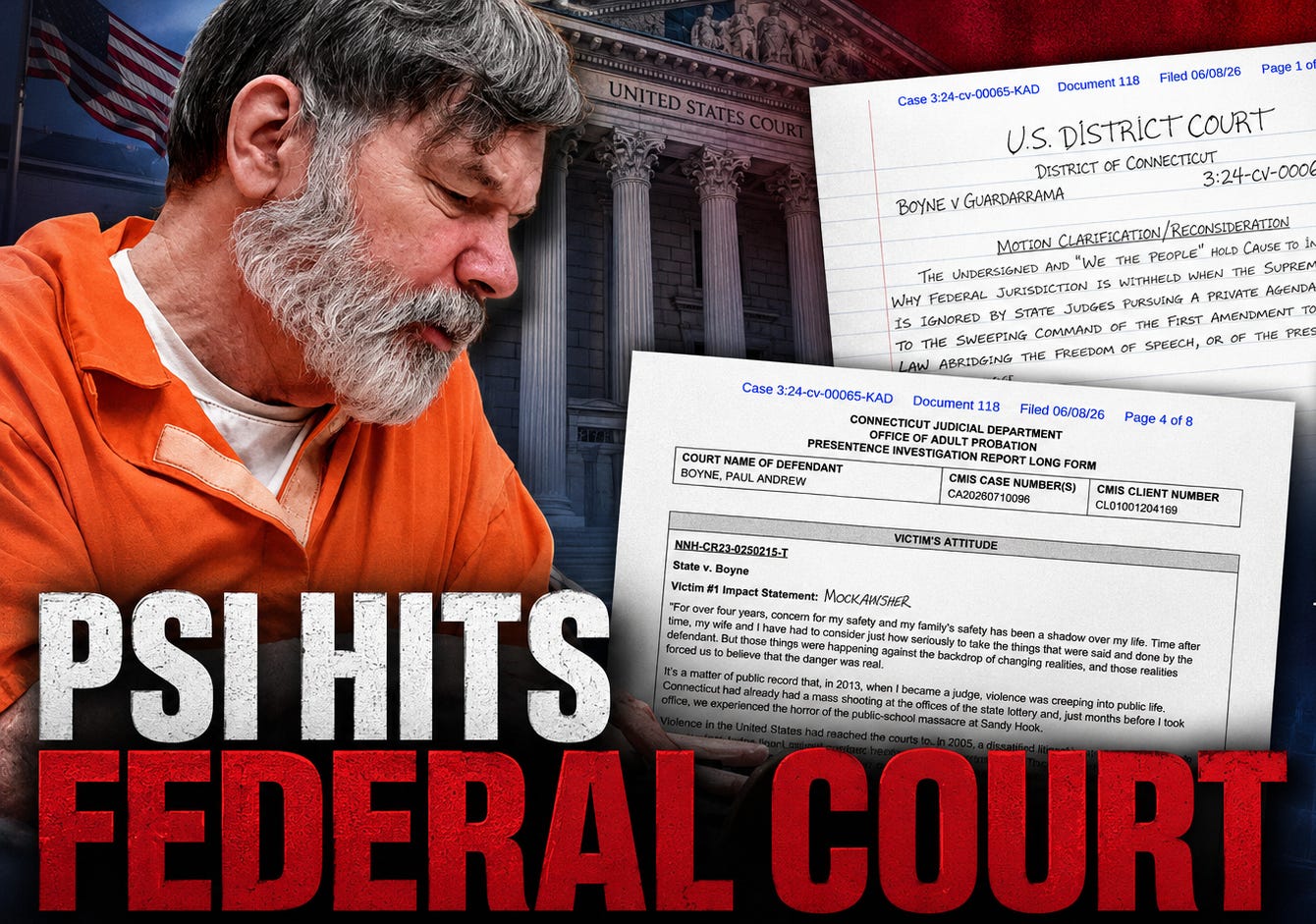
LUTHMANN NOTE: Paul Boyne is not the poster child for polite speech, careful editing, or bedside manners. Good. The First Amendment was not built for polite press releases and cocktail-party commentary. It was built for ugly cases, angry words, hostile criticism, and speech the government wants to crush. Connecticut judges say Boyne’s blog terrified them. Boyne says Connecticut buried him for attacking the family-court machine. Now the Presentencing Investigation and Report (PSI) pages are in federal court. That means Judge Kari Dooley and the federal judiciary cannot keep pretending this is just a state-court mess. Or can they? The speech-chilling issue is sitting on the docket for all to see. This piece is “Paul Boyne’s PSI Hits The Federal Docket,” first available on TheFamilyCourtCircus.com.

By Richard Luthmann
The Hidden Paper Is Now Federal-Court Paper
(NEW HAVEN CONNECTICUT) – The Paul Boyne case has now crossed from state-court punishment into federal-court exposure, and that changes the story. The PSI material and victim-impact pages are no longer just background noise from a Connecticut sentencing file. They are now part of the federal docket in Boyne v. Connecticut, Case No. 3:24-cv-00065-KAD, Document 118, filed June 8, 2026.
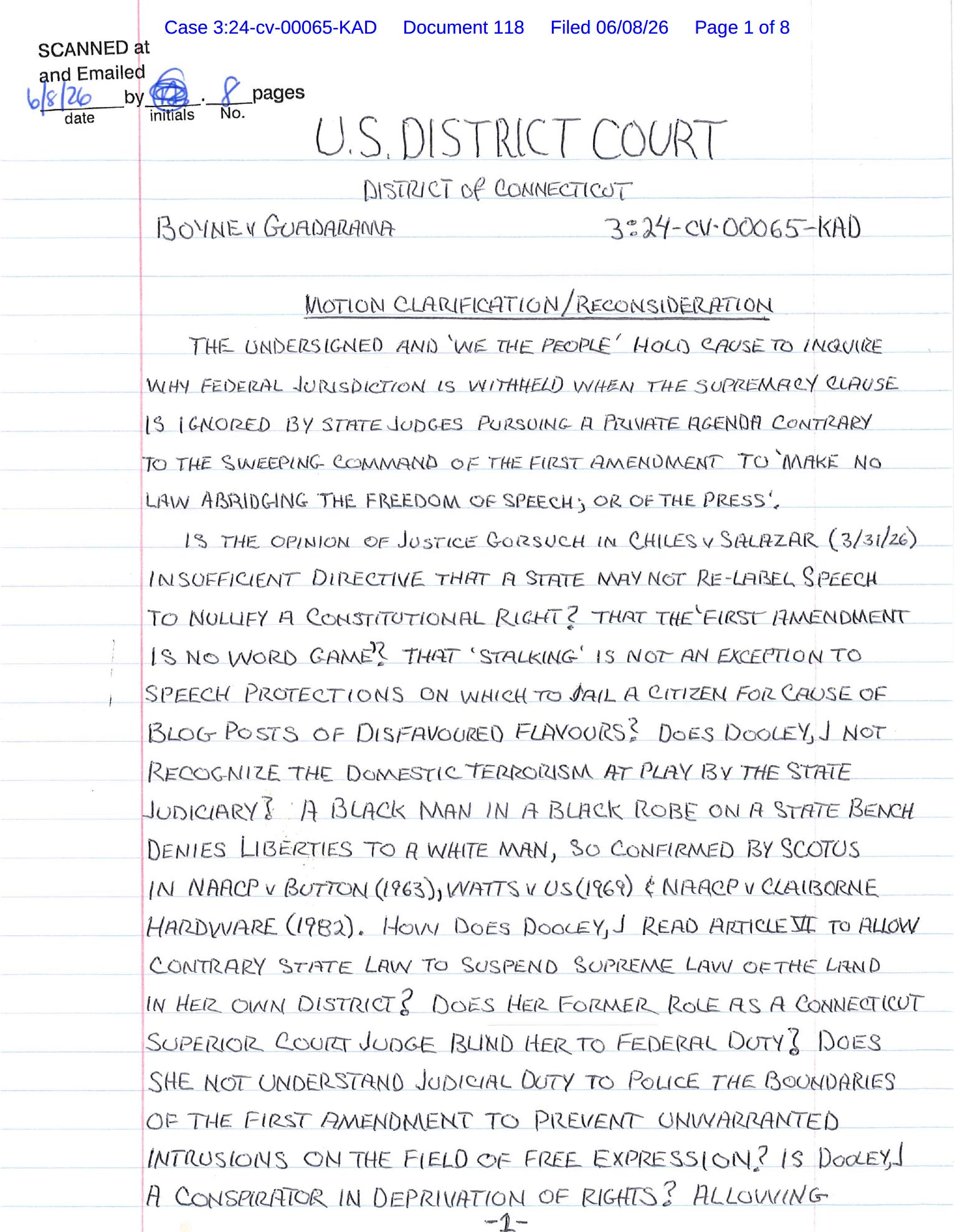
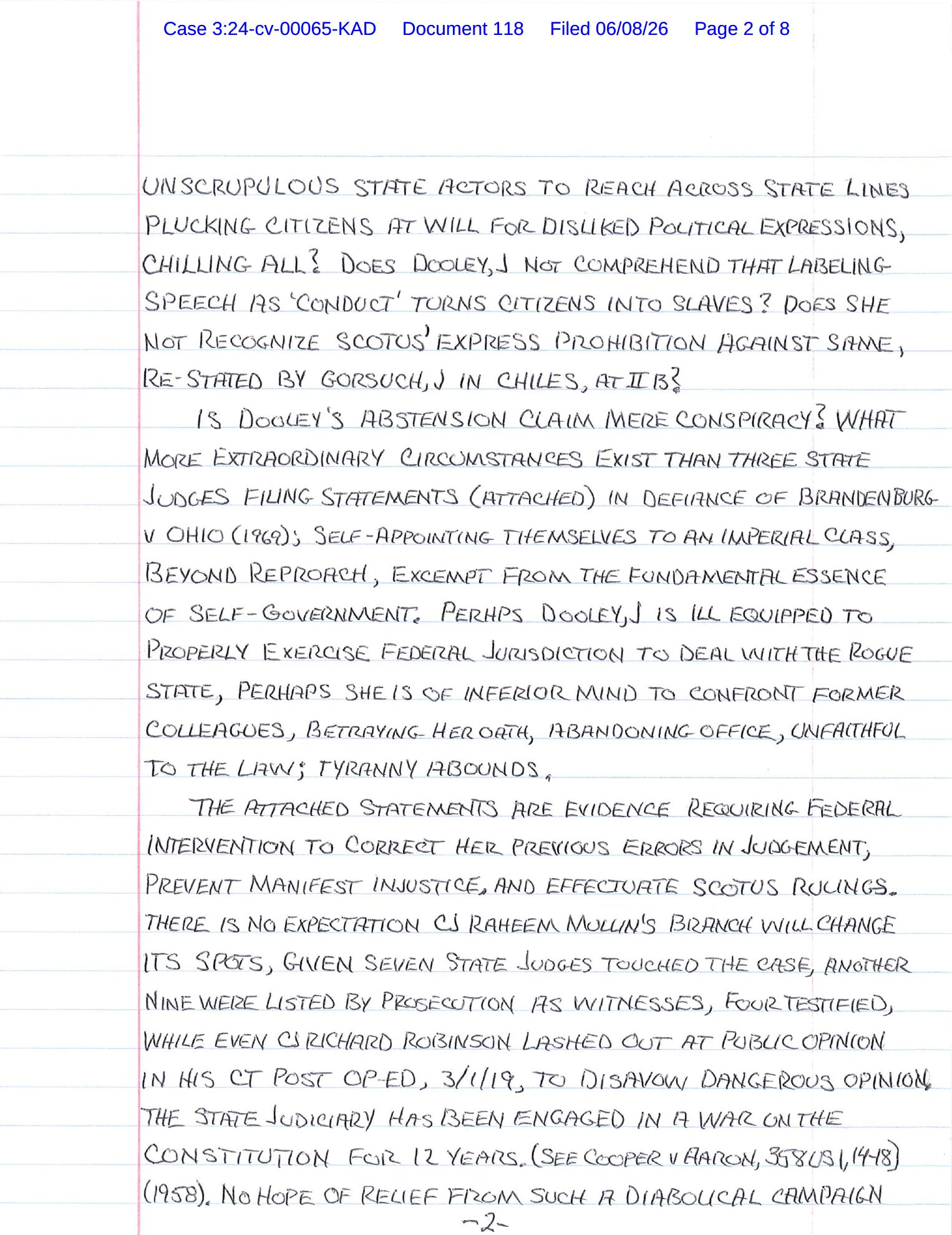
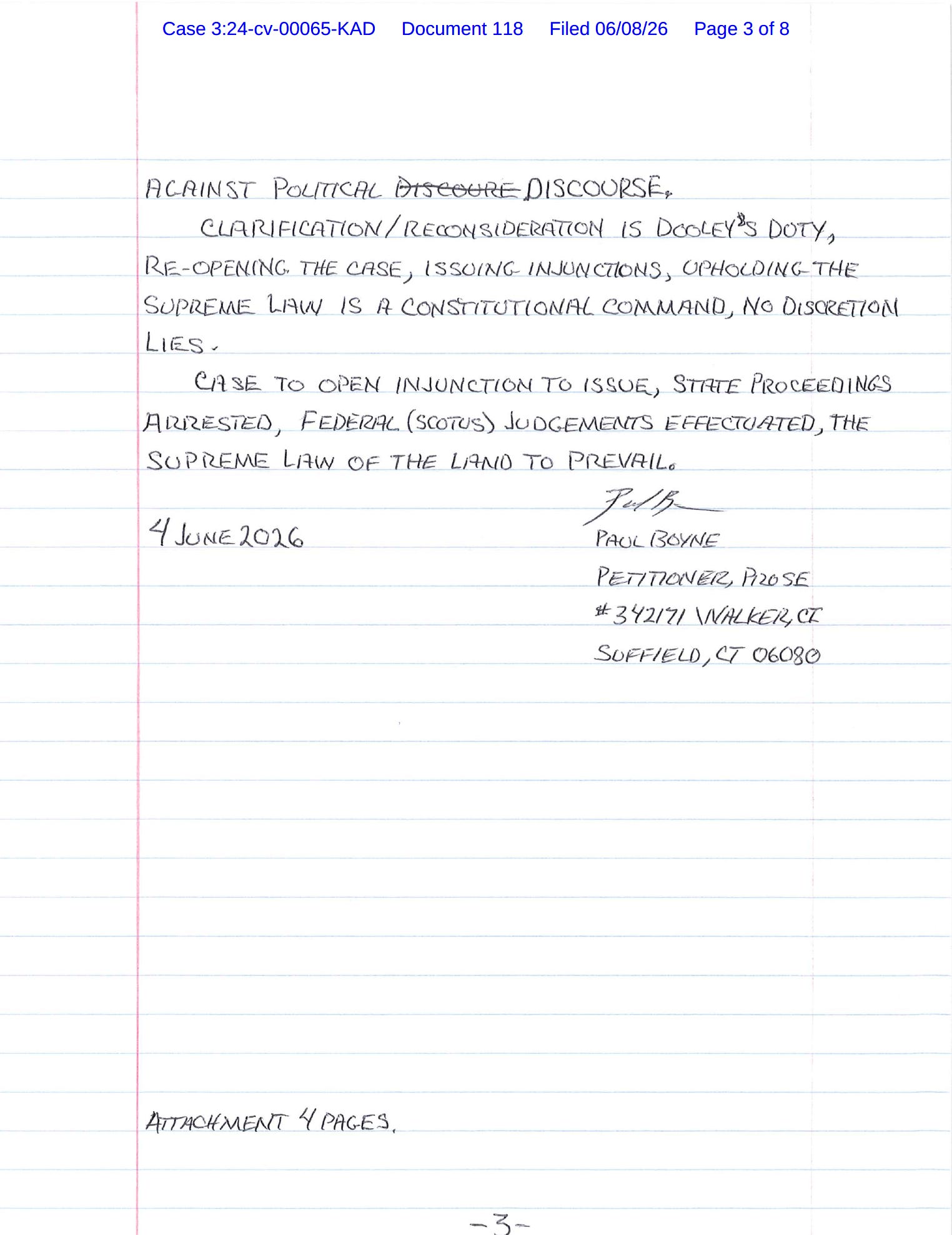
That filing includes Boyne’s handwritten June 4, 2026, Motion Clarification/Reconsideration and attached pages containing victim-impact statements attributed to former Judge Thomas G. Moukawsher, Judge Jane K. Grossman, and Judge Elizabeth J. Stewart.


That fact matters because the federal court now has the clash in black and white: Boyne says Connecticut judges criminalized disfavored speech by relabeling it as conduct, while the judges say his blog became a campaign of intimidation, fear, threats, personal targeting, and court disruption.
This is not a defense of every ugly word Boyne ever wrote. No one is pretending violent rhetoric is harmless or that judges should live without security.
But Boyne raises a First Amendment question with teeth. If the state can take hostile commentary about judges, mix it with fear and institutional embarrassment, call the whole thing “conduct,” and then bury the speaker in prison, every family-court critic, courthouse blogger, reform advocate, and angry parent in America should pay attention.
The Connecticut Division of Criminal Justice announced that Boyne was convicted of 12 counts of first-degree stalking and six counts of electronic stalking, and New Haven Judge Peter Brown imposed a sentence of 20 years in prison plus 10 years of special parole.
The U.S. Government’s own actuarial tables show that Boyne is not expected to live out his prison term. And that is before factoring in serious health comorbidities, the medical costs of which will ultimately be covered by Connecticut taxpayers to warehouse an old, sick, Virginia blogger and journalist with no connection to the Nutmeg State other than speech.
Those are not symbolic consequences. That is a life-altering punishment, and the constitutional question now sitting before the federal court is whether Connecticut punished true threats or punished the viewpoint it hated.
Paul Boyne’s PSI: The Speech-Conduct Word Game
Boyne’s handwritten filing is raw, accusatory, and unmistakably jailhouse prose, but beneath the heat is a serious constitutional argument. He asks why federal jurisdiction is allegedly being withheld when, in his view, state judges ignored the Supremacy Clause and the First Amendment’s command that government shall make no law abridging freedom of speech or of the press.
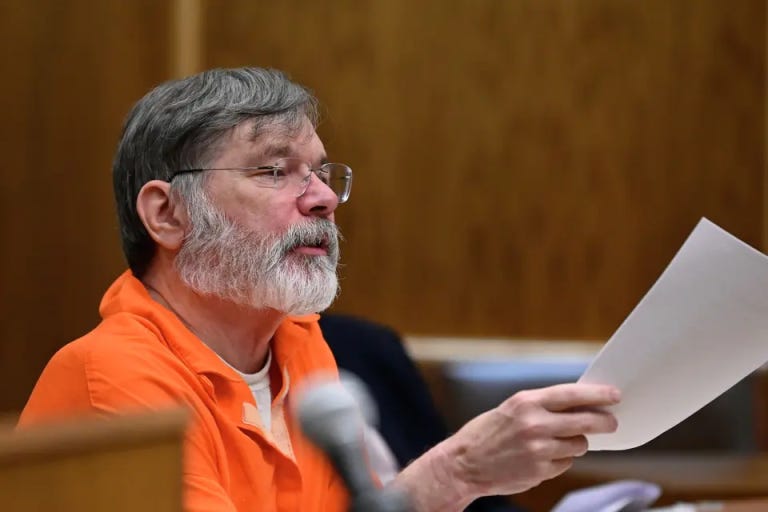
His argument is that Connecticut cannot evade constitutional scrutiny by rebranding speech as conduct. That is exactly why Chiles v. Salazar matters.
In Chiles, the U.S. Supreme Court addressed the government’s attempt to regulate speech by treating it as professional conduct, and the ruling is now powerful ammunition for anyone arguing that the state cannot make First Amendment problems disappear through labels. Boyne’s filing leans directly into that point: if the government is punishing expression, the court has to analyze expression, not simply accept the state’s preferred label and walk away.
That is the frame federal court cannot dodge. Boyne argues that Connecticut family-court judges and prosecutors treated his blog as criminal activity because the viewpoint was hostile to the judiciary, family court, and particular judges.
The state’s answer is that this was not mere criticism, but stalking and threatening behavior. That is the real fight. The line between protected speech and unprotected true threats is not drawn by whether the target felt fear alone, whether the speech was offensive, whether the target was a judge, or whether the speech made court administration harder.
Under Counterman v. Colorado, true-threat prosecutions require a culpable mental-state inquiry, with the Supreme Court holding that recklessness is the constitutional floor.
Under Brandenburg v. Ohio, advocacy of force cannot be punished unless it is directed to producing imminent lawless action and likely to produce it.
Under Watts v. United States, crude violent political rhetoric can still be protected hyperbole depending on context.
Boyne is forcing the federal court to decide whether Connecticut applied those rules or treated judicial outrage as a substitute for constitutional analysis.
Paul Boyne’s PSI: A Liberal Fantasy In Victim-Impact Form
The PSI pages are the article’s engine because they show the Connecticut judiciary’s best argument in the judges’ own words, and former Judge Thomas G. Moukawsher’s submission is the loudest exhibit. But it does not read like a sober judicial accounting.
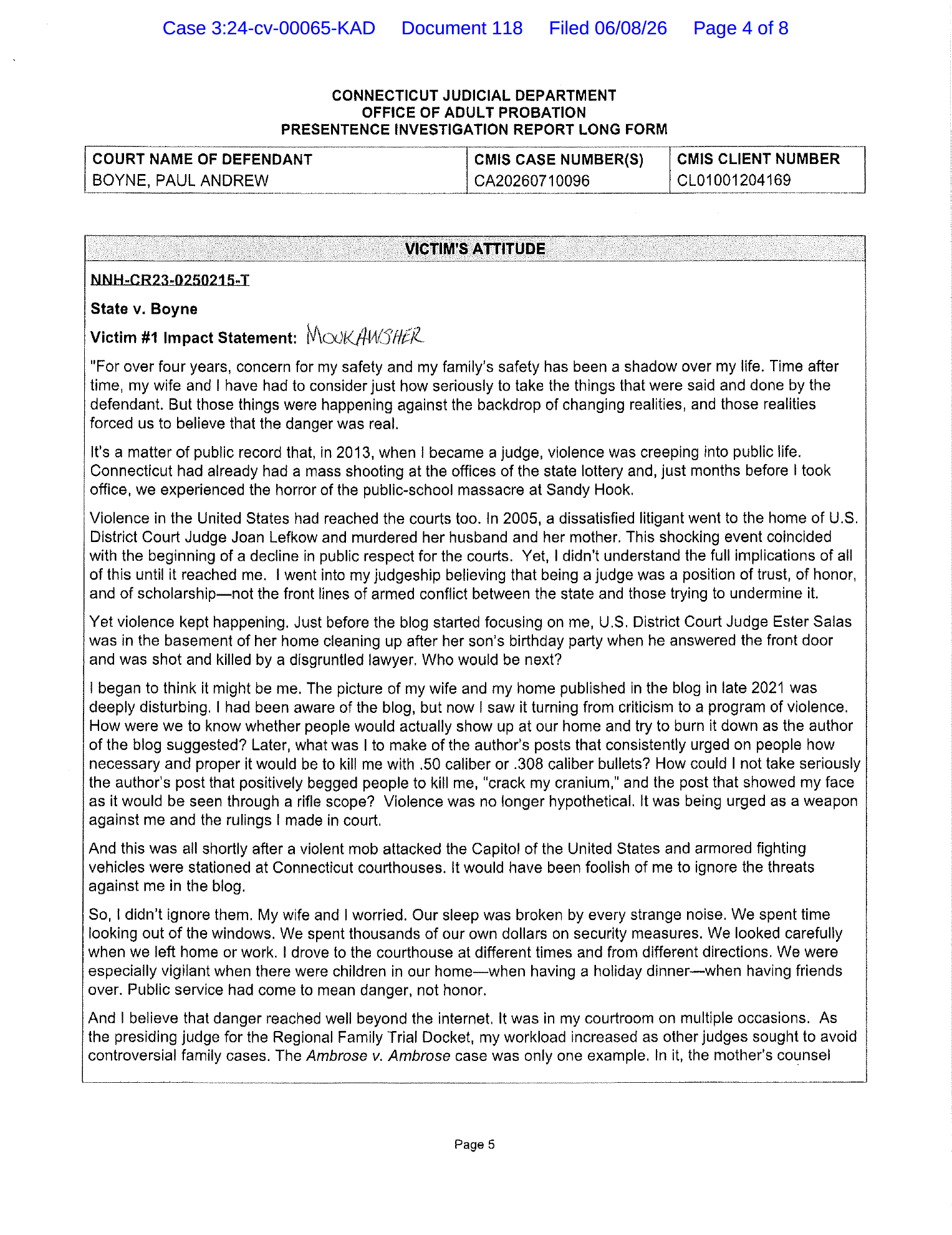
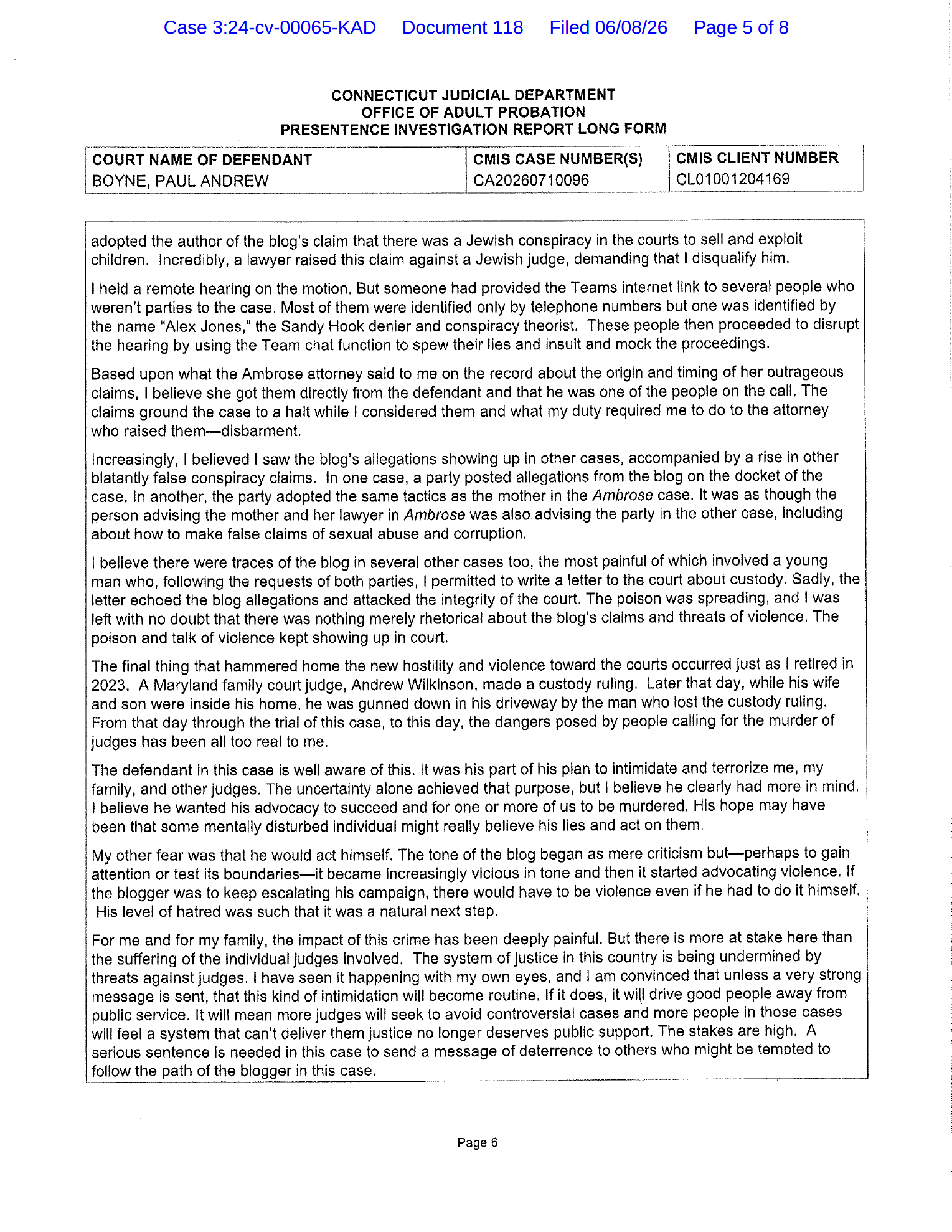
It reads like an ideologically driven piece of advocacy, a trip through Mouk-Land, where every disfavored blog post becomes a step toward domestic terrorism, every courthouse critic becomes a shadowy menace, and every angry family-court litigant is folded into a fever-dream narrative about national violence, January 6, Sandy Hook, judicial assassinations, and looming right-wing chaos.
Moukawsher does not merely say he was afraid. He builds a political atmosphere around the fear. He places Boyne’s blog inside a sweeping national montage that includes the murder of family members of U.S. District Judge Joan Lefkow, the attack on the family of U.S. District Judge Esther Salas, violence around public life, the Capitol riot, and broader threats against judges.
That is advocacy, not analysis. It is the language of a man trying to persuade the sentencing court that a hostile family-court blog was not merely ugly speech or even alleged criminal harassment, but part of a larger cultural sickness that required a hard institutional response.
That is why the submission matters. Moukawsher says the publication of information involving his wife and home was deeply disturbing. He says he viewed certain posts as urging people to kill him. He says his family spent money on security, changed routines, monitored noises, and lived with fear. He also claims the blog disrupted family-court proceedings and spread allegations into other cases. Those are serious assertions, and they deserve to be reported accurately.
But they also deserve to be scrutinized. The submission does not simply describe fear; it weaponizes fear into a constitutional argument by implication. In Mouk-Land, the judiciary is not a public institution subject to brutal criticism. It is a besieged moral class, and the critic becomes the enemy at the gate.
Judge Jane K. Grossman’s statement is equally severe, but it also follows the same institutional script. She does not frame Boyne as a critic who crossed lines; she frames him as a full-spectrum menace whose words allegedly invaded every corner of her public and private life. Grossman says Boyne’s activity was not ordinary appellate criticism, not public commentary, and not protected watchdog work, but a prolonged campaign involving references to her gender, religion, appearance, home, workplace, computers, threats, security changes, court staff, and family life. In other words, she stacks every available category of personal impact into one sentencing narrative: fear, disruption, humiliation, danger, and contamination of the courthouse environment.
That is powerful victim-impact writing. It is also exactly why it requires scrutiny. Grossman’s statement does not merely ask the court to punish proven unlawful conduct. It asks the court to see Boyne’s speech through the lens of judicial vulnerability, institutional anxiety, and personal offense. She says she altered routes, avoided photographs, scrubbed personal information from public databases, spent money upgrading security, and watched court staff react to vulgar posts. Those claims are serious. But they also reveal the danger in this case. Once harsh criticism of a judge is poured into a vessel labeled “fear,” the First Amendment problem can get buried beneath emotional gravity. The constitutional question is not whether Grossman felt threatened. The question is whether Connecticut proved true threats and unlawful stalking under the proper legal standard, or whether it allowed offensive anti-judicial speech to become criminal because the target wore a robe.
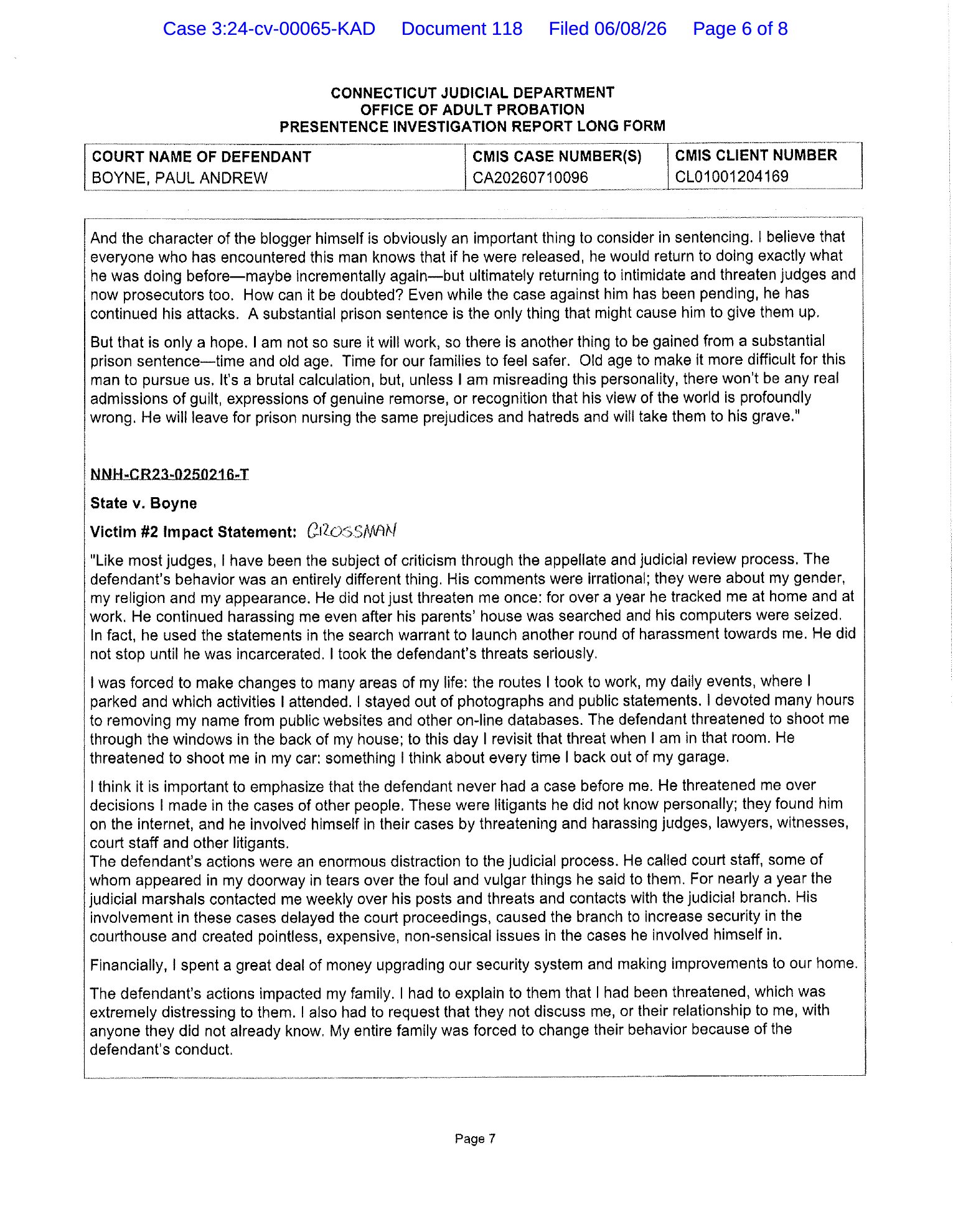
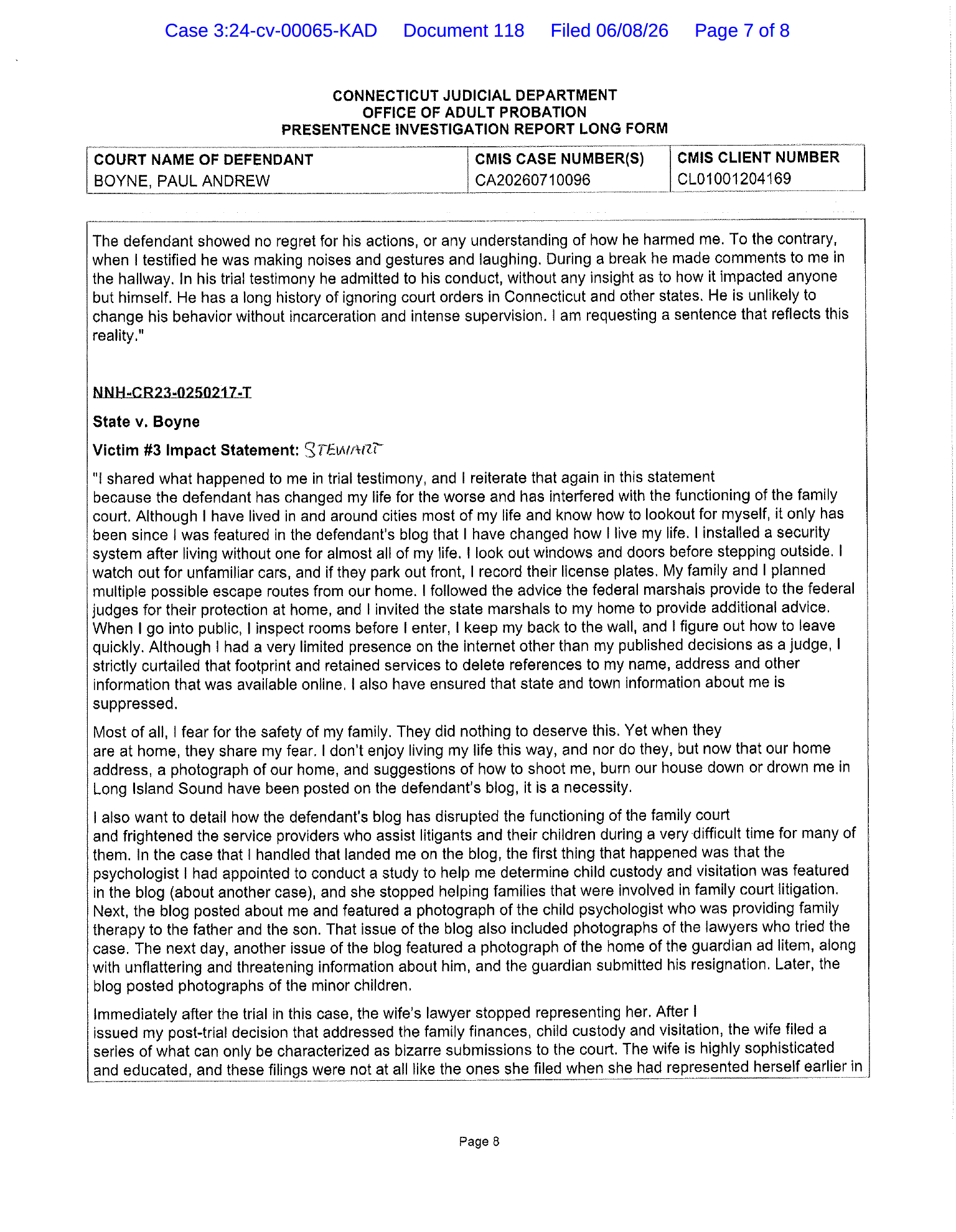
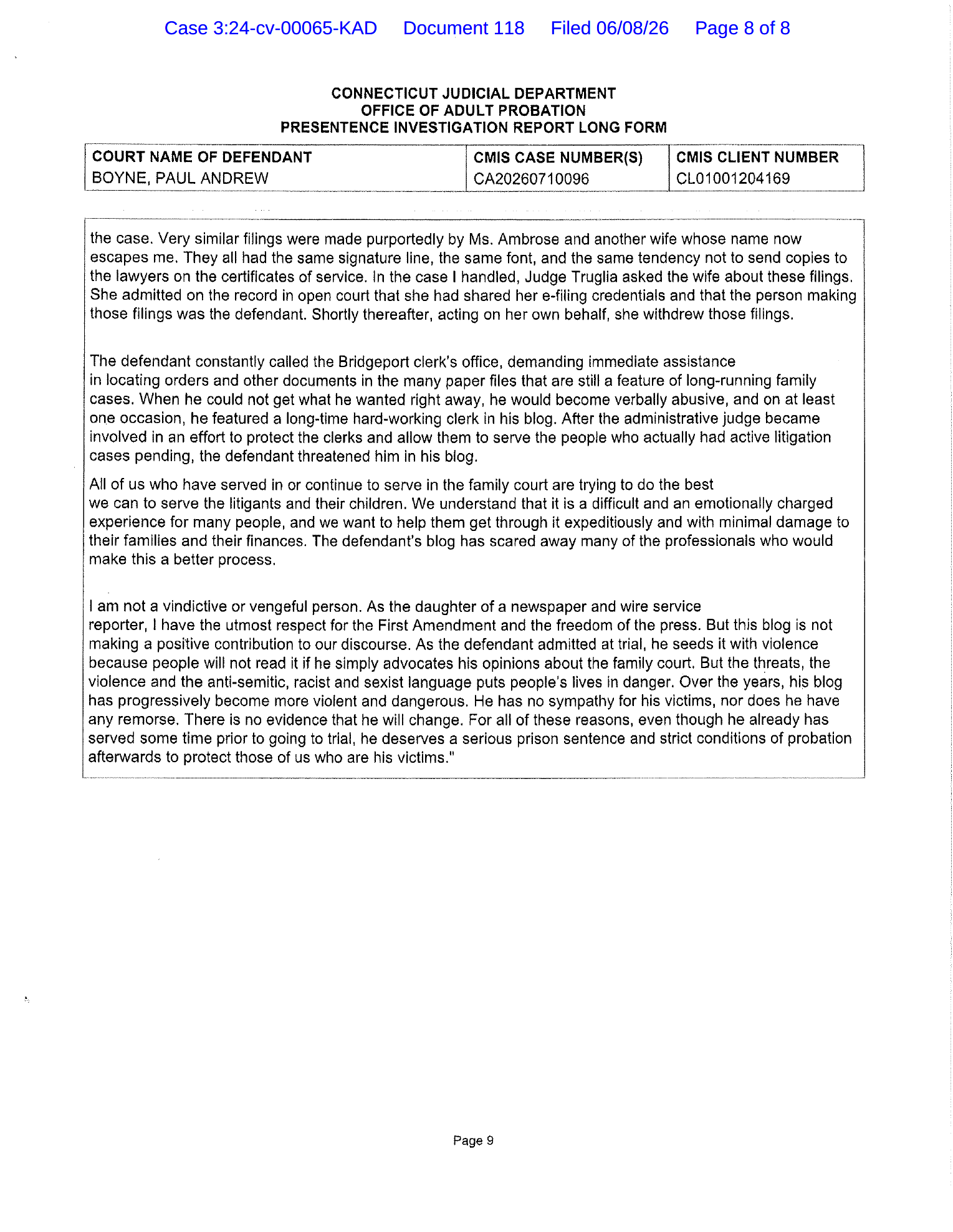
Judge Elizabeth J. Stewart’s statement travels the same road. She says Boyne’s blog changed her life, affected how she moved in public, caused her to delete personal information online, and disrupted the family-court ecosystem, including psychologists, lawyers, guardians, clerks, professionals, and litigants.
She also acknowledges respect for the First Amendment and press freedom, but then declares that Boyne’s blog was not a positive contribution because, in her view, it included threats, violent language, and anti-Semitic, racist, and sexist attacks. That is the key move. She nods toward constitutional liberty, then folds the speech back into a moral indictment of the speaker.

This is Connecticut’s case in human terms: fear, disruption, intimidation, vulgarity, and institutional disorder. But that is not the end of the analysis. It is the beginning.
Fear can be real and still be constitutionally insufficient. Disruption can be ugly and still be protected. A judge can feel targeted and still be required to prove that the speech crossed the line into a true threat or unlawful stalking.
Grossman and Stewart’s submissions matter because they show exactly how the Connecticut judiciary wants the federal court to view Boyne: not as a speaker with constitutional claims, but as a contaminant inside the courthouse bloodstream. That is the speech-chilling danger. Once criticism becomes contamination, punishment becomes cleanup.
Paul Boyne’s PSI: The Constitutional Question Is Not Whether Judges Were Afraid
The federal court’s job is not to sneer at judicial fear, and it is not to pretend violent language becomes harmless because it appears on a blog. Judges are public officials, but they are also human beings with families, homes, and real security risks.
True threats are not protected speech, and targeted stalking can be punished when the state proves the necessary elements under constitutional standards. The problem is that fear alone cannot be the whole test, especially when the speaker is attacking government actors and the speech concerns courts, public proceedings, judicial power, family-court administration, and alleged corruption.
The First Amendment exists precisely because government officials will often experience hostile criticism as destabilizing, dangerous, unfair, and personally invasive. If official fear becomes the master key, the government will always find a way to unlock punishment.
That is where NAACP v. Claiborne Hardware Co. belongs in this conversation. In that case, the Supreme Court made clear that mere advocacy of force or violence does not automatically remove speech from First Amendment protection, and liability must be tied with precision to wrongful conduct.
That does not mean Boyne wins. It means the federal court must do the constitutional work. It must distinguish between specific true threats, unlawful stalking conduct, protected advocacy, political hyperbole, public-record publication, and viewpoint-hostile criticism. It must ask whether the state court punished Boyne for what crossed the legal line or whether it allowed the entire anti-family-court viewpoint to become evidence of criminality.
The PSI pages show judges repeatedly connecting Boyne’s writings to public distrust, family-court disruption, litigants spreading allegations, professionals resigning, and the judiciary becoming harder to administer.
Those harms may be real, but courts do not get to criminalize speech because it makes the courthouse harder to manage. That is not public safety. That is institutional self-protection.
Federal Court Now Has The File And The Burden
The federal court now has the materials in front of it. It has Boyne’s handwritten motion demanding federal intervention. It has the attached PSI pages showing exactly how Connecticut judges described the impact of his blog. It has the state’s public record of conviction and sentencing. It has a constitutional landscape shaped by Chiles, Counterman, Brandenburg, Watts, and Claiborne Hardware.
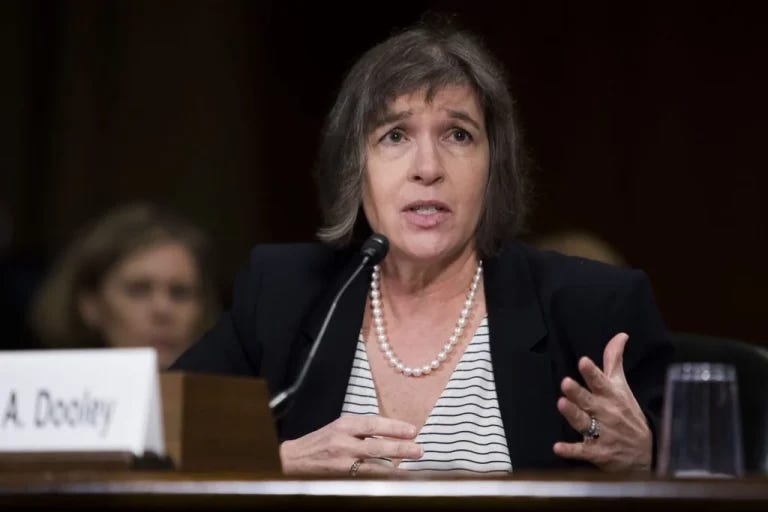
The next question is not whether Paul Boyne is likable, careful, sympathetic, or editorially sane. He’s not. BELIEVE ME. But the Constitution requires none of these things to protect Boyne’s digital expressions of disgust.
The next question is whether the federal court will confront the viewpoint-discrimination and speech-chilling issues, or continue treating the case as a state-court problem too radioactive to touch.
Family court is already the deepest bunker in American local government. It is where sealed files, custody fights, GAL networks, expert witnesses, judicial discretion, parental desperation, and accusations of corruption collide under a roof the public rarely gets to inspect.
When critics of that system speak, they are often treated as unstable before anyone reads the documents. When they publish, they are accused of harassment. When they name judges, lawyers, guardians, and court professionals, the system’s instinct is containment.
That is why the Boyne case matters beyond Boyne. If courts can punish protected criticism by branding it intimidation whenever the viewpoint is anti-judicial, every parent, journalist, whistleblower, and reform advocate is next in line. If Connecticut proved true threats under the proper standard, the conviction should withstand scrutiny. If Connecticut used fear to bury disfavored speech, federal court has a duty to say so.
The First Amendment is not reserved for clean hands and polite sentences. It is built for the ugly cases, because the ugly cases are where government power shows its teeth.
