


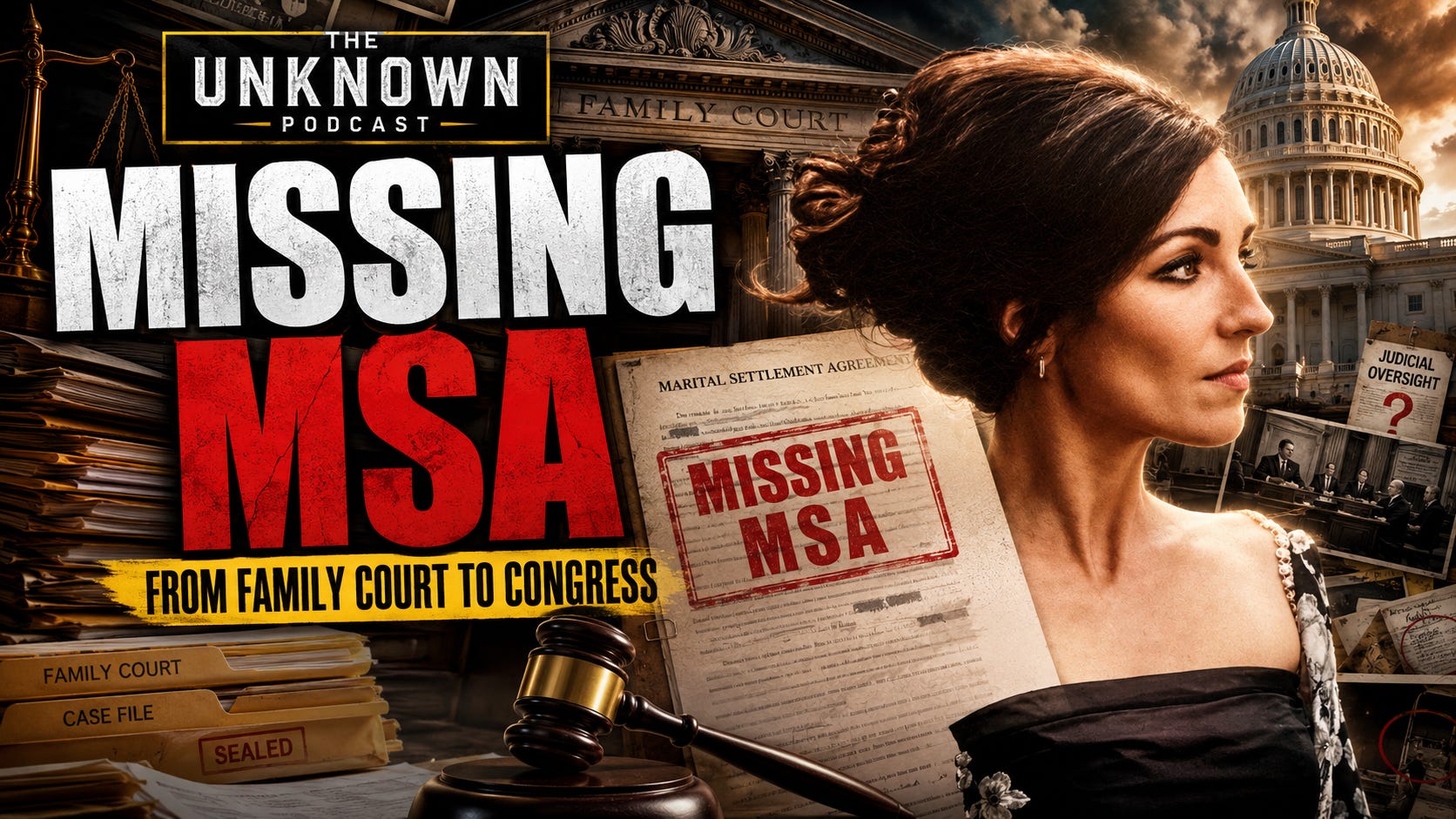
LUTHMANN NOTE: Elizabeth Fitzgibbon’s Missing MSA story is why the family court machine fears sunlight. The public is supposed to accept the magic words: clerical error, judicial discretion, harmless mistake, appellate review, move along. No. When a court loses the controlling divorce document, sends the wrong couple’s paperwork, and then allegedly backfills the wreckage with legal fiction, the question is not whether the file got messy. The question is whether the citizen still has rights. Fitzgibbon took that question to the Supreme Court. Now she is taking it to voters. That is exactly how family court reform becomes political power. This piece is “Missing MSA Missing Justice.”

By Richard Luthmann with Michael Volpe
Missing MSA Missing Justice: A Wisconsin Mother Says the Court Lost the Deal — Then Lost the Plot
Elizabeth Fitzgibbon did not come on The Unknown Podcast with a normal candidate story. She came with a family court war story that sounded like a courthouse file room caught fire, and the judges decided to call the smoke “justice.”
Fitzgibbon, a Wisconsin mother and independent congressional candidate, told Michael Volpe and Richard Luthmann that her run for Congress was born out of what she calls a landmark family law case in Winnebago County. The core allegation is simple enough for any voter to understand: a marital settlement agreement disappeared. The fallout, however, became a legal maze.

She said she filed an original marital settlement agreement in January 2022, then later filed an amended agreement after concluding the first version was inequitable. Fitzgibbon said she and her then-husband believed they were divorced under the amended agreement. But when the divorce judgment arrived, it allegedly came attached to another couple’s marital settlement agreement. When the court later sent a document belonging to Fitzgibbon’s case, she said it was the original, nullified agreement — not the amended agreement she believed controlled the divorce.
Then came the bombshell. Fitzgibbon said the court informed her that the amended MSA had been “irretrievably lost,” despite a record entry showing she had submitted it. She also said the case exposed problems with Winnebago County’s document-handling process because paper filings could sit for days or weeks before being electronically filed.
That is where a clerical disaster allegedly became something much larger. Fitzgibbon said Court Commissioner John Birmingham acknowledged he had not reviewed the amended MSA for equity, had instead seen the original agreement, and had “mistakenly” divorced the parties under the wrong marital settlement agreement. According to Fitzgibbon, Birmingham ordered the parties to scrap the mess, co-create a new MSA, and return for another default divorce hearing.
Missing MSA Missing Justice: From Clerical Error to Custody Chaos
The story did not stay in the file room. Fitzgibbon said it hit her finances, her custody situation, and her relationship with her son.
She told Volpe and Luthmann that after the MSA debacle emerged, her ex-husband allegedly withheld marital assets and began interfering with placement. She said the parties made no progress on co-creating a new MSA, and after Birmingham retired, the case entered what she described as an exploitable legal fog. Fitzgibbon claimed her ex took their son on June 22, 2022, and kept him from her for 79 days. She said she filed emergency requests and a motion to have the February 7 divorce declared void and unenforceable because the court-created ambiguity was “wreaking havoc” on her finances and child.
Volpe, who has covered family court cases across the country, immediately recognized the pattern. Instead of simply resolving the placement crisis, the system appointed a guardian ad litem. Fitzgibbon said the GAL was appointed to investigate the withholding period, but she accused the GAL of expanding into placement, scheduling, counseling, and school issues. Volpe framed that as classic family court mission creep: every problem becomes another paid appointment, another insider, another layer of bureaucracy.
Luthmann zeroed in on the legal nerve center: how did this become a constitutional issue? Fitzgibbon’s answer was that the court did not merely lose a document; it allegedly substituted a process she says had no statutory basis. She said Judge Brian Kaberline initially echoed the earlier position that the parties needed to co-create a new MSA, not reconstruct the old one. Later, according to Fitzgibbon, the court pivoted and ordered the parties to reconstruct a document that multiple participants had already recognized could not be reproduced.
Luthmann pushed back hard, suggesting the judge may have been trying to reach a pragmatic, “Solomonic” resolution. Fitzgibbon rejected that view. She argued the judge created a proposal, called it a marital settlement agreement, applied the approval of a retired court commissioner who allegedly never saw it, and backdated the divorce to make the new paper govern an old judgment. That, she said, was not justice. It was legal fiction with real consequences.
Missing MSA Missing Justice: From Family Court Victim to Federal Candidate
The most important part of the interview came after the legal autopsy. Fitzgibbon is not just complaining about the family court. She is trying to convert her case into federal politics.
She told Volpe and Luthmann that after her appellate fight and U.S. Supreme Court petition, she concluded the problem was larger than her own case. She described the state appellate system as a “self-reinforcing feedback loop” and said family law litigants face a “gigantic wall” of doctrines blocking federal review, including Rooker-Feldman and the domestic relations exception. Her proposed federal remedy is explosive: she wants Congress to look at exceptions or reforms that would give aggrieved family court litigants access to impartial federal adjudication.
That opened the bigger reform conversation. Fitzgibbon argued that states act as undisclosed third parties to marriage and divorce contracts, while also having financial incentives tied to federal funding streams. She specifically targeted Title IV-D, saying child support incentives can create “perverse incentives” for bad family outcomes. When pressed by Volpe, she said the answer should begin with a serious audit of where the money goes, who receives it, and how those funding ratios affect court behavior.
Luthmann pressed the federalism problem. Family law is mostly state law. Why run for Congress instead of a state representative? Fitzgibbon answered that some reforms are state matters, but the federal money, federal court barriers, and congressional roots of domestic relations jurisdiction make the problem federal, too. Her pitch is not just family court reform. It is “constitutional alignment,” a test she says she would apply to domestic relations, judicial impunity, monetary policy, AI and digital privacy, healthcare, education, bodily sovereignty, foreign policy, retirement, welfare, and free speech.
As a candidate, Fitzgibbon faces the obvious problem: Independents rarely win. She said voters across the left and right are dissatisfied with the party system and with longtime Republican incumbent Glenn Grothman. Her campaign argument is that she can speak to people who feel politically homeless and want accountability instead of party machinery. She said she had gathered about 1,300 signatures toward ballot access, above the 1,000 required, and wanted a buffer against challenges.
That is the story. A missing MSA became a missing trust case. A divorce file became a congressional platform. And a Wisconsin mother who says family court broke the rules now wants to take the fight to Washington.


