

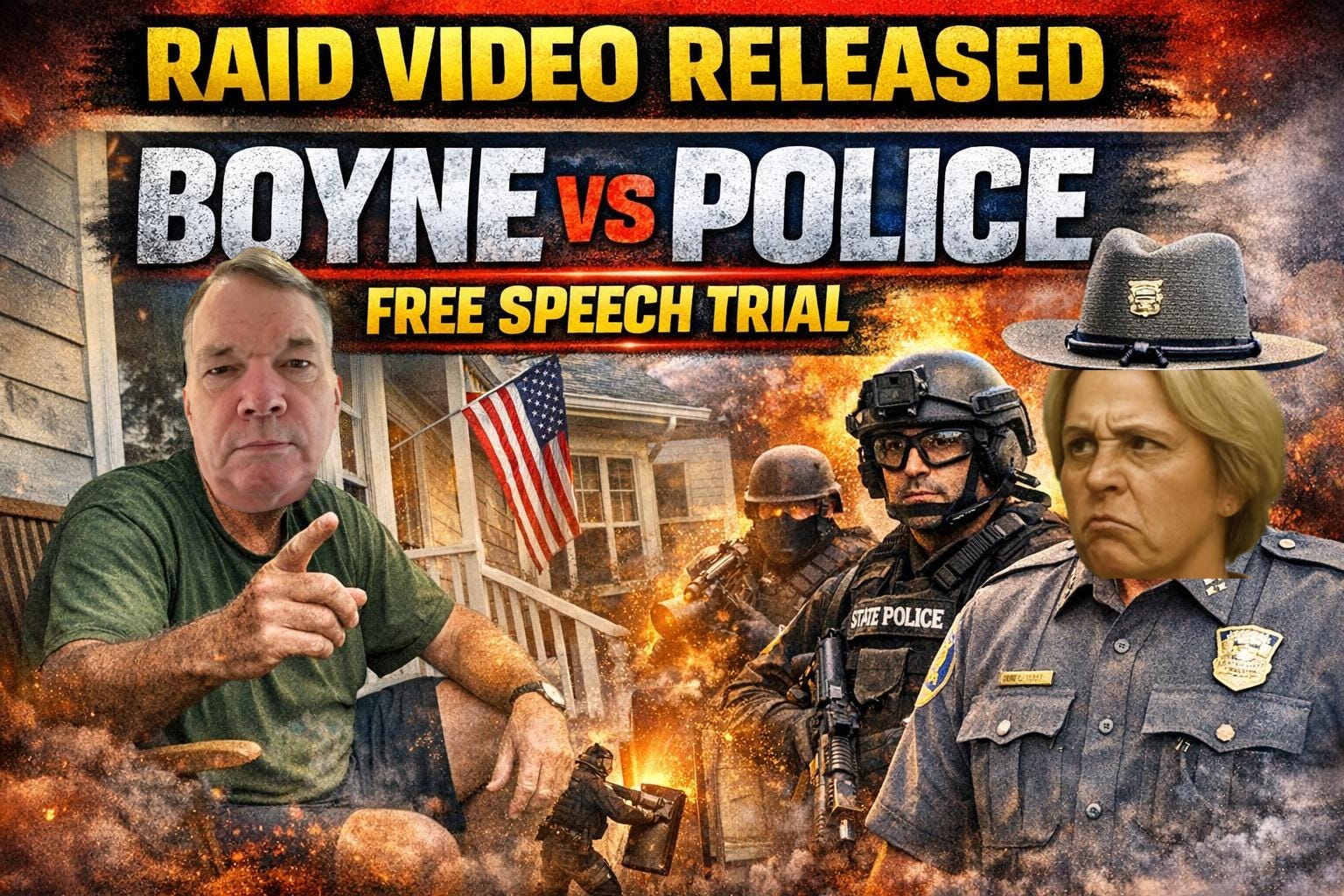
LUTHMANN NOTE: Porch Raid Video Released. State’s Exhibit 26 just detonated the Connecticut prosecution’s entire case against journalist Paul Boyne. Once the video was played in open court, it became public property. Now everyone can see it. What does the video show? Not a criminal. Not a stalker. Not a man issuing threats. It shows Paul Boyne calmly sitting on his porch and schooling Connecticut investigators on the First Amendment and the federal precedent of U.S. v. Cassidy. During a police raid, Boyne turns the encounter into a constitutional seminar. He repeatedly asks the officers (including CT State Trooper Sammy McCord) a devastating question: “Who is the victim?” The State’s own evidence captures the defendant explaining why internet speech functions like a bulletin board that people must choose to read. That moment alone collapses the theory that this case was about criminal threats. The trial closed after Boyne testified in his own defense. Jury instructions arrive Monday. But after watching Exhibit 26, the legal reality is unavoidable: no reasonable juror should walk away believing this prosecution proved a crime beyond a reasonable doubt. This piece is titled “Porch Raid Video Released” and was first available on TheFamilyCourtCircus.com.

By Richard Luthmann
(NEW HAVEN, CONNECTICUT) – The most explosive piece of evidence in the Paul Boyne free speech trial is now public. State’s Exhibit 26 — the GoPro video recorded by Connecticut State Police during the 2022 raid on Boyne’s Virginia home — has surfaced online and is now available exclusively on TheFamilyCourtCircus.com.
The footage shows Boyne sitting on his front porch as armed officers execute the search warrant. Instead of panic, the scene becomes something entirely different: a live constitutional debate.
Boyne immediately begins challenging the officers about the legality of the raid and the basis for the investigation. He repeatedly invokes the First Amendment, accusing the officers of targeting speech rather than criminal conduct.
At one point, Boyne references the landmark federal case United States v. Cassidy, explaining that online speech posted on the internet is not “communicated” in the traditional sense because users must actively seek it out. He compares websites to a bulletin board on someone’s lawn: if someone chooses to read it and becomes offended, that is their decision.
He presses investigators with a simple question: “Is there a victim here?”
The officers struggle to answer.
The exchange continues as Boyne challenges the underlying theory of the investigation. He tells the officers that people across the country discuss family court abuses online and that the internet cannot be criminalized simply because someone dislikes what is written.
The video also shows Boyne warning Detective Samantha McCord that the raid could violate civil rights laws if it was based solely on protected speech. This moment would later become central to Boyne’s defense strategy.
Boyne argues the video proves he believed his speech was protected political journalism exposing corruption in Connecticut family courts, particularly in cases involving credibly accused abuser Christopher Ambrose.
The State argues the writings constitute criminal threats. But the video adds another dimension. Instead of a threatening suspect, jurors saw a man arguing constitutional law with police officers during a dawn raid.
The clip was played in open court during the trial. Once admitted into evidence, it became part of the public record. Now the public can see it for themselves.
With the trial closing on March 6 and the jury set to be charged March 9, the porch video may become one of the most scrutinized pieces of evidence in a case already being called the “Connecticut Free Speech Circus.”


